
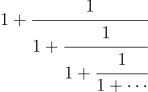
Most people have heard of the golden ratio, but have you ever heard of the silver ratio? I only heard of it this week. The golden ratio can be expressed by a continued fraction in which all coefficients equal 1.
The silver ratio is the analogous continued fraction with all coefficients equal to 2.
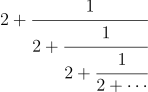
You might think for a moment that the silver ratio should be just twice the golden ratio, but the coefficients contribute to the series in a non-linear way. The silver ratio actually equals 1 + √2. The golden ratio has a simple geometric interpretation. I don’t know of a geometric interpretation of the silver ratio. (Update: See Maxwell’s Demon for geometric applications of the silver ratio.)
A previous post mentioned that the golden ratio and related numbers are the worst case for Hurwitz’s theorem. The silver ratio and its cousins are the second worst case for the theorem.
If you remove the largest possible square from an A4 sheet of paper you get a rectangle with side length in silver ratio proportions since the A4 (and any A family page) has side ratios 1:sqrt{2}.
At the risk of stating the obvious, this is also the sine or cosine of either acute angle of the right triangle formed by taking the diagonal of the unit square.
Yesterday I found out that the silver ratio can be found as a limiting ratio of this number sequence: oeis A179807. It begins as the FIbonacci sequence but begins to differ at the 6:th term. 1, 1, 2, 3, 5, 9, 17, 34, 71, 153, 337, 755, 1713, 3925, 9064… Example 9064/3925 tends to the silver ratio, but it doesn’t become apparant until the 250:th term.
The Golden Ratio is also the worst case for the Euclidean algorithm.
http://en.wikipedia.org/wiki/Euclidean_algorithm#Algorithmic_efficiency
I recently drew up a simple geometric derivation of the silver ratio and the corresponding silver rhombus. I came upon this blog entry searching for other references of which there seem to be very few and none for the silver rhombus. The image can be found in my entry about polar zonohedra and the silver ratio.
http://zomadic.blogspot.com/2011/04/pecha-kucha-inspire-japan.html
If you create the same continued fraction with 3’s, do you get a “bronze” ratio?