
The arithmetic mean of two numbers a and b is (a + b)/2.
The geometric mean of a and b is √(ab).
The harmonic mean of a and b is 2/(1/a + 1/b).
This post will generalize these definitions of means and state a general inequality relating the generalized means.
Let x be a vector of non-negative real numbers, x = (x1, x2, x3…, xn). Define Mr( x ) to be
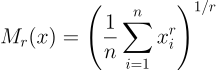
unless r = 0 or r is negative and one of the xi is zero. If r = 0, define Mr( x ) to be the limit of Mr( x ) as r decreases to 0 . And if r is negative and one of the xi is zero, define Mr( x ) to be zero. The arithmetic, geometric, and harmonic means correspond to M1, M0, and M−1 respectively.
Define M∞( x ) to be the limit of Mr( x ) as r goes to ∞. Similarly, define M−∞( x ) to be the limit of Mr( x ) as r goes to –∞. Then M∞( x ) equals max(x1, x2, x3…, xn) and M−∞( x ) equals min(x1, x2, x3…, xn).
In summary, the minimum, harmonic mean, geometric mean, arithmetic mean and maximum are all special cases of Mr( x ) corresponding to r = –∞, –1, 0, 1, and ∞ respectively. Of course other values of r are possible; these five are just the most familiar. Another common example is the root-mean-square (RMS) corresponding to r = 2.
A famous theorem says that the geometric mean is never greater than the arithmetic mean. This is a very special case of the following theorem.
If r ≤ s then Mr( x ) ≤ Ms( x ).
In fact we can say a little more. If r < s then Mr( x ) < Ms( x ) unless x1 = x2 = x3 = …. = xn or s ≤ 0 and one of the xi is zero.
We could generalize the means Mr a bit more by introducing positive weights pi such that p1 + p2 + p3 + … + pn = 1. We could then define Mr( x ) as
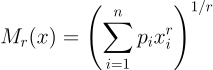
with the same fine print as in the previous definition. The earlier definition reduces to this new definition with pi = 1/n. The above statements about the means Mr( x ) continue to hold under this more general definition.
For more on means and inequalities, see Inequalities by Hardy, Littlewood, and Pólya.
Update: Analogous results for means of functions, replacing sums with integrals. Also, physical examples of harmonic mean with springs and resistors.
Related post: Old math books
Of all those the one I find more counter-intuitive is M0.
This is a great post. Keep up with the good work.
These are just generalised p-norms, right? What is the “famous theorem” you refer to? Is it a consequence of Hölder’s inequality?
On the topic of inequalities, if you haven’t got it already I strongly recommend Steele’s The Cauchy-Schwarz Master Class. It’s a wonderfully readable tour through inequalities and their history.
Mark,
These means correspond to p-norms if r ≥ 1, but not for smaller values of r.
The famous theorem I refer to is the geometric mean – arithmetic mean inequality.
I agree about Steele’s book. It’s one of my favorites.
By “generalised” I meant exactly those cases for when r < 1. The wikipedia article on L_p spaces talks about these generalisations for 0 ≤ r < 1. I hadn’t seen the case of r < 0 before, however.
Actually, all p-norms require an absolute value: $latex left(sum_{i=1}^n |x_i|^rright)^{1/r}$
That’s pretty cool about r = 0. I had to plot it to convince myself it was true. The limit comes in from both directions, too. Now I’m trying to prove it for fun.
Another useful generalization is the concept of Chisini mean: Chisini was a less-known Italian mathematician. You can read the idea here:
http://en.wikipedia.org/wiki/Chisini_mean
A really excellent source of these types of inequalities is Chapter 2 of Bela Bollobas’s “Linear Analysis”. It summarizes quite a lot of Hardy, Littlewood and Polya, but with rather more up-to-date notation.
See https://en.m.wikipedia.org/wiki/Generalized_mean#Proof_of_power_means_inequality for a detailed proof of the general theorem. There are several steps, but it’s primarily a consequence of Jensen’s inequality (which shouldn’t be too surprising since Jensen’s inequality itself is about arithmetic means).