
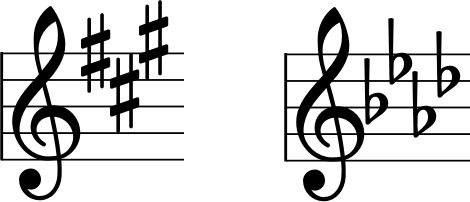
When I was a kid, I suppose sometime in my early teens, I was interested in music theory, but I couldn’t play piano. One time I asked a lady who played piano at our church to play a piece of sheet music for me so I could hear how it sounded. The music was in the key of A, but she played it in A♭. She didn’t say she was going to change the key, but I could tell from looking at her hands that she had.
I was shocked by the audacity of changing the music to be what you wanted it to be rather than playing what was on the page. I was in band, and there you certainly don’t decide unilaterally that you’re going to play in a different key!
In retrospect what the pianist was doing makes sense. Hymns are very often in the key of A♭. One reason is it’s a comfortable key for SATB singing. Another is that if many hymns are in the same key, that makes it easy to go from one directly into another. If a traditional hymn is not in A♭, it’s probably in a key with flats, like B♭ or D♭. (Contemporary church music is often in keys with sharps because guitarists like open strings, which leads to keys like A or E.)
The pianist wasn’t a great musician, but she was good enough. Picking her key was a coping mechanism that worked well. Unless someone in the congregation has perfect pitch, you can change a song from the key of D to the key of D♭ and nobody will know.
There’s something to be said for clever coping mechanisms, especially if they’re declared, “You asked for A. Is it OK if I give you B?” It’s better than saying “Sorry, I can’t help you.”
Music written in A and A♭ actually appears exactly the same on the score (unless there are accidentals, such as other flats or sharps not in the key) – the difference lies only in the key signature. So in this case, that would have meant the “transcription” required no effort.
However, it does remind me of my younger days playing the clarinet. Because it is tuned to B♭, I learnt how to sight-transpose up a tone for any music not specifically written for the clarinet. That was more challenging with an E♭ saxophone – I never got that sorted in my head!
It is easy to transpose from A to A♭, because you play the same notes on the staff, but treat it as a key signature of 4 flats instead of 3 sharps. Transposing to any other arbitrary key is much more difficult. And, as a pianist, I generally would rather play a song in A♭ than A.
Any key with 1-6 flats (or sharps) can be similarly transposed easily by subtracting the number from 7 and viewing the score as being written in that many sharps (or flats).