
If n is a positive integer, then rounding Γ(1/n) up to the nearest integer gives n. In symbols,

We an illustrate this with the following Python code.
>>> from scipy.special import gamma
>>> from math import ceil
>>> for n in range(1, 101):
    ... assert(ceil(gamma(1/n)) == n)
You can find a full proof in [1]. I’ll give a partial proof that may be more informative than the full proof.
The asymptotic expansion of the gamma function near zero is
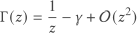
where γ is the Euler-Mascheroni constant.
So when we set z = 1/n we find Γ(1/n) ≈ n − γ + O(1/n²). Since 0 < γ < 1, the theorem above is true for sufficiently large n. And it turns out “sufficiently large” can be replaced with n ≥ 1.
[1] Gamma at reciprocals of integers: 12225. American Mathematical Monthly. October 2022. pp 789–790.