
Andrzej Odrzywolek recently posted an article on arXiv showing that you can obtain all the elementary functions from just the function

and the constant 1. The following equations, taken from the paper’s supplement, show how to bootstrap addition, subtraction, multiplication, and division from the eml function.
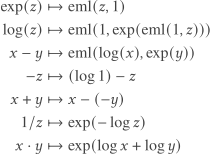
See the paper and supplement for how to obtain constants like π and functions like square and square root, as well as the standard circular and hyperbolic functions.
It may seem like a cute exercise in theory of computation, but consider the implications for deep neural networks. Stacking emls and 1s is exact (to the degree that log and exp are exact), as opposed to the universal approximator theorem, which only gives epsilon-delta guarantees.