
The alternating series test is part of the standard calculus curriculum. It says that if you truncate an alternating series, the remainder is bounded by the first term that was left out. This fact goes by in a blur for most students, but it becomes useful later if you need to do numerical computing.
To be more precise, assume we have a series of the form

where the ai are positive and monotonically converge to zero. Then the tail of the series is bounded by its first term:
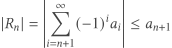
The more we can say about the behavior of the ai the more we can say about the remainder. So far we’ve assumed that these terms go monotonically to zero. If their differences

also go monotonically to zero, then we have an upper and lower bound on the truncation error:
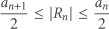
If the differences of the differences,

also converge monotonically to zero, we can get a larger lower bound and a smaller upper bound on the remainder. In general, if the differences up to order k of the ai go to zero monotonically, then the remainder term can be bounded as follows.

Source: Mark B. Villarino. The Error in an Alternating Series. American Mathematical Monthly, April 2018, pp. 360–364.