
Here is an identity that doesn’t look correct but it is. For real x and y,

I found the identity in [1]. The author’s proof is short. First of all,

Then
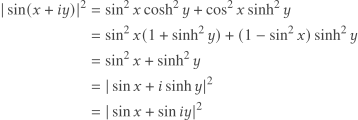
Taking square roots completes the proof.
Now note that the statement at the top assumed x and y are real. You can see that this assumption is necessary by, for example, setting x = 2 and y = i.
Where does the proof use the assumption that x and y are real? Are there weaker assumptions on x and y that are sufficient?
[1] R. M. Robinson. A curious trigonometric identity. American Mathematical Monthly. Vol 64, No 2. (Feb. 1957). pp 83–85
The definition of absolute value is where x and y are assumed to be real. For x = 2 and y = i, the expression i \cos x \sinh y is real, not imaginary.
Does this give any insight into distances in the imaginary plane? Trying to wrap my mind on the possible intuitive meaning…
I don’t see an intuitive explanation.
I could not let it go, it really felt like distances…
I did a bit of research, and came up with this :
Geometrically:
∣ sin (x + iy) ∣ = distance from origin in the plane
after the coordinate transformation:
(,) ↦ (sin , sinh )
The real direction behaves like motion on a circle.
The imaginary direction behaves like motion on a hyperbola.
The complex modulus measures Euclidean distance after these two motions combine orthogonally.
Using the exponential definitions, the identity begins to look like a statement about distances between two exponential points on the complex plane.