
I ran across an old article [1] that gave a sort of multiplication table for trig functions and inverse trig functions. Here’s my version of the table.
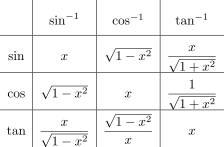
I made a few changes from the original. First, I used LaTeX, which didn’t exist when the article was written in 1957. Second, I only include sin, cos, and tan; the original also included csc, sec, and cot. Third, I reversed the labels of the rows and columns. Each cell represents a trig function applied to an inverse trig function.
The third point requires a little elaboration. The table represents function composition, not multiplication, but is expressed in the format of a multiplication table. For the composition f( g(x) ), do you expect f to be on the side or top? It wouldn’t matter if the functions commuted under composition, but they don’t. I think it feels more conventional to put the outer function on the side; the author make the opposite choice.
The identities in the table are all easy to prove, so the results aren’t interesting so much as the arrangement. I’d never seen these identities arranged into a table before. The matrix of identities is not symmetric, but the 2 by 2 matrix in the upper left corner is because
sin(cos−1(x)) = cos(sin−1(x)).
The entries of the third row and third column are not symmetric, though they do have some similarities.
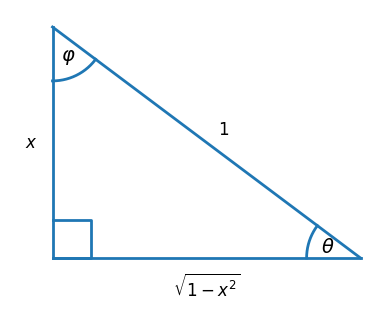
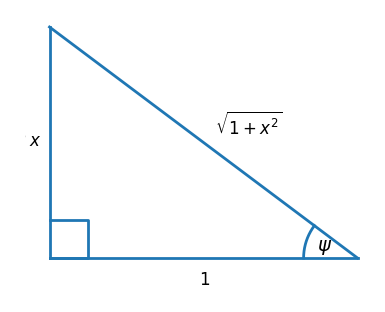
You can prove the identities in the sin, cos, and tan rows by focusing on the angles θ, φ, and ψ below respectively because θ = sin−1(x), φ = cos−1(x), and ψ = tan−1(x). This shows that the square roots in the table above all fall out of the Pythagorean theorem.
See the next post for the hyperbolic analog of the table above.
[1] G. A. Baker. Multiplication Tables for Trigonometric Operators. The American Mathematical Monthly, Vol. 64, No. 7 (Aug. – Sep., 1957), pp. 502–503.
It’d be interesting to see a similar table for cosh, sinh, and tanh, especially since these functions appear in a representation of Lorentz boost in relativity as a 2D “rotation” amongst space and time and somehow deliver the gamma=1/sqrt(1-v^2) of relativity fame.