
I alluded to Lebesgue constants in the previous post without giving them a name. There I said that the bound on order n interpolation error has the form

where h is the spacing between interpolation points and δ is the error in the tabulated values. The constant c depends on the function f being interpolated, and to a lesser extent on n. The constant λ is independent of f but depends on n and on the relative spacing between the interpolation nodes. This post will look closer at λ.
Given a set of n + 1 nodes T

define
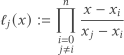
Then the Lebesgue function is defined by
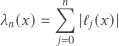
and the Lebesgue constant for the grid is the maximum value of the Lebesgue function
![\Lambda_n(T)=\max_{x\in[a,b]} \lambda_n(x)](https://www.johndcook.com/lebesgueconst4.svg)
The values of Λ are difficult to compute, but there are nice asymptotic expressions for Λ when the grid is evenly spaced:

When the grid points are at the roots of a Chebyshev polynomial then
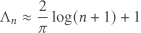
The previous post mentioned the cases n = 11 and n = 29 for evenly spaced grids. The corresponding values of Λ are approximately 155 and 10995642. So 11th order interpolation is amplifying the rounding error in the tabulated points by a factor of 155, which might be acceptable. But 29th order interpolation is amplifying the rounding error by a factor of over 10 million.
The corresponding values of Λ for Chebyshev-spaced nodes are 2.58 and 3.17. Chebyshev spacing is clearly better for high-order interpolation, which you have that option.