
TimF left a comment on my guitar pick post saying the image was a “squircle-ish analog for an isosceles triangle.” That made me wonder what a more direct analog of the squircle might be for a triangle.
A squircle is not exactly a square with rounded corners. The sides are continuously curved, but curved most at the corners. See, for example, this post.
Suppose the sides of our triangle are given by L1(x, y) = 1 for i = 1, 2, 3. For example,
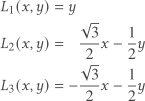
We design a function f(x, y) as a soft penalty for points not being on one of the sides and look at the set of points f(x, y) = 1.
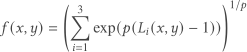
You might recognize this as a Lebesgue norm, analogous to the one used to define a squircle.
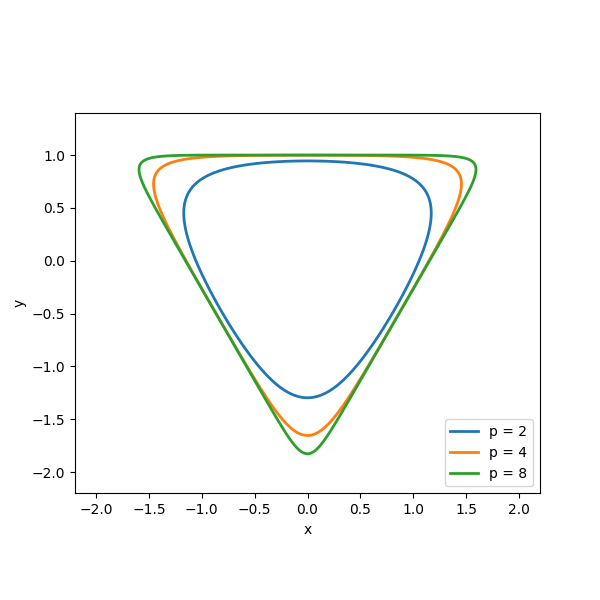
The larger p is, the heavier the penalty for being far from a side and the closer the level set f(x, y) = 1 comes to being a triangle.
There’s a natural example of a “triangular squircle” that comes from the intersection of the plane x + y + z = 1 and the hyperboloid x * y * z = c.
For c = 0 we are tracing out the boundary of the triangular simplex in the upper orthant, and then as c increases to a max of 1/27 the bounding curve shrinks to a circle.
Here it is in Desmos 3d: https://www.desmos.com/3d/jktxymxg6b
There’s a very natural problem in dynamical systems with these curves as the solutions: a 3-dimensional system of ODEs that has “rock paper scissors” dynamics, with
x’ = x * (y – z)
y’ = y * (z – x)
z’ = z * (x – y)
The plane x + y + z = 1 is the constraint that the total proportion of individuals (x, y, z) must sum to 1. The equations come from x increasing with rate x * y (defeats y) and decreasing with rate (x * z) defeated by z, etc.
It also turns out xyz is an invariant, which is most easily checked by looking at ln(xyz). Thus these intersections are the orbits of these dynamics. So for c close to 0, we are really close to the boundary, and the dynamics get super close to each of the vertices where it’s almost entirely one population, and along the way along an edge (for example going from near (x,y,z)=(0,1,0) to (x,y,z)=(1,0,0) we have almost no z, so then a little bit of x is able to eat up all the y population without itself having any predators, then once there’s a big enough x population, a little bit of z can take over, etc).
These orbits become a circle when we are close to c = 1/27, which is right around the neutrally stable equilibrium (1/3, 1/3, 1/3). And in between we are interpolating, with paths that correspond to the cyclic dynamics.
Woah, I could have used this a couple of months ago!
I’m doing a remodel that includes kitchen and baths, and my contractor threw a fit when I expressed my hatred of tile, primarily due to the grout between them. I despised the maintenance, the shape, the texture change, and more. Pretty much everything.
My contractor sent me to a few tile stores that had in-house designers. At my local Floor & Decor, the designer walked me past their large number of display walls, and asked me to define what bothered me the most, and what I liked best (if anything). We first learned that regular 2D grids of grout were at the top of my hate list. Second was semi-regular grids, like subway tiling, where the vertical grout lines were short, but the horizontal were still long. Then we looked at some mosaic tiles, where the pattern extended across multiple tiles, and the grout was integrated into the design. While I love this approach, I had no love of patterned tiles.
Then we looked at irregular tiles, such as fan shaped, where the grout was all curved, doubling-down on the tile curves themselves. This process also yielded my preferences for tile color and type (ceramic, porcelain, glass, etc.). I was surprised to see that 100% of the tiles I liked best were all glass. I decided I could live with this, and put (expensive!) glass fan-shaped tiles on my “maybe” list.
The general idea of non-rectilinear tiles got me thinking of grout as a “negative space”. How could that space itself be made artful? I thought of biological patterns, like blood and nervous systems, where thick-to-thin branching was a feature. But I didn’t want a directional pattern: I wanted a larger pattern that was reminiscent of the biological patterns.
This got me thinking of the gaps between adjacent squircles, especially when using squircles of varying size and rotation. Which in turn got me thinking of using irregular (perhaps random) tilings to create the negative space. I played with the idea, but the resulting graphics were unsatisfying, primarily due to the appearance of random large-ish grout splotches that were difficult to remove. Squircles weren’t great tiles on their own, so I went with the fan tiles (which are being installed as I write this).
Your post made me realize I hadn’t considered the possibility other squircleoids! (I’m getting that word added to the OED.) Using both squircles with tricles(?) would give me “pointy things” to disrupt the grout splotches. I haven’t modeled this yet, but it feels like a good path.
Then I pondered “squirclizing” an arbitrary geometric form, such as an aperiodic tile (or set). This could greatly reduce the number of different tile shapes and sizes needed while still providing interesting negative spaces.
Thanks!
Here the sides are nowhere straight, right? Another approach could use bump functions for limited-sized corners and C^inf smoothness?