
I ran across a cranky formula for π based on physical constants here
![\pi = \left( \frac{E}{\frac{1}{2}mc^{2}} \right)^{1/2} \left[ J_{\lambda} \cdot \lambda^{5} \left( e^{\frac{hc}{\lambda kT}} - 1 \right) \right]](https://www.johndcook.com/crank1.svg)
and decided to play around with it.
The source describes λ as “wavelength (chosen in the microwave region)” and I thought perhaps you could chose a value of λ to make the equation work. But as a comment pointed out, the bracketed expression is simply 2hc², independent of λ, due to Planck’s blackbody law. That means we can simplify the expression above to
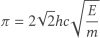
Now the values of h and c are known. In fact, they’re now exactly known by definition: other SI units are defined in terms of h and c. The mass of an electron is known to 11 significant figures.
But E in the equation above is “Total energy of the universe.” I don’t even know what that means. Does it refer to the observable universe? Does it include dark energy? Does it include the energy equivalent of mass?
I asked a couple LLMs that the total energy of the universe might mean and what its value might be, and they said something like “Depends. It might be zero. It might be infinite. But if I had to say, I’d say around 1070 Joules.”
If we solve the equation above for E we get 2.8480347886530404 × 10¹⁹ Joules. I have no idea how to justify that.
The expression for π is not dimensionless. I suppose you could choose some nonstandard units that would make the equation work.
The source I linked to above cites Mathematical Cranks by Underwood Dudley, but I couldn’t find it in the book.