
The golden ratio is the first and best known of the metallic ratios. I’ve written about the silver ratio a few times, most recently here. And I’ve mentioned the bronze ratio a couple times. The metallic ratios after bronze don’t have standard names.
The nth metallic ratio M(n) is the number whose continued fraction representation contains all ns.
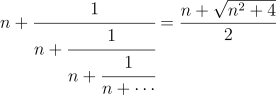
When n = 1, 2, and 3 we get the gold, silver, and bronze ratios.
You can approximate any positive real number as a ratio of metallic ratios. To see this, note that for large n, M(n) is approximately n. For any positive rational number a/b,
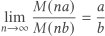
and so you can make M(na) / M(nb) as close to a/b as you like by taking n large enough. And since the rationals are dense in the reals, you can approximate any positive real number as close as you’d like.
Let’s look for metallic ratios whose ratios approximate π to within 0.001 with the following Python code.
from math import pi, sqrt

M = lambda n: 0.5*(n + sqrt(n**2 + 4))

for n in range(1, 100):
    a = round(pi*n)
    b = n
    r = M(a)/M(b)
    if abs(r - pi) < 0.001:
        print(a, b, r)
This shows
π ≈ M(132) / M(42) = 3.1412…
Could we find smaller numbers that work? The following code shows the answer is no.
k = 132 + 42
# loop over numbers whose sum is less than k
for n in range(1, k):
    for a in range(1, n):
        b = n - a
        r = M(a)/M(b)
        if abs(r - pi) < 0.001:
            print(a, b, r)
            exit()
I spot Copper and Nickel used for 4 and 5. Gianni Sarcone mentions metals for 6 and higher but doesn’t provide sources. Scientific American has a post on this as well but also doesn’t provide references.