
This morning Futility Closet mentioned that

How common is this? In other words, what is the probability that a random set of digits ai will satisfy the following?
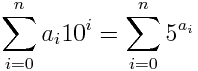
How does the probability depend on n?
This morning Futility Closet mentioned that
How common is this? In other words, what is the probability that a random set of digits ai will satisfy the following?
How does the probability depend on n?
Comments are closed.
Don’t you mean a sequence of digits a_i, with length n? Python seems to say that nothing below 5000000 satisfies it besides 3909511, though I could be wrong.
The probability is much higher if you do not exclude leading zeroes, for example: 000010. For the sake of the exercise, we will ignore these numbers.
Any number of n digits that contains z zeroes must end in (5*(n-z) + z) modulo 10; that is, for 3909511, which has 7 numbers (1 zero), it must end in 1, because (5*6+1)%10 = 1.
Also, no two-digit number may contain a digit of 3 or above; three-digit, 5+; four-digit, 6+; five-digit: 8+; six-digit numbers may not have a 9. This is because raising 5 to the power of any of the forbidden numbers results in a sum which exceeds the number under consideration. In practice, this rule is unnecessary because 3909511 is the smallest number for which this equation is true.
On the flip side: The maximal number space exists once the value of i is found that satisfies this equation: (10^(i+1))-1 > i*5^9. This equation is true for i=7 but false for i=8; thus, an 8-digit number would be the highest number which could satisfy the equation. Further thinking: The maximal 8-digit number of 99,999,999 gives a numerical sum, as above, of 8*(5^9) – 15,625,000. Ergo, no number larger than 15,625,000 would need to be examined to be true. A nine-digit number would have a maximal numeric sum of 9*(5^9) – 17,578,125 — and as such, no sum could ever get to the 9 digits required to match.
By writing a program in your language of choice (mine is Perl), an exhaustive scan of this number space is trivial — and discovers that 3905911 is the only number which meets this criteria.
…and of course, when I said “true for i=7 but false for i=8”, I meant the exact opposite.
And how does he come up with similar examples so often?
Or more generally for x rather than just 5.
Ah, here it is; the answer, unless I’m figuring/pythoning wrong, is pretty boring, did you know it already?
No 8-digit numbers have this property. Beyond that:
5**9 * 9 = 17578125, an 8-digit number. Oh well.
5^9 *7 = 13671875 > 9999999
5^9 *8 = 15625000 < 99999999
5^9 *9 = 17578125 < 999999999
…
Geometric progression won against arithmetic.
John’s original posting got me thinking broader, as Scott commented above, for bases other than just powers of 5. A little Python later I am running a more general form of the problem. This may open a whole new can of worms…
For example: 1^1 = 1
and I guess, technically also: 0^0 = 0
So far I have found the following:
1 is valid for base 1 ( 1^1 = 1 )
none for base 2
12 is valid for base 3 ( 3^1 + 3^2 = 12 )
4624 is valid for base 4
595968 is valid for base 4 (bit of a surprise finding a 2nd number)
3909511 is valid for 5 (validating my method and code)
none for base 6
13177388 is valid for base 7
1033 is valid for base 8
I’ll have to leave it to someone else to get a PhD working further with this idea :)
1/2 a day later…. all I found was one more:
10 is valid for base 9
Other than that, we may be looking at a closed set of numbers with this behaviour.