
Suppose you have a constant function f(x) = c. What is the Fourier transform of f?
We will show why the direct approach doesn’t work, give two hand-wavy approaches, and a rigorous definition.
Direct approach
Unfortunately there are multiple conventions for defining the Fourier transform.
For this post, we will define the Fourier transform of a function f to be

If f(x) = c then the integral diverges unless c = 0.
Heuristic approach
The more concentrated a function is in the time domain, the more it spreads out in the frequency domain. And the more spread out a function is in the time domain, the more concentrated it is in the frequency domain. If you think this sounds like the Heisenberg uncertainty principle, you’re right: there is a connection.
A constant function is as spread out as possible, so it seems that its Fourier transform should be as concentrated as possible, i.e. a delta function. The delta function isn’t literally a function, but it can be made rigorous. More on that below.
Gaussian density approach
The Fourier transform of the Gaussian function exp(−x²/2) is the same function, i.e. the Gaussian function is a fixed point of the Fourier transform. More generally, the Fourier transform of the density function for a normal random variable with standard deviation σ is the density function for a normal random variable with standard deviation 1/σ.
As σ gets larger, the density becomes flatter. So we could think of our function f(x) = c as some multiple of a Gaussian density in the limit as σ goes to infinity. The Fourier transform is then some multiple of a Gaussian density with σ = 0, i.e. a point mass or delta function.
Rigorous approach
If f and φ are two well-behaved functions then

In other words, we can move the “hat” representing the Fourier transform from one function to the other. The equation above is a theorem when f and φ are nice functions. We can use it to motivate a definition when the function f is not so nice but the function φ is very nice. Specifically, we will assume φ is an infinitely differentiable function that goes to zero at infinity faster than any polynomial.
Given a Lebesgue integrable function f, we can think of f as a linear operator via the map
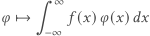
More generally, we can define a distribution to be any continuous [1] linear operator from the space of test functions to the complex numbers. A distribution that can be defined by integral as above is called a regular distribution. When we say we’re taking the Fourier transform of the constant function f(x) = c, we’re actually taking the Fourier transform of the regular distribution associated with f. [2]
Not all distributions are regular. The delta “function” δ(x) is a distribution that acts on test functions by evaluating them at 0.

We define the Fourier transform of (the regular distribution associated with) a function f to be the distribution whose action on a test function φ equals the integral of the product of f and the Fourier transform of φ. When a function is Lebesgue integrable, this definition matches the classical definition.
With this definition, we can calculate that the Fourier transform of a constant function c equals

Note that with a different convention for defining the Fourier transform, you might get 2π c δ or just c δ.
An advantage of the convention that we’re using is that the Fourier transform of the Fourier transform of f(x) is f(−x) and not some multiple of f(−x). This implies that the Fourier transform of √2π δ is 1 and so the Fourier transform of δ is 1/√2π.
Related posts
- How to differentiate a non-differentiable function
- Two meanings of distribution
- The Dirac comb (Sha) function
- Bessel series for a constant
[1] To define continuity we need to put a topology on the space of test functions. That’s too much for this post.
[2] The constant function doesn’t have a finite integral, but its product with a test function does because test functions decay rapidly. In fact, even the product of a polynomial with a test function is integrable