
The nth pentagonal number Pn is the number of dots in diagrams like those below with n concentric pentagons.
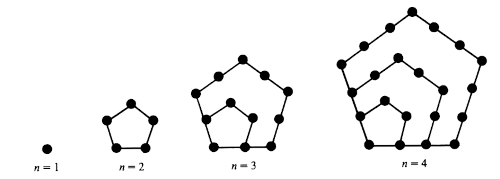
We have the formula
Pn = (3n² − n)/2
where n is a positive integer. If n is an integer but not positive, the equation above defines a generalized pentagonal number.
If you’re given an n, you can easily compute Pn. But suppose you’re given a large number x. How would you determine if it is a pentagonal number? And if it is a pentagonal number, how would you find n such that x = Pn?
Rejecting non-pentagonal numbers
If
x = Pn = (3n² − n)/2
then we can solve a quadratic equation for n:
n = (1 ± √(24x + 1))/6.
If 24x + 1 is not a perfect square, n is not an integer and x is not a pentagonal number, ordinary or generalized.
Small numbers
For example,
√(24 × 20260615 + 1)) = 22051.185…
and so 20260615 is not a pentagonal number nor a generalized pentagonal number.
Big numbers
Now suppose
x = 170141183460469231731687303715884105727.
Is this a pentagonal number? You can’t just compute √(24x + 1) in floating point arithmetic because the result is a 20-digit number, and floating point number have 15 digits of precision, so you can’t tell whether the result is an integer.
However, you can compute
⌊√(24x + 1)⌋
with only integer arithmetic using the sqrt_floor function from this post.
def sqrt_floor(n):
    a = n
    b = (n + 1) // 2
    while b < a:
        a = b
        b = (a*a + n) // (2*a)
    return a
The following prints a positive number,
x = 2**127 - 1
y = 24*x + 1
r = sqrt_floor(y)
print(y - r**2)
which tells us y is not a perfect square.
Finding the index
Now suppose y is a perfect square. Then the roots of
(1 ± √(24x + 1))/6
are rational, but are they integers? In fact one, and only one, of the roots will be an integer. If
24x + 1 = r²
then r is congruent to ±1 mod 6 because the left side is congruent to 1 mod 6. If r = 1 mod 6 then the smaller root is an integer, and if r = 5 mod 6 then the larger root is an integer.
So if 24x + 1 = r², then x is a pentagonal number if r = 5 mod 6 and a generalized pentagonal number otherwise.
The function pentagonal_index takes a number x and return n if x = Pn and None if no such n exists.
def pentagonal_index(x):
    y = 24*x + 1
    r = sqrt_floor(y)
    if r*r != y:
        return None
    if r % 6 == 5:
        return (1 + r) // 6
    else:
        return (1 - r) // 6
We can test this with the following code.
P = lambda n: (3*n**2 - n) // 2
for n in [2, 3, -4, -5, 10**200]:
    assert(pentagonal_index(P(n)) == n)
Integer division in Python
Note that P(10**200) is too big to fit into a float, but the code works fine. This is because we use integer division (//) everywhere. If we had said
P = lambda n: (3*n**2 - n) / 2
the test above would pass for the small values of n but output
OverflowError: integer division result too large for a float
when it came to n = 10200.