
The Online Etymological Dictionary gives the following etymology for grok:
grok (v.)
“understand empathically,” 1961, an arbitrary formation by U.S. science fiction writer Robert A. Heinlein (1907-1988) in his book “Stranger in a Strange Land.” In the book it is a transliteration of a Martian word and is said to mean etymologically “to drink.” It attained popular use in 1960s-70s counterculture but is perhaps obsolete now except in internet technology circles.
I don’t believe anything in the statement above is disputed. And yet Google’s Ngram Viewer tells a very different story.
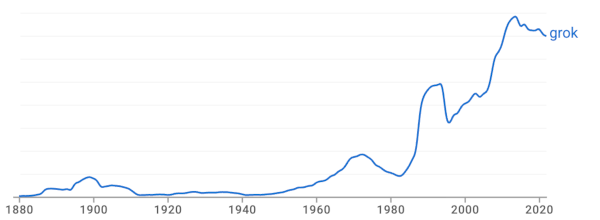
The plot implies that use of the word grok had been increasing before Heinlein’s book came out and is now much more common than it was in the 1970s. Note that the plot ends before the Grok AI came out in late 2023.
Apparently the Ngram data is unreliable, mainly for two reasons: OCR errors and inaccurate date attribution. Presumably the blip around 1900 was due to the former, OCR causing words like crok or grog to be cataloged as grok. And presumably the rise in usage before 1961 was due to the latter, misattributing the date of sources published after 1961.
The supposed rise in usage before 1961 is interesting. You’d expect some lag between the time a word circulates in conversation and when it appears in books, but apparently this lag can be smaller than the effect of date misattribution.
Etymonline speculates that grok is “perhaps obsolete now except in internet technology circles.” That matches my experience. Even in technological circles, the word was uncommon before Grok was released. Maybe it was more common in print than in conversation.
Related posts
Previous posts with Ngram stats. The effects are so large that they’re probably directionally correct after adjusting for a substantial error rate.
You can actually check the books from which Ngrams extract the data. Most usage of “grok” is in foreign language dictionaries or in use of foreign language inside a story in English.
Thanks. I didn’t know you could do that.
These foreign language quotations may have also been OCR errors. I asked Claude “What languages outside of English had a word ‘grok’ before 1961” and it said there are none. Grok gave a similar answer except it came up with the Lithuanian word grók with a stress mark.
https://en.wiktionary.org/wiki/grok says it’s also an alternative form of groch, which is Polish for pea. I found a couple of examples: https://archive.org/details/jbc.bj.uj.edu.pl.0033_NDIGCZAS035768_100654494/page/n17/mode/2up?q=grok (“gotłujący szybko kawę, herbate, czekcladę, grok, rosół i mleko”) and https://archive.org/details/jbc.bj.uj.edu.pl.NDIGCZAS018693_66742549/page/n5/mode/2up?q=grok (“na ten Nowyrok, Zeby się wam rodziła pszenicka i grok”).
Most of the examples I found were OCR errors, such as for “groß”.