
Let σ(n) be the sum of the positive divisors of n and let gcd(a, b) be the greatest common divisor of a and b.
Form an n by n matrix M whose (i, j) entry is σ(gcd(i, j)). Then the determinant of M is n!.
The following code shows that the theorem is true for a few values of n and shows how to do some common number theory calculations in SymPy.
from sympy import gcd, divisors, Matrix, factorial

def f(i, j):
    return sum( divisors( gcd(i, j) ) )

def test(n):
    r = range(1, n+1)
    M = Matrix( [ [f(i, j) for j in r] for i in r] )
    return M.det() - factorial(n)

for n in range(1, 11):
    print( test(n) )
As expected, the test function returns zeros.
If we replace the function σ above by τ where τ(n) is the number of positive divisors of n, the corresponding determinant is 1. To test this, replace sum by len in the definition of f and replace factorial(n) by 1.
In case you’re curious, both results are special cases of the following more general theorem. I don’t know whose theorem it is. I found it here.
For any arithmetic function f(m), let g(m) be defined for all positive integers m by
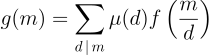
Let M be the square matrix of order n with ij element f(gcd(i, j)). Then
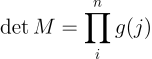
Here μ is the Möbius function. The two special cases above correspond to g(m) = m and g(m) = 1.
It’s better to use igcd() to get the gcd of integers. gcd() does polynomial gcd.