
The Sierpinski triangle has come up several times on this blog. Here’s yet another way to produce a Sierpinski triangle, this time by taking the bitwise-and of two integers. The ith bit of x&y is 1 if and only if the ith bit of x and the ith bit of y are both 1.
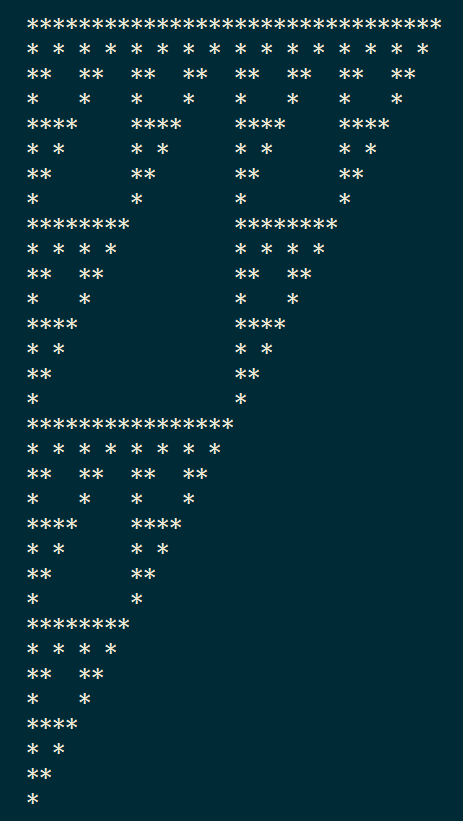
The following C program prints an asterisk when the bitwise-and of i and j is zero.
    #include <stdio.h>

    int main() {
        int N = 32;
        for (int i = 0; i < N; i++) {
            for (int j = 0; j < N; j++)
                printf("%c", (i&j) ? ' ' : '*');
            printf("\n");
        }
    }
Here’s a screenshot of the output.
Thanks John. That’s an interesting pattern.
Below is a c# implementation:
static void Main(string[] args) { int N = 32; for (int i = 0; i < N; i++) { for (int j = 0; j < N; j++) { Console.Write((i&j) == 0 ? '*' : ' '); } Console.WriteLine(); } Console.ReadLine(); }I ended up code golfing with some colleagues and came up with this:
perl -le ‘for$a(0..63){print map$a&$_&&$”,0..63}’