
This post will revisit a previous post in more detail. I’ve written before about how Möbius transformations map circles and lines to circles and lines. In this post I’d like to explore how you’d calculate which circle or line a given circle or line goes to. Given an equation of a line or circle, what is the equation of its image?
Circles to circles
A while back I wrote a post called Circles to Circles, demonstrating how Möbius transformations map circles and lines to circles and lines. If you think of a line as a degenerate circle, a circle of infinite radius, then you could simply say Möbius transformations map circles to circles.
For example I showed in that post that the transformation
m(z) = (z + 2)/(3z + 4)
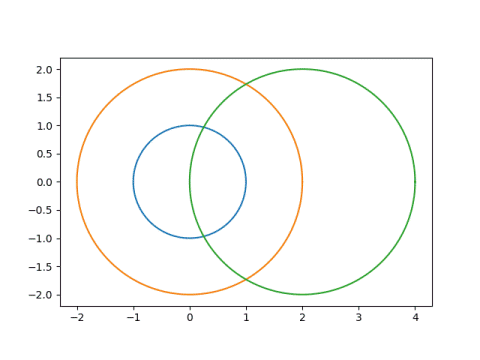
maps these circles
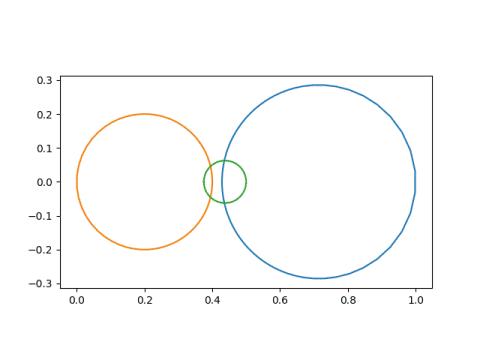
to these circles
and that these lines
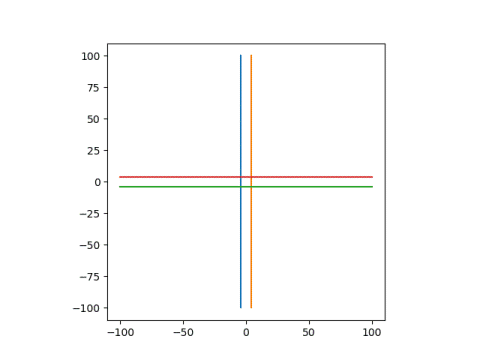
go to these circles
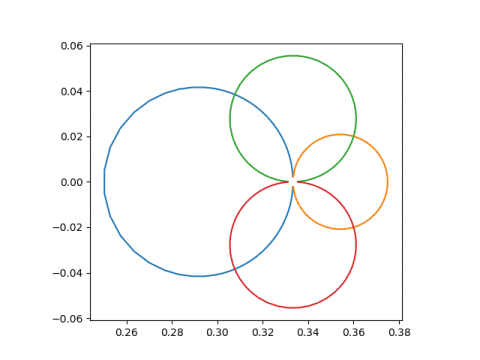
Circle or line image
Given the equation of a circle or a line, how would you know whether its image is a circle or a line?
A Möbius transformation
m(z) = (az + b) / (cz + d)
has a singularity at z = –d/c. If a line or curve goes through the point –d/c then its image is a line. Otherwise the image is a circle.
If the line or curve does go through –d/c, so that the image is a line, it’s easy to find an equation of the line. Pick two points, z1 and z2 on the original curve or line. Let w1 – m(z1) and w2 – m(z2). Then find the equation of a line through w1 and w2. For example, a parametric form is
w1 + t(w2 – w1)
for all real t.