
The previous post derived the identity

and said in a footnote that the identity holds at least for x > 1 and y > 1. That’s true, but let’s see why the footnote is necessary.
Let’s have Mathematica plot

The plot will be 0 where the identity above holds.
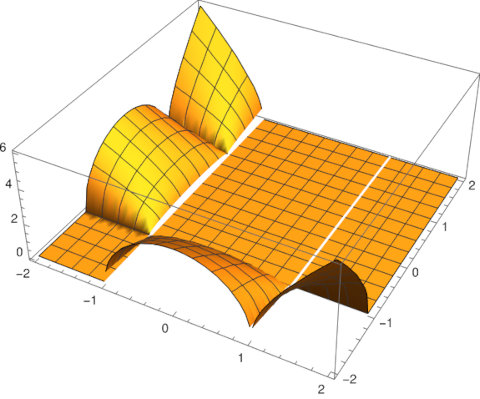
The plot is indeed flat for x > 1 and y > 1, and more, but not everywhere.
If we combine the two square roots

and plot again we still get a valid identity for x > 1 and y > 1, but the plot changes.
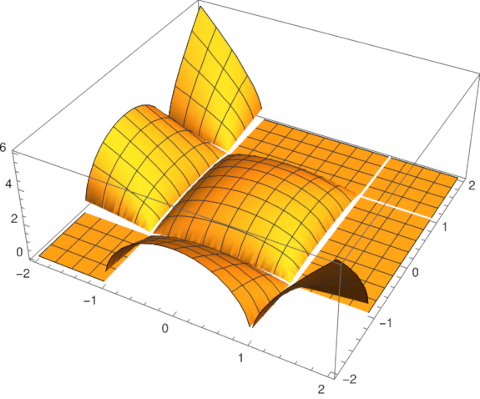
This is because √a √b does not necessarily equal √(ab) when the arguments may be negative.
The square root function and the arccosh function are not naturally single-valued functions. They require branch cuts to force them to be single-valued, and the two functions require different branch cuts. I go into this in some detail here.
There is a way to reformulate our identity so that it holds everywhere. If we replace

with

which is equivalent for z > 1, the corresponding identity holds everywhere.
We can verify this with the following Mathematica code.
f[z_] := Exp[(1/2) (Log[z - 1 ] + Log[z + 1])]
FullSimplify[Cosh[ArcCosh[x] + ArcCosh[y]] - x y - f[x] f[y]]
This returns 0.
By contrast, the code
FullSimplify[
 Cosh[ArcCosh[x] + ArcCosh[y]] - x y - Sqrt[x^2 - 1] Sqrt[y^2 - 1]]
simply returns its input with no simplification, unless we add restrictions on x and y. The code
FullSimplify[
 Cosh[ArcCosh[x] + ArcCosh[y]] - x y - Sqrt[x^2 - 1] Sqrt[y^2 - 1],
 Assumptions -> {x > -1 && y > -1}]
does return 0.