
A couple days ago, Levent Alpöge, a mathematician working at Anthropic, discovered a counterexample to the Jacobian conjecture using Claude Fable 5.
I was curious whether most mathematicians were trying to prove or disprove the conjecture, so I asked Claude.
Before a counterexample to the Jacobian conjecture was found, did most mathematicians believe it was true or false?
Claude’s response was
The premise of this question isn’t quite right — no counterexample to the Jacobian conjecture has been found. It remains an open problem in mathematics: no one has proven it true, and no one has found a counterexample disproving it. … If you encountered a claim that a counterexample was found, do you have a source for that? I’d be happy to look into it, since that would actually be a major result in algebraic geometry if true.
Of course Claude doesn’t know that it solved the conjecture. It didn’t even solve the conjecture. It was an inanimate tool in the hand of a mathematician, just like a piece of chalk or a dry erase marker.
The middle part of Claude’s response was that mathematicians are (were) divided on whether the conjecture is true. So it was not like the Riemann hypothesis, which most people believe to be true, or the P = NP conjecture, which most people believe to be false.
Now what is the Jacobian conjecture? It says that a polynomial function from ℝn to ℝn with constant, non-zero Jacobian determinant has a polynomial inverse. (The conjecture was stated more generally for fields of characteristic 0, in which the derivatives defining the Jacobian would have to be defined algebraically, not in terms of limits.)
Alpöge came up with a counterexample, a polynomial function from ℝ³ to ℝ³ with constant Jacobian determinant −2. The function is
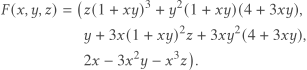
It’s a tedious but simple calculus exercise to show that the determinant equals −2 everywhere. The inverse function theorem says that a function is locally invertible at any point where the Jacobian determinant is non-zero, so Alpöge’s function is locally invertible everywhere.
However, the function takes on some values more than once. For example, (0, 0, −1/4) and (1, −3/2, 13/2) both map to (−1/4, 0, 0). Therefore the function is not invertible globally. So not only does the function not have a polynomial inverse, it doesn’t have an inverse even if you allow non-polynomial functions.
Alpöge’s counterexample disproves the Jacobian conjecture for n = 3. It can trivially be extended to all n > 3 by defining the function to be Alpöge’s function for three variables and the identity for the rest. The conjecture remains open for n = 2.
It’s an amazing achievement, but n=2 was the original connector and may be harder.
Another collision is (0,1,-4) and (-2,1,2) that both map to (0,1,0).
It’s obvious in hindsight but it should say “with constant, non-zero Jacobian *determinant*”, not just “with constant, non-zero Jacobian”. That got me confused at first.