
The function expq(x) is defined by taking the power series for exp(x) and keeping only the terms whose index is a multiple of q. For example, exp2(x) keeps only the even-numbered terms in the exponential power series and so equals cosh(x).

In general,
![\exp_q(x) = \sum_{n=0}^\infty [q \mid n] \frac{x^n}{n!} = \sum_{n=0}^\infty \frac{x^{nq}}{(nq)!}](https://www.johndcook.com/expq2.svg)
The first sum uses Iverson’s bracket notation: a Boolean expression in brackets denotes the function that returns 1 when the expression is true and zero when it is false. Here the bracket equals 1 when q divides n and is zero otherwise.
Closed forms
Let ω = exp(2πi / q). Then
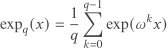
This lets us find closed-form expressions for expq(x). For example, when q = 4, ω = i and

Here’s a proof of the identity above:
![\begin{align*} \frac{1}{q} \sum_{k=0}^{q-1} \exp(\omega^k x) &= \frac{1}{q} \sum_{k=0}^{q-1} \sum_{n=0}^\infty \frac{\omega^{kn}x^n}{n!} \\ &= \sum_{n=0}^\infty \left( \frac{1}{q} \sum_{k=0}^{q-1} \omega^{kn}\right) \frac{x^n}{n!} \\ &= \sum_{n=0}^\infty [q \mid n] \frac{x^n}{n!} \\ &= \exp_q(x) \end{align*}](https://www.johndcook.com/expq5.svg)
In the proof we used the identity
![\frac{1}{q} \sum_{k=0}^{q-1} \omega^{kn} = [q \mid n]](https://www.johndcook.com/expq6.svg)
which is important in deriving the properties of the discrete Fourier transform.
Differential equations
The first time I saw the function expq(x) was in differential equations, though I didn’t know at the time the function had a name.
When a course in differential equations gets to power series solutions, a common example or homework problem is to solve

for k = 3 or 4, i.e. to find a function that equals its third or fourth derivative.
If the initial conditions are

and

the unique solution to
is y(x) = expk(x).
Mathematica and Mittag-Leffler
Mathematica does not have a built-in function implementing expq(x), but it does have an implementation of the Mittag-Leffler function, and so thanks to a relation between this function and expq(x) you can implement the latter as
expq[x_, q_] := MittagLefflerE[q, x^q]
Combinatorics
The first time I saw the notation expq(x) was in combinatorics. I had intended to include an application from that book here, but I make that the topic for the next post.