
For a real number x, the irrationality index μ(x) is a way of measuring how well x can be approximated by rational numbers. If x is rational, μ(x) = 1. If x is irrational, μ(x) ≥ 2.
OpenAI recently published a proof that μ(π) = 2. Almost all real numbers have irrationality exponent 2, so the new result says π is typical in this regard. There are numbers proven to have irrationality index greater than 2 (more on that below), but π isn’t one of them.
The irrationality exponent μ(x) is defined as the supremum of the set of values ν such that
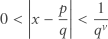
for infinitely many coprime integers p and q with q > 0.
This means that the approximation error for approximating π with a rational number p/q is typically on the order of 1/q², just like most irrational numbers.
There are numbers with higher irrationality exponents. For example, Cahen’s constant C has irrationality exponent 3. This means C is an irrational number that has infinitely many rational approximations p/q with error less than 1/q³.