
Pascal’s triangle is the most famous triangular arrangement of numbers. I’ve written about other numerical triangles, such as Bell’s triangle and the trinomial triangle. There’s another well-known triangle that somehow I never heard of until recently: the harmonic triangle, first explored by Leibniz around 1700.
To create the harmonic triangle, start with the harmonic series
1, 1/2, 1/3, 1/4, 1/5, …
This is the first column of the triangle. Next take the differences of the terms:
(1 − 1/2), (1/2 − 1/3), (1/3 − 1/4), … = 1/2, 1/6, 1/12, …
This, shifted down one space, is the second column of the triangle. Taking differences again gives the third column, and so forth. Column c of the triangle consists of the cth differences of the harmonic series.
    1
    1/2  1/2
    1/3  1/6   1/3
    1/4  1/12  1/12  1/4
    1/5  1/20  1/30  1/20  1/5
    …
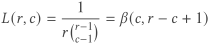
Each entry is the difference of the entries to its west and northwest. If we let L(r, c) be the element in the rth row and cth column, then

Every numerator is 1, though it’s not immediately obvious why this should be the case. And every number is a value of the beta function, the function that gives the normalizing constant for the beta distribution [1].
Related posts
- The ellipse hidden inside Pascal’s triangle
- Analogs of binomial coefficients
- Odd numbers in Pascal’s triangle
[1] Ayoub B. Ayoub. The Harmonic Triangle and the Beta Function. Mathematics Magazine, Vol. 60, No. 4 (Oct., 1987), pp. 223-225