
The idea of finite geometries sounds like an oxymoron the first time you hear of it, something like dry water or cold fire, but the axioms of some kinds of geometry can indeed be satisfied by finite models.
The axioms of projective plane geometry are as follows.
- Any two distinct points lie on exactly one line.
- Any two distinct lines meet in exactly one point.
- There exist four points, no three of which are collinear.
The most famous example of a finite projective plane is the Fano plane.
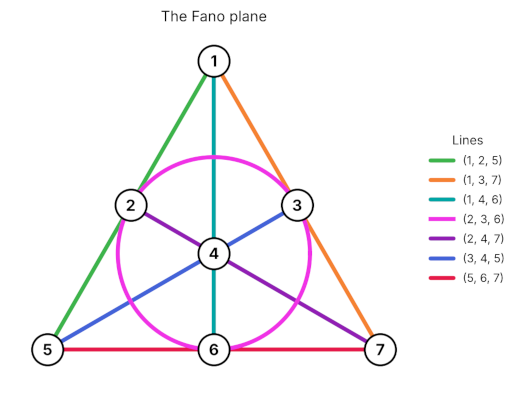
It helps to switch back and forth between thinking of finite geometries geometrically and in terms of set theory. The fact that the Fano plane has an easy-to-understand illustration is fortunate, but not to be taken for granted. Also, it could be misleading to lean to heavily on the fact that the lines and points of finite geometry can, in this case, be represented by points and line segments (and a circle) in the Euclidean plane.
The set-theoretic perspective is that the points are the one-element sets {1}, {2}, …, {7}, and the lines are the sets listed in the legend of the graph: {1, 2, 5}, {1, 3, 7}, …, {5, 6, 7}. It’s simple to confirm that any pair of points lines in exactly one of the three-element set, that the intersection of any pair of the three-element sets is a one-element set, and that there are three points—1, 2, 3, and 4 will do—such that no three line on the same line, i.e. no three belong to the same three-element set.
The Fano plane is the unique projective plane with 7 points, but there are four non-equivalent projective planes with 9 points.
There are many other examples of non-isomorphic finite projective planes with the same number of points, but there are also many unsettled conjectures, at least as of an hour ago, regarding the existence of finite projective planes of various orders.
Finite geometry might seem like a technicality, spaces that satisfy the axioms but are not what anyone had in mind when the axioms were codified. So why care about finite geometries? For one thing, unexpected examples are quite valuable since they help separate the consequences of a set of axioms from common expectations.
For another, finite geometries come up in applications, such as combinatorics and cryptography. These discrete applications take advantage of intuition from traditional geometry. This intuition is an imperfect guide, so conclusions need to be verified by concrete calculations, but geometric intuition suggests what one ought to verify.