
This morning I wrote a post that included the central Delannoy numbers. The nth central Delannoy number Dn counts the number of ways a king can move from one corner of a chessboard to the diagonally opposite corner without backtracking.
The more general Delannoy numbers Dm,n are the analogy for an m × n rectangular board, not necessarily square.
Dm,n is also the number of possible sequence alignments for a strand of DNA with m base pairs and a strand with n base pairs [1]. At each step in the alignment process, you can introduce a gap in the first strand, the second strand or neither, which is analogous to the king who can move N, E, or NE at each step.
The Delannoy numbers can be computed recursively:
def D(m, n):
    if m == 0 or n == 0:
        return 1
    return D(m - 1, n) + D(m, n - 1) + D(m - 1, n - 1)
The code above can be sped up tremendously by adding the decorator
@lru_cache(maxsize=None)
above the function definition to turn on memoization. I did an experiment computing D12,15 with and without memoization and the times were 77.1805 seconds and 0.000062 seconds respectively, i.e. memoization made the code over a million times faster.
Incidentally, D12,15 = 2653649025 and so there are a lot of ways to align even short sequences unless you place some restriction on the permissible alignments.
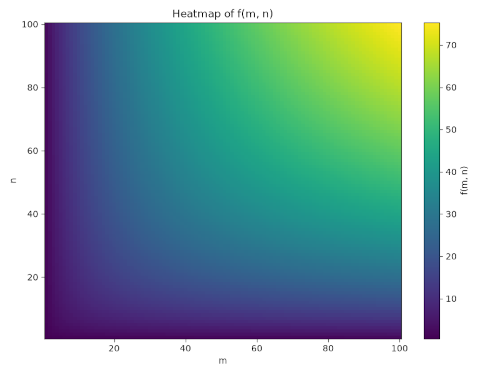
Update: Here’s a heatmap plotting log10(Dm,n). Obviously the function increases with m and n: bigger chessboards have more possible paths. Moreover, it’s larger along the diagonal (i.e. the central Delannoy numbers). If you look along northeast to southwest diagonals, the function is largest in the middle where m = n.
[1] Torres, A., Cabada, A., & Nieto, J. J. (2003). An exact formula for the number of alignments between two DNA sequences. DNA Sequence, 14(6), 427–430. https://doi.org/10.1080/10425170310001617894