
There’s a common saying in discussion of fractals that the length of a coastline depends on how small a device you use to measure it. I thought this was a hypothetical, say as applied to the steps in the construction of the Koch snowflake. But the saying has its roots in actually surveying.
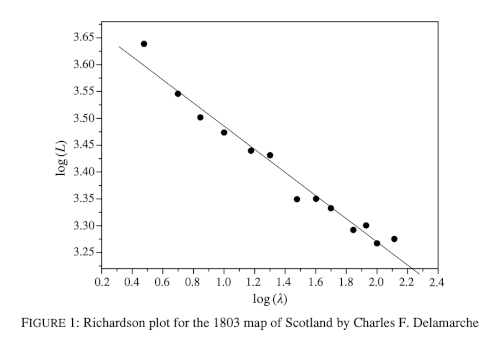
Lewis Fry Richardson (1881–1953) noticed that the length of the coast of Scotland depended on a the size of segments used to measure it. More specifically, he found that the length followed a power law, i.e. that there’s a linear relation between the log of the coastline length and the log of the ruler length.
Here’s a reproduction of Richardson’s plot, taken from [1].
Mandelbrot built on Richardson’s observation and defined the idea of fractal dimension.
I was under the impression that fractals were invented as mathematical novelties that researchers later found applications for. But as is often the case, the application came first. Or at least some applications came first.
Ideally there’s always a feedback cycle where applications lead to theory and theory leads to applications. As Donald Knuth put it, “The best theory is inspired by practice. The best practice is inspired by theory.”
Related posts
[1] Eoghan Bradley and Mark McCartney. Four hundred years of the fractal coastline of Scotland. The Mathematical Gazette, November 2019, Vol. 103, No. 558 (November 2019), pp. 518-521