
The Artemis II mission launched yesterday. Much like the Apollo 8 mission in 1968, the goal is to go around the moon in preparation for a future mission that will land on the moon. And like Apollo 13, the mission will swing around the moon rather than entering lunar orbit. Artemis II will deliberately follow the trajectory around the moon that Apollo 13 took as a fallback.
Apollo 8 spent 2 hours and 44 minutes in low earth orbit (LEO) before performing trans-lunar injection (TLI) and heading toward the moon. Artemis II made one low earth orbit before moving to high earth orbit (HEO) where it will stay for around 24 hours before TLI. The Apollo 8 LEO was essentially circular at an altitude of around 100 nautical miles. The Artemis II HEO is highly eccentric with an apogee of around 40,000 nautical miles.
Apollo 8 spent roughly three days traveling to the moon, measured as the time between TLI and lunar insertion orbit. Artemis II will not orbit the moon but instead swing past the moon on a “lunar free-return trajectory” like Apollo 13. The time between Artemis’ TLI and perilune (the closest approach to the moon, on the far side) is expected to be about four days. For Apollo 13, this period was three days.
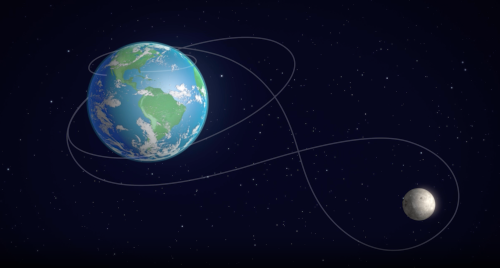
The furthest any human has been from earth was the Apollo 13 perilune at about 60 nautical miles above the far side of the moon. Artemis is expected to break this record with a perilune of between 3,500 and 5,200 nautical miles.