
The previous post looked at the expected IQ range in a jury of 12. This post will look more generally at computing the expected range of n samples from a N(0, 1) random variable. This will give the expected range in units of σ, i.e. multiply the results by σ if your σ isn’t 1.
As mentioned in the previous post, the expected range is given by

where φ and Φ are the PDF and CDF of a standard normal. The integral can be calculated in closed form for n ≤ 5, but in general it requires numerical integration [1].
The following Python code can compute dn.
from scipy.stats import norm
from scipy.integrate import quad
import numpy as np

def d(n):
    integrand = lambda x: x*norm.pdf(x)*norm.cdf(x)**(n-1)
    res, info = quad(integrand, -np.inf, np.inf)
    return 2*n*res
For large n we have the asymptotic approximation
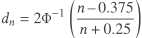
which we could implement in Python by
def approx(n):
    return 2*norm.ppf((n - 0.375)/(n + 0.25))
For very large n the asymptotic expression may be more accurate than the integral due to numerical integration error.
Here are a few example values.
|-----+-------|
|   n |   d_n |
|-----+-------|
|   2 | 1.128 |
|   3 | 1.693 |
|   5 | 2.326 |
|  10 | 3.078 |
|  12 | 3.258 |
|  23 | 3.858 |
|  50 | 4.498 |
| 100 | 5.015 |
|-----+-------|
[1] Order Statistics by H. A. David. John Wiley & Sons. 1970.
I just asked Microsoft Copilot to create the code for Mathematica (which I have, but I am a complete newbie at). I was amazed at how easy it was.
Create Mathematica code to numerically evaluate the integral, for n=12, of $2*n* \int_{-infty}^ {infty} \Phi(x)^{n-1} *x*\phi(x) dx$
where $\Phi(x)$ is the CDF of the standard normal and $\phi(x)$ is the PDF.
It gave me
n = 12;
Φ[x_] := CDF[NormalDistribution[], x];
φ[x_] := PDF[NormalDistribution[], x];
N[ 2 n NIntegrate[ Φ[x]^(n – 1) * x * φ[x], {x, -∞, ∞},
Method -> “GlobalAdaptive”, WorkingPrecision -> 30 ],
20
]
It ran for a fraction of a second and gave me:
3.2584552797438259806
with comments:
Notes on the implementation
WorkingPrecision -> 30 ensures numerical stability because the integrand involves a product of a CDF power and a PDF.
Method -> “GlobalAdaptive” helps with tails and smoothness.
The integral converges rapidly, so {-∞, ∞} is fine; Mathematica handles the truncation automatically.
Scottish criminal trials (but not civil trials) have juries of 15 people. For n = 15 the d_n factor is 3.4718.