
Machine learning represents words as vectors and measures the similarity of words by the angles between the vectors.
For vectors x and y,

where θ is the angle between the vectors, and so
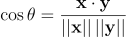
This is the cosine similarity between the words represented by x and y.
Small angles have large cosines, and so words with larger cosine similarities are closer together than words with smaller cosine similarities. The cosine similarity between a word and itself equals 1, and we’d expect unrelated words to have a cosine similarity near 0.
You can do a sort of arithmetic with vector embeddings of words. The canonical example is that
“king” − “man” + “woman” ≈ “queen”
Implicit in this equation is that we’re really adding vector representations of the words. Let a, b, c, and d be the vector embeddings of the words king, man, woman, and queen. What we’re really asserting is that
a − b + c ≈ d,
except that’s not true! Or at least it’s not true unless you view it in the right context.
The angle between a − b + c and d is about 49°, which corresponds to a cosine similarity of 0.656. Here I’m using the gensim glove-twitter-200 embedding that represents words as 200-dimensional vectors.
The way to interpret the equation above is not that a 49° degree angle is approximately 0, or that a similarity of 0.656 is approximately 1.
In high dimensions, such as 200-dimensional word embeddings, nearly all vectors are nearly perpendicular. I wrote a post about this here. So the angle between randomly selected words will usually be close to 90°, and so in that context an angle of 49° is relatively small. For example, the angle between the vector representations of king and fireplace is 89.25°.
If you divide word vectors by their norm, you can think of each vector as a point on a high-dimensional sphere, in our case a sphere in 200 dimensions. The proportion of vectors within 49° of a given point is surprisingly small in high dimensions.
Let’s say our point of interest is the north pole of an n-dimensional sphere. We’d like to calculate the proportion of the area of the sphere that is within an angle θ of the pole. I go through the calculations here. (Update: I give an approximation here that’s easier to work with than the exact formula.)
When n = 3, 17% of the area is with 49 degrees of the pole. But when n = 200, the proportion is on the order of 10−26, essentially zero.
The vector d above representing queen is within a relatively tiny region around the vector a − b + c.
In terms of cosine similarity, 0.656 is a large similarity. Words with a cosine similarity in this range are quite close, even though we wouldn’t normally think of 0.656 being close to 1. In this context, 0.656 is close to 1.
I think the sense in which “queen” is close to “king-man+woman” is that $d$ is the closest vector in the dictionary to point $a-b+c$. The rank-order is more robust than cosine to dimensionality.
It might be fun to ask the opposite question: what convex combination of $a,b,c$ is closest to $d$?