An AI Odyssey, Part 4: Astounding Coding Agents

AI coding agents improved greatly last summer, and again last December-January. Here are my experiences since my last post on the subject.

The models feel subjectively much smarter. They can accomplish a much broader range of tasks. They seem to have a larger, more comprehensive in-depth view of the code base and what you are trying to accomplish. They can locate more details in obscure parts of the code related to the specific task at hand. By rough personal estimate, I would say that they helped me with 20% of my coding effort last August and about 60% now. Both of these figures may be below what is possible, I may not be using them to fullest capability.

This being said, they are not a panacea. Sometimes they need help and direction to where to look for a problem. Sometimes they myopically look at the trees and don’t see the forest, don’t step back to see the big picture to understand something is wrong at a high level. Also they can overoptimize to the test harness. They can also generate code that is not conceptually consistent with existing code.

They can also generate much larger amounts of code than necessary. Some warn that that this will lead to explosion of coding debt. On the other hand, you can also guide the coding agent to refactor and improve its own code—quickly. In one case I’ve gotten it to reduce the size of one piece of code to less than half its original size with no change in behavior.

I use OpenAI Codex rather than Claude Code.  I’m glad to hear some technically credible people think this a good choice. Though maybe I should try both.

My work is a research project for which the code itself is the research product, so I can’t give specifications of everything in advance; writing the code itself is a process of discovery. Also, I want a code base that remains human-readable. So I am deeply involved in discussion with the coding agent that will sometimes go off to do a task for some period of time. It is not my desire to treat the agent as what some have called a dark software factory.

Some say they fear that using a coding agent will result in forgetting how to write code without one. I have felt this, but from having exercised this muscle for such a very long time I don’t think it is a skill I would easily forget. The flip side of this argument is, you might even learn new coding idioms from observing what the coding agent writes, that is a good thing.

Some say they haven’t written a line of code in weeks because the coding agent does it for them. I don’t think I’ll ever stop writing code, any more than I will stop scribbling random ideas on the back of an envelope, or typing out some number of lines of code by which I discover some new idea in real time while I am typing. Learning is multisensory.

My hat’s off to the developers who are able to keep many different agents in flight at the same time. Personally I have difficulty handling the cognitive load of thinking deeply about each one and doing a mental context switch across many agents. Though I am experimenting with running more than one agent so I can be doing something while another agent is working.

I continue to be astounded by productivity gains in some situations. I recently added a new capability, which normally I think would’ve taken me two months to learn a whole new algorithmic method and library to use. With the coding agent, it took me four days to get this done, on the order of 10X productivity increase. Though admittedly things are not always that rosy.

In short, the tools are getting better and better. I’m looking forward to what they will be like a few months or a year from now.

Gaussian distributed weights for LLMs

The previous post looked at the FP4 4-bit floating point format. This post will look at another 4-bit floating point format, NF4, and higher precision analogs. NF4 and FP4 are common bitsandbytes 4-bit data types. If you download LLM weights from Hugging Face quantized to four bits, the weights might be in NF4 or FP4 format. Or maybe some other format: there’s a surprising amount of variety in how 4-bit numbers are implemented.

Why NF4

LLM parameters have a roughly Gaussian distribution, and so evenly spaced numeric values are not ideal for parameters. Instead, you’d like numbers that are closer together near 0.

The FP4 floating point numbers, described in the previous post, are spaced 0.5 apart for small values, and the larger values are spaced 1 or 2 apart. That’s hardly a Gaussian distribution, but it’s closer to Gaussian than a uniform distribution would be. NF4 deliberately follows more of a Gaussian distribution.

QLoRA

The QLoRA formats [1], unlike FP4, are not analogs of IEEE numbers. The bits are not interpreted as sign, exponent, and mantissa, but rather as integers to be used as indexes. An NFn number is an index into a list of 2n real numbers with Gaussian spacing. To put it another way, the numbers represented by NFn have uniformly distributed z-scores.

That makes sense at a high level, but the paper [1] is hard to follow in detail. It says

More formally, we estimate the 2k values qi of the data type as follows:

q_i = \frac{1}{2}\left(Q_X\left(\frac{i}{2^k + 1}\right) + Q_X\left(\frac{i+1}{2^k + 1} \right) \right)

where QX(·) is the quantile function of the standard normal distribution N(0, 1).

The paper doesn’t give the range of i but it says there are 2k values, implying that i runs from 0 to 2k −1 or from 1 to 2k. Either way runs into infinite values since Q(0) = −∞ and Q(1) = ∞. We could avoid infinities by letting i run from 1 to 2n − 1.

The next sentence is puzzling.

A problem for a symmetric k-bit quantization is that this approach does not have an exact representation of zero, which is an important property to quantize padding and other zero-valued elements with no error.

I understand the desire to represent 0 exactly, but the equation above has an exact representation of 0 when i = 2n − 1. Perhaps the authors had in mind that i takes on the values ½, 1 + ½, 2 + ½, …, 2n − ½. This would be reasonable, but a highly unusual use of notation. It seems that the real problem is not the lack of a representation of 0 but an unused index, with i running from 1 to 2n − 1.

To be fair, the first sentence quoted above says “we estimate the 2k values …” and so the equation above may not be intended as a definition but as motivation for the actual definition.

Reproducing NF4

The authors give a procedure for using 2n values of i and obtaining an exact representation of 0, and they give a list of NF4 values in Appendix E. I was not able to get the two to match. I implemented a few possible interpretations of the procedure described in the paper, and each approximates the list of values in the appendix, but not closely.

The following code, written with the help of ChatGPT, reverse engineers the NF4 values to 8 decimal places, i.e. to the precision of a 32-bit floating point number.

from scipy.stats import norm

Q = norm.ppf

α  = 0.9677083
Z  = Q(α)
δ1 = (α - 0.5)/7
δ2 = (α - 0.5)/8

q = [0]*16
for i in range(7):
    q[i] = -Q(α - i*δ1)/Z
for i in range(8):
    q[i+8] = Q(0.5 + (i+1)*δ2)/Z
    
# Values given in Appendix E
NF4 = [
    -1.0,
    -0.6961928009986877,
    -0.5250730514526367,
    -0.39491748809814453,
    -0.28444138169288635,
    -0.18477343022823334,
    -0.09105003625154495,
    0.0,
    0.07958029955625534,
    0.16093020141124725,
    0.24611230194568634,
    0.33791524171829224,
    0.44070982933044434,
    0.5626170039176941,
    0.7229568362236023,
    1.0
]

# Compare 
for i in range(16):
    print(i, NF4[i] - q[i])

The magic number α = 0.9677083 is a mystery. I asked ChatGPT to look into this further, and it said that bitsandbytes uses α = 929/960 = 0.9677083333333333. When I use this value for α the precision is about the same, which is fine. However, the values in the paper were given to 16 decimal places, so I thought it might be able to match the values to more precision.

Quibbles over the exact values of NF4 aside, the NF4 format works well in practice. Models. quantized to 4 bits using NF4 perform better than models quantized to other 4-bit formats on some benchmarks.

Related posts

[1] QLoRA: Efficient Finetuning of Quantized LLMs by Tim Dettmers, Artidoro Pagnoni, Ari Holtzman, and Luke Zettlemoyer. https://arxiv.org/abs/2305.14314.

4-bit floating point FP4

In ancient times, floating point numbers were stored in 32 bits. Then somewhere along the way 64 bits became standard. The C programming language retains the ancient lore, using float to refer to a 32-bit floating point number and double to refer to a floating point number with double the number of bits. Python simply uses float to refer to the most common floating point format, which C calls double.

Programmers were grateful for the move from 32-bit floats to 64-bit floats. It doesn’t hurt to have more precision, and some numerical problems go away when you go from 32-bits to 64-bits. (Though not all. Something I’ve written about numerous times.)

Neural networks brought about something extraordinary: demand for floating point numbers with less precision. These networks have an enormous number of parameters, and its more important to fit more parameters into memory than it is to have higher precision parameters. Instead of double precision (64 bits) developers wanted half precision (16 bits), or even less, such as FP8 (8 bits) or FP4 (4 bits). This post will look at 4-bit floating point numbers.

Why even bother with floating point numbers when you don’t need much precision? Why not use integers? For example, with four bits you could represent the integers 0, 1, 2, …, 15. You could introduce a bias, subtracting say 7 from each value, so your four bits represent −7 through 8. Turns out it’s useful to have a more dynamic range.

FP4

Signed 4-bit floating point numbers in FP4 format use the first bit to represent the sign. The question is what to do with the remaining three bits. The notation ExMy denotes a format with x exponent bits and y mantissa bits. In the context of signed 4-bit numbers,

xy = 3

but in other contexts the sum could be larger. For example, for an 8-bit signed float, xy = 7.

For 4-bit signed floats we have four possibilities: E3M0, E2M1, E1M2, and E0M3. All are used somewhere, but E2M1 is the most common and is supported in Nvidia hardware.

A number with sign bit s, exponent e, and mantissa m has the value

(−1)s 2eb (1 + m/2)

where b is the bias. The purpose of the bias is to allow positive and negative exponents without using signed numbers for e. So, for example, if b = 1 and e = 1, 2, or 3 then the exponent part 2eb can represent 1, 2, or 4.

The bias impacts the range of possible numbers but not their relative spacing. For any value of bias b, the E3M0 format is all exponent, no mantissa, and so its possible values are uniformly distributed on a log scale. The E0M3 format is all mantissa, so its values are uniformly distributed on a linear scale. The E1M2 and E2M1 formats are unevenly spaced on both log and linear scales.

There is an exception to the expression above for converting (sem) into a real number when e = 0. In that case, m = 0 represents 0 and m = 1 represents ½.

Table of values

Since there are only 16 possible FP4 numbers, it’s possible to list them all. Here is a table for the E2M1 format.

Bits s exp m  Value
-------------------
0000 0  00 0     +0
0001 0  00 1   +0.5
0010 0  01 0     +1
0011 0  01 1   +1.5
0100 0  10 0     +2
0101 0  10 1     +3
0110 0  11 0     +4
0111 0  11 1     +6
1000 1  00 0     -0
1001 1  00 1   -0.5
1010 1  01 0     -1
1011 1  01 1   -1.5
1100 1  10 0     -2
1101 1  10 1     -3
1110 1  11 0     -4
1111 1  11 1     -6

Note that even in this tiny floating point format, there are two zeros, +0 and −0, just like full precision floats. More on that here.

Pychop library

The Python library Pychop emulates a wide variety of reduced-precision floating point formats. Here is the code that used Pychop to create the table above.

import pychop

# Pull the format metadata from Pychop.
spec = pychop.MX_FORMATS["mxfp4_e2m1"]
assert (spec.exp_bits, spec.sig_bits) == (2, 1)

def e2m1_value(s: int, e: int, m: int) -> float:
    sign = -1.0 if s else 1.0

    # Subnormal / zero
    if e == 0:
        return sign * (m / 2.0)

    # Normal
    return sign * (2.0 ** (e - 1)) * (1.0 + m / 2.0)

def display_value(bits: int, x: float) -> str:
    if bits == 0b0000:
        return "+0"
    if bits == 0b1000:
        return "-0"
    return f"{x:+g}"

rows = []
for bits in range(16):
    s = (bits >> 3) & 0b1
    e = (bits >> 1) & 0b11
    m = bits & 0b1
    x = e2m1_value(s, e, m)

    rows.append(
        {
            "Bits": f"{bits:04b}",
            "s": s,
            "exp_bits": f"{e:02b}",
            "m": m,
            "Value": display_value(bits, x),
        }
    )

# Pretty-print the table.
header = f"{'Bits':<4} {'s':>1} {'exp':>3} {'m':>1} {'Value':>6}"
print(header)
print("-" * len(header))
for row in rows:
    print(
        f"{row['Bits']:<4} " f"{row['s']:>1} "
        f"{row['exp_bits']:>3} "
        f"{row['m']:>1} "
        f"{row['Value']:>6}"
    )

Other formats

FP4 isn’t the only 4-bit floating point format. There’s a surprisingly large number of formats in use. I intend to address another format my next post.

Update: See the next post for a discussion of NF4, a format whose representable numbers more closely matches the distribution of LLM weights.

HIPAA compliant AI

The best way to run AI and remain HIPAA compliant is to run it locally on your own hardware, instead of transferring protected health information (PHI) to a remote server by using a cloud-hosted service like ChatGPT or Claude. [1].

There are HIPAA-compliant cloud options, but they’re both restrictive and expensive. Even enterprise options are not “HIPAA compliant” out of the box. Instead, they are “HIPAA eligible” or that they “support HIPAA compliance,” because you still need the right Business Associate Agreement (BAA), configuration, logging, access controls, and internal process around it, and the end product often ends up far less capable than a frontier model. The least expensive and therefore most accessible services do not even allow this as an option.

Specific examples:

  • Only sales-managed ChatGPT Enterprise or Edu customers are eligible for a BAA, and OpenAI explicitly says it does not offer a BAA for ChatGPT Business. The consumer ChatGPT Health product says HIPAA and BAAs do not apply. ChatGPT for Healthcare pricing is based on ChatGPT Enterprise, depends on organization size and deployment needs, and requires contacting sales. Even within Enterprise, OpenAI’s Regulated Workspace spec lists Codex and the multi-step Agent feature as “Non-Included Functionality,” i.e. off limits for PHI.
  • Google says Gemini can support HIPAA workloads in Workspace, but NotebookLM is not covered by Google’s BAA, and Gemini in Chrome is automatically blocked for BAA customers. If a work or school account does not have enterprise-grade data protections, chats in the Gemini app may be reviewed by humans and used to improve Google’s products.
  • GitHub Copilot, despite being a Microsoft product, is not under Microsoft’s BAA. Azure OpenAI Service is, but only for text endpoints. While Microsoft is working on their own models, it is unlikely that they will deviate significantly here.
  • Anthropic says its BAA covers only certain “HIPAA-ready” services, namely the first-party API and a HIPAA-ready Enterprise plan, and does not cover Claude Free, Pro, Max, Team, Workbench, Console, Cowork, or Claude for Office. The HIPAA-ready Enterprise offering is sales-assisted only. Bundled Claude Code seats are not covered. AWS Bedrock API calls can work, but this requires extensive configuration and carries its own complexities and restrictions.

Running AI locally is already practical as of early 2026. Open-weight models that approach the quality of commercial coding assistants run on consumer hardware. A single high-end GPU or a recent Mac with enough unified memory can run a 70B-parameter model at a reasonable token speed.

There’s an interesting interplay between economies of scale and diseconomies of scale. Cloud providers can run a data center at a lower cost per server than a small company can. That’s the economies of scale. But running HIPAA-compliant computing in the cloud, particularly with AI providers, incurs a large direct costs and indirect bureaucratic costs. That’s the diseconomies of scale. Smaller companies may benefit more from local AI than larger companies if they need to be HIPAA-compliant.

Related posts

[1] This post is not legal advice. My clients are often lawyers, but I’m not a lawyer.

An AI Odyssey, Part 3: Lost Needle in the Haystack

While shopping on a major e-commerce site, I wanted to get an answer to an obscure question about a certain product.

Not finding the answer immediately on the product page, I thought I’d try clicking the AI shopping assistant helper tool to ask this question.

I waited with anticipation for an answer I would expect be more informative and useful than a standard search result. But it was not to be. The AI tool had nothing worthwhile.

Then I decided on an old-fashioned keyword search across all the product reviews. And, lo and behold, I immediately found several credible reviews addressing my question.

It is not good usability when multiple search mechanisms exist but only one of them is reliable. And it is surprising that a retrieval-based approach (e.g., RAG) could not at least match the effectiveness of a simple keyword search over reviews.

Models are capable, but effective integration can be lacking. Without improvements for cases like this, customers will not be satisfied users of these new AI tools.

Related posts

Typesetting sheet music with AI

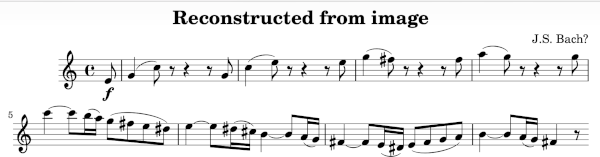
Lilypond is a TeX-like typesetting language for sheet music. I’ve had good results asking AI to generate Lilypond code, which is surprising given the obscurity of the language. There can’t be that much publicly available Lilypond code to train on.

I’ve mostly generated Lilypond code for posts related to music theory, such as the post on the James Bond chord. I was curious how well AI would work if I uploaded an image of sheet music and asked it to produce corresponding Lilypond code.

In a nutshell, the results were hilariously bad as far as the sheet music produced. But Grok did a good job of recognizing the source of the clips.

Test images

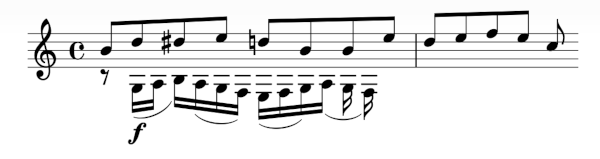
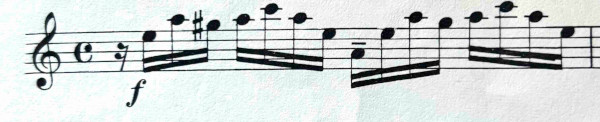
Here are the two images I used, one of classical music

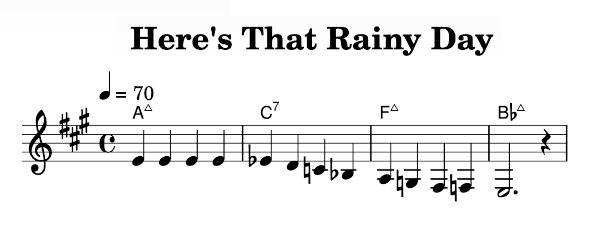
and one of jazz.

I used the same prompt for both images with Grok and ChatGPT: Write Lilypond code corresponding to the attached sheet music image.

Classical results

Grok

Here’s what I got when I compiled the code Grok generated for the first image.

This bears no resemblance to the original, turning one measure into eight. However, Grok correctly inferred that the excerpt was by Bach, and the music it composed (!) is in the style of Bach, though it is not at all what I asked for.

ChatGPT

Here’s the corresponding output from ChatGPT.

Not only did ChatGPT hallucinate, it hallucinated in two-part harmony!

Jazz results

One reason I wanted to try a jazz example was to see what would happen with the chord symbols.

Grok

Here’s what Grok did with the second sheet music image.

The notes are almost unrelated to the original, though the chords are correct. The only difference is that Grok uses the notation Δ for a major 7th chord; both notations are common. And Grok correctly inferred the title of the song.

I edited the image above. I didn’t change any notes, but I moved the title to center it over the music. I also cut out the music and lyrics credits to make the image fit on the page easier. Grok correctly credited Johnny Burke and Jimmy Van Heusen for the lyrics and music.

ChatGPT

Here’s what I got when I compiled the Lilypond code that ChatGPT produced. The chords are correct, as above. The notes bear some similarity to the original, though ChatGPT took the liberty of changing the key and the time signature, and the last measure has seven and a half beats.

ChatGPT did not speculate on the origin of the clip, but when I asked “What song is this music from?” it responded with “The fragment appears to be from the jazz standard ‘Misty.'”

From logistic regression to AI

It is sometimes said that neural networks are “just” logistic regression. (Remember neural networks? LLMs are neural networks, but nobody talks about neural networks anymore.) In some sense a neural network is logistic regression with more parameters, a lot more parameters, but more is different. New phenomena emerge at scale that could not have been anticipated at a smaller scale.

Logistic regression can work surprisingly well on small data sets. One of my clients filed a patent on a simple logistic regression model I created for them. You can’t patent logistic regression—the idea goes back to the 1840s—but you can patent its application to a particular problem. Or at least you can try; I don’t know whether the patent was ever granted.

Some of the clinical trial models that we developed at MD Anderson Cancer Center were built on Bayesian logistic regression. These methods were used to run early phase clinical trials, with dozens of patients. Far from “big data.” Because we had modest amounts of data, our models could not be very complicated, though we tried. The idea was that informative priors would let you fit more parameters than would otherwise be possible. That idea was partially correct, though it leads to a sensitive dependence on priors.

When you don’t have enough data, additional parameters do more harm than good, at least in the classical setting. Over-parameterization is bad in classical models, though over-parameterization can be good for neural networks. So for a small data set you commonly have only two parameters. With a larger data set you might have three or four.

There is a rule of thumb that you need at least 10 events per parameter (EVP) [1]. For example, if you’re looking at an outcome that happens say 20% of the time, you need about 50 data points per parameter. If you’re analyzing a clinical trial with 200 patients, you could fit a four-parameter model. But those four parameters better pull their weight, and so you typically compute some sort of information criteria metric—AIC, BIC, DIC, etc.—to judge whether the data justify a particular set of parameters. Statisticians agonize over each parameter because it really matters.

Imaging working in the world of modest-sized data sets, carefully considering one parameter at a time for inclusion in a model, and hearing about people fitting models with millions, and later billions, of parameters. It just sounds insane. And sometimes it is insane [2]. And yet it can work. Not automatically; developing large models is still a bit of a black art. But large models can do amazing things.

How do LLMs compare to logistic regression as far as the ratio of data points to parameters? Various scaling laws have been suggested. These laws have some basis in theory, but they’re largely empirical, not derived from first principles. “Open” AI no longer shares stats on the size of their training data or the number of parameters they use, but other models do, and as a very rough rule of thumb, models are trained using around 100 tokens per parameter, which is not very different from the EVP rule of thumb for logistic regression.

Simply counting tokens and parameters doesn’t tell the full story. In a logistic regression model, data are typically binary variables, or maybe categorical variables coming from a small number of possibilities. Parameters are floating point values, typically 64 bits, but maybe the parameter values are important to three decimal places or 10 bits. In the example above, 200 samples of 4 binary variables determine 4 ten-bit parameters, so 20 bits of data for every bit of parameter. If the inputs were 10-bit numbers, there would be 200 bits of data per parameter.

When training an LLM, a token is typically a 32-bit number, not a binary variable. And a parameter might be a 32-bit number, but quantized to 8 bits for inference [3]. If a model uses 100 tokens per parameter, that corresponds to 400 bits of training data per inference parameter bit.

In short, the ratio of data bits to parameter bits is roughly similar between logistic regression and LLMs. I find that surprising, especially because there’s a sort of no man’s land between [2] a handful of parameters and billions of parameters.

Related posts

[1] P Peduzzi 1, J Concato, E Kemper, T R Holford, A R Feinstein. A simulation study of the number of events per variable in logistic regression analysis. Journal of Clinical Epidemiology 1996 Dec; 49(12):1373-9. doi: 10.1016/s0895-4356(96)00236-3.

[2] A lot of times neural networks don’t scale down to the small data regime well at all. It took a lot of audacity to believe that models would perform disproportionately better with more training data. Classical statistics gives you good reason to expect diminishing returns, not increasing returns.

[3] There has been a lot of work lately to find low precision parameters directly. So you might find 16-bit parameters rather than finding 32 bit parameters then quantizing to 16 bits.

An AI Odyssey, Part 2: Prompting Peril

I was working with a colleague recently on a project involving the use of the OpenAI API.

I brought up the idea that, perhaps it is possible to improve the accuracy of API response by modifying the API call to increase the amount of reasoning performed.

My colleague quickly asked ChatGPT if this was possible, and the answer came back “No, it’s not possible to do that.” then I asked essentially the same question to my own instance of ChatGPT, and the answer was, “Yes, you can do it, but you need to use the OpenAI Responses API.”

How did we get such different answers? Was it the wording of the prompt? Was it the custom instructions given in the account personalization, where you describe who you are and how you want ChatGPT to respond? Is it possibly different conversation history? Many factors could have contributed to the different response. Unfortunately, many of these factors are either not easily controllable at the user level or not convenient to change to alternatives in a protracted trial and error search.

I’ve had other times when I will first get a highly standardized, generic answer from ChatGPT, even in Thinking mode, that I know is not quite right or just seems off. Then when I push back, I may get a profoundly different answer.

It’s simply a fact that large language models are conditional probabilistic systems that do not guarantee reproducibility in practice, even given the same inputs, even at temperature=0 [1]. Their outputs depend sensitively on prompt wording, context window contents, system instructions, and model configuration. Small differences in these inputs can yield substantially different outputs.

How well an AI chatbot responds can obviously have a massive impact on how effective the tool will be for your use case. Differences in responses could materially affect the outcome of your project. I take this as a wake-up call to be persistent, vigilant and flexible in attempts to obtain reliable answers from these new AI tools.

Notes

[1] (some) sources of nondeterminism: floating point / GPU nondeterminism, differing order of operations from distributed collectives, ties or near-ties in token probabilities, backend/infrastructure changes, model routing, hidden system prompt differences or tool availability.

An AI Odyssey, Part 1: Correctness Conundrum

I recently talked with a contact who repeated what he’d heard regarding agentic AI systems—namely, that they can greatly increase productivity in professional financial management tasks. However, I pointed out that though this is true, these tools do not guarantee correctness, so one has to be very careful letting them manage critical assets such as financial data.

It is widely recognized that AI models, even reasoning models and agentic systems, can make mistakes. One example is a case showing that one of the most recent and capable AI models made multiple factual mistakes in drawing together information for a single slide of a presentation.  Sure, people can give examples where agentic systems can perform amazing tasks. But it’s another question as to whether they can always do them reliably. Unfortunately, we do not yet have procedural frameworks that provides reliability guarantees that are comparable to those required in other high-stakes engineering domains.

Many leading researchers have acknowledged that current AI systems have a degree of technical unpredictability that has not been resolved. For example, one has recently said, “Anyone who has worked with AI models understands that there is a basic unpredictability to them, that in a purely technical way we have not solved.”

What industrial-strength reliability looks like

Manufacturing has the notion of Six Sigma quality, to reduce the level of manufacturing defects to an extremely low level. In computing, the correctness requirements are even higher, sometimes necessitating provable correctness. The Pentium FDIV bug in the 1990s caused actual errors in calculations to occur in the wild, even though the chance of error was supposedly “rare.” These were silent errors that might have occurred undetected in mission critical applications, leading to failure. This being said, the Pentium FDIV error modes were precisely definable, whereas AI models are probabilistic, making it much harder to bound the errors.

Exact correctness is at times considered so important that there is an entire discipline, known as formal verification, to prove specified correctness properties for critical hardware and software systems (for example, the manufacture of computing devices). These methods play a key role in multi-billion dollar industries.

When provable correctness is not available, having at least a rigorous certification process (see here for one effort) is a step in the right direction.

It has long been recognized that reliability is a fundamental challenge in modern AI systems. Despite dramatic advances in capability, strong correctness guarantees remain an open technical problem. The central question is how to build AI systems whose behavior can be bounded, verified, or certified at domain-appropriate levels. Until this is satisfactorily resolved, we should use these incredibly useful tools in smart ways that do not create unnecessary risks.

AGI, ASI, A*I – Do we have all we need to get there?

Demis: “[to get to AGI] maybe there’s one or two big innovations needed

Sam: “everything based off what we see today is that it will happen.”

Ilya: “But is the belief really that if you just 100x the scale, everything would be transformed? I don’t think that’s true.

Dario: “If you just kind of like eyeball the rate at which these capabilities are increasing, it does make you think that we’ll get there by 2026 or 2027.

Jerry: “is [the transformer architecture] the last thing? I’m pretty sure it isn’t.

For years leading researchers have been speculating one way or the other as to whether better algorithms are needed to get to AGI, artificial general intelligence (however that might be defined).

Around the time of the release of GPT-4, some were saying they felt something more was needed. Since then, we have had several major new advances, like reasoning models and tool use. If we’d said, “we don’t need anything else” three years ago, where would we be now?

For frankness, I like this from John Schulman: “it’s hard to know what we need.” And for strategy, Demis: “you can think of as 50% of our effort is on scaling, 50% of it is on innovation. My betting is you’re going to need both to get to AGI.”