
Euclidean geometry dates back at least to Euclid (circa 300 BC), and so you might think it’s been pretty well picked over by now. And yet people still occasionally discover new plane geometry theorems.
Some of these new theorems are complicated, asking question that the ancients would not have asked. But once in a while someone discovers a gem that the ancients could have appreciated but didn’t find.
One example is Miquel’s pivot theorem [1]. The theorem was discovered in 1838, which relative to the timeline of Euclidean geometry makes it a recent discovery.
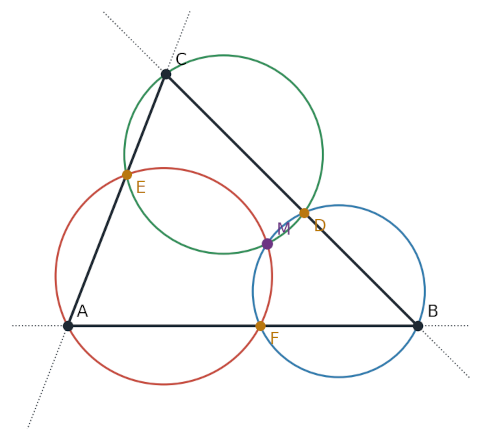
Choose a point on each side of a triangle. Then for each vertex draw a circle through it and the chosen points on the adjacent sides. Miquel’s theorem says the three circles meet in one point.
Here’s an example. For a trangle ABC, choose points D, E, and F on each side. The three circles described in the theorem intersect at M.
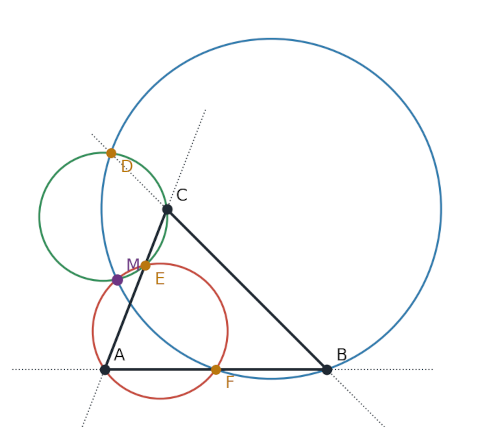
Now the three points D, E, and F don’t have to be limited to the sides of the triangle; they can be on the line segment containing the side. Here’s an example where D is outside the triangle.
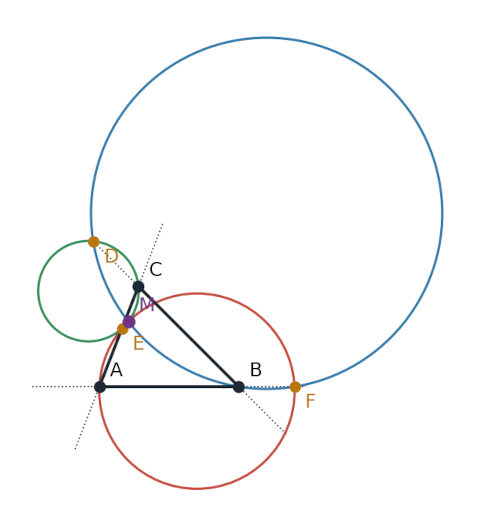
And here’s an example where two of the chosen points, D and F, are outside the triangle. The three circles still intersect at one point M.
Related posts
[1] Miquel, Auguste (1838), “Mémoire de Géométrie”, Journal de Mathématiques Pures et Appliquées, 1: 485–487
This doesn’t completely work if the points D, E, or F coincide with one of the triangular vertices. Then the circle created reduces to a line which doesn’t (necessarily) intersect with the other two circles at the same location.
https://www.geogebra.org/calculator/a73cxekz