
Euclid’s fifth postulate says that given a line ℓ and a point P not on ℓ , there is a unique line through P parallel to ℓ. In the projective plane there are no parallel lines, and in the hyperbolic plane there are at least two lines through P parallel to ℓ.
Recent posts have looked at finite projective and affine planes. This post will look at finite hyperbolic planes.
Finite projective planes come up far more often in application than finite hyperbolic planes. I’ve seen several resources on finite geometries that don’t mention the hyperbolic case. Finite hyperbolic geometries have less structure than their projective or affine counterparts and so are less useful.
The definition of a finite hyperbolic plane isn’t entirely standardized. We will use the following axioms for this post.
- Any two distinct points lie on exactly one line.
- Given a line ℓ and a point P not on ℓ, there exist at least two lines through P parallel to ℓ.
- There exist four points, no three collinear.
- Every line contains at least two points.
An example of a system satisfying these axioms is the complete graph of six vertices. The nodes are the points and the edges are the lines. In set-theoretic terms, the points are the one-element subsets of {1, 2, 3, 4, 5, 6} and the lines are all possible two-element subsets.
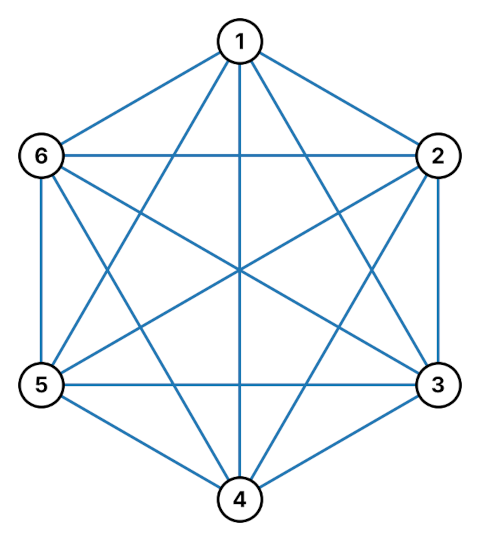
Note that lines in the finite hyperbolic plane are two element sets. The lines {5, 6} and {1, 3}, for example, are parallel because they do not intersect, even though the representations of {5, 6} and {1, 3} in the visualization above are not parallel in the Euclidean sense.
There are many other examples of system satisfying the hyperbolic plane axioms. Too many in some sense. You could say finite hyperbolic systems are less common in application because they are more common in count.