Prime chains

The title of this post has a double meaning. We will look at chains in the sense of number theory and in the sense of cryptocurrency, i.e. Cunningham chains and blockchains, that involve prime numbers.

Cunningham chains

A chain of primes is a sequence of prime numbers in which each is almost double its predecessor. That is, the next number after p is 2p ± 1.

In a Cunningham chain of the first kind, the successor of p is 2p + 1. For example,

41, 83, 167.

In a Cunningham chain of the second kind, the successor of p is 2p − 1. For example,

19, 37, 73.

Two questions come up immediately. First, are there infinitely many Cunningham chains? Second, how long can a Cunningham chain be? What is known and what is conjectured are at opposite ends of the spectrum. It is unknown whether there are infinitely many Cunningham chains of length 2, but it is conjectured that there are infinitely many Cunningham chains of all lengths.

According to this page, the longest known Cunningham chains of the first kind has length 17, and the longest known Cunningham chain of the second kind has length 19. We can verify these results with the following Python code.

from sympy import isprime

def chain_length(start, kind):
    p = start
    c = 0
    while isprime(p):
        c += 1
        p = 2*p + kind
    return c

print(chain_length(2759832934171386593519, 1))
print(chain_length(79910197721667870187016101, -1))

Bi-twin chains

A number n is the basis of a bi-twin chain of length k if n − 1 is the start of a Cunningham chain of the first kind of length k and n + 1 is the start of a Cunningham chain of the second kind of length k.

I say more about bi-twin prime chains in the next post.

Primecoin

Primecoin was one of the first cryptocurrencies, coming out four years after Bitcoin. Primecoin is still going, though its market cap is six orders magnitude smaller than that of Bitcoin.

What’s interesting about Primecoin is that it uses finding prime chains as its proof of work task [1]. To mint a new Primecoin block, you must find a prime chain of the required length whose origin a multiple of the hash of the block header [2].

Primecoin allows any of the three kinds of prime chains mentioned above: Cunningham chains of the first or second kind, or a bi-twin prime chain. Primecoin adjusts its mining difficulty over time by varying the length of Cunningham or bi-twin chain needed to mint a new block.

Related posts

[1] Strictly speaking, Primecoin requires finding probable prime chains, as explained here.

[2] The origin of a prime chain is n if the first item in a Cunningham chain of the first kind is is n + 1, or if the first item in a Cunningham chain of the first kind or a bi-twin chain is n − 1.

Compressing a set of hash values

Suppose you have a set of k hash values, each n bits long. Can you compress the set into less than kn bits?

It’s not possible to compress a list of hashes into less than kn bits, but you can hash a set into fewer bits.

Suppose you have a set of 230, roughly a billion, 64-bit hashes. Sort the set and look at the size of gaps between elements. You might expect that consecutive items on the list are roughly 234 apart, and so you could reconstruct the list by reporting the first item and the gaps between the rest, which are 34-bit numbers, not 64-bit numbers, a savings of 30 bits per hash.

This doesn’t exactly work, but it’s the kernel of a good idea. We don’t know that the distance between hashes can be represented by a 34 bit number. The gap could be more or less than 234, but we don’t expect it to often be much more than 234. So we use a variable-length encoding such that when the distance between values is on the order of 234, or less, we save bits, but we allow for the distance to be any size.

Applications

What we’ve described is the essence of Golomb-Rice coding. Its implementation in the Bitcoin protocol is referred to as Golomb-Coded Sets (GCS), described in BIP 158. Golomb-Rice coding is also used other applications where the  values to be compressed are not hashes, such as in lossless auto compression.

Encoding

Let’s go into some detail as to how the distances between sorted values are represented. Suppose you expect the differences to be on the order of M where M is a power of 2. For each difference d, let q and r be the quotient and remainder by M, i.e.

dqMr.

Encode q as a unary number, i.e. string of q 1s, and encode r as an ordinary binary number. Then Golomb-Rice coding of d is the concatenation of the representations of q and r. with a 0 in the middle as a separator. Using || to denote string concatenation we have

unary(q)  ||  0  ||  binary(r).

In general, unary encoding is extremely inefficient, but we’re betting that q will typically be quite small.

The reason we require M to be a power of 2 is so the representation of r will have a fixed length [1].

Let’s work out an example. Suppose M = 220 and

d = 222 + 123456 = 4 × M + 123456.

Then we write q as 1111 and r as 0011110001001000000 and encode d as the string

111100011110001001000000

Decoding

You can concatenate the encodings of consecutive d values and still be able to unambiguously decode the result. Because the r representations have a constant length, you know when an r ends and the next q begins.

For example, suppose we have the following string of bits.

1110010011001011001011111001000000110010001110011101111000101111011

We decode the string from left to right. We count how many ones we see, skip over a 0, then regarding the next 20 bits as a binary number.

111 0 01001100101100101111 1 0 01000000110010001110 0 11101111000101111011

We see three 1s before the first 0 and so we conclude q1 = 3. We skip over the 0 and read the value of r.

r1 = 01001100101100101111two = 314159.

Next we see a single 1 before the next 0, so q2 = 1. We read the next value of r as

r2 =  01000000110010001110two = 265358.

Next we see a 0, i.e. there are no 1s, and so the final q3 = 0. And we have

r3 =  11101111000101111011two = 979323.

So our reconstructed values of d are

d1 = q1 M+ r1 = 3 × 220 + 314159 = 3459887

d2 = q2 M+ r2 = 1 × 220 + 265358 = 1313934

d3 = q3 M+ r3 = 0 × 220 + 979323 = 979323.

Now these are difference values. We need to know the smallest value m in order to construct the original set of values from the differences. Then the full values are m, m + d1, m + d1 + d2, and m + d1 + d2 + d3,.

Related posts

[1] This is the Rice part. Robert Rice simplified Samuel Golomb’s encoding scheme in the special case that M is a power of 2.

Obscuring P2P nodes with Dandelion

The weakest link in the privacy of cryptocurrency transactions is often outside the blockchain. There are technologies such as stealth addresses and subaddresses to try to thwart attempts to link transactions to individuals. They do a good job of anonymizing transaction data, but the weak link may be metadata, as is often the case.

Cryptocurrency nodes circulate transaction data using a peer-to-peer network. An entity running multiple nodes can compare when data arrived at each of its nodes and triangulate to infer which node first sent a set of transactions. The Dandelion protocol, and its refinement Dandelion++, aims to mitigate this risk. Dandelion++ is currently used in Monero and a few other coins; other cryptocurrencies have considered or are considering using it.

Dandelion plant

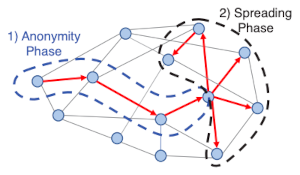
The idea behind the Dandelion protocol is to have a “stalk” period and a “diffusion” period. Imagine data working up the stalk of a dandelion plant before diffusing like seeds in the wind. The usual P2P process is analogous to simply blowing on the seed head [1].

During the stalk period, information travels from one node to one node. Then after some number of hops, the diffusion process begins; the final node in the stalk period diffuses the information to all its peers. An observer with substantial but not complete visibility of the network may be able to determine which node initiated the diffusion, but maybe not the node at the other end of the stem.

A natural question is how this differs from something like Tor. In a nutshell, Tor offers identity protection before you enter a P2P network, and Dandelion offers identity protection inside the P2P network.

For more details, see the original paper on Dandelion [2].

Related posts

[1] The original paper on Dandelion uses a dandelion seed as the metaphor for the protocol. “The name ‘dandelion spreading’ reflects the spreading pattern’s resemblance to a dandelion seed head and refers to the diagram below. However, other sources refer to the stalk and head of the dandelion plant, not just a single seed. Both mental images work since the plant has a slightly fractal structure with a single seed looking something like the plant.

Illustration from Dandelion protocol paper

[2] Shaileshh Bojja Venkatakrishnan, Giulia Fanti, Pramod Viswanath. Dandelion: Redesigning the Bitcoin Network for Anonymity. Proceedings of the ACM on Measurement and Analysis of Computing Systems, Volume 1, Issue 1 Article No.: 22, Pages 1–34. Available here: https://doi.org/10.1145/3084459.

What is a Pedersen commitment?

I’m taking a break from my series on celestial navigation. The previous posts give the basics, but I haven’t thought of a way to go further that I’m satisfied with. So now for something completely different: Pedersen commitments.

Pedersen commitments are a building block of zero knowledge proofs (ZKP), and they give an opportunity to look at a couple other interesting topics: nothing-up-my-sleeve constructions and homomorphic encryption.

A Pedersen commitment to a value v takes a random number x and two generators of an elliptic curve, G and H, and returns

C = vGxH.

The significance of C is that it appears to be a random number to the recipient, but the sender who calculated it can later show that it was computed from v and xC is called a commitment to the value v because the sender cannot later say that C was computed from a different v and a different x.

Mathematical details

The addition in

C = vGxH

is carried out on an elliptic curve, such as Ed25519 in the case of Monero. Multiplication is defined by repeated addition, though it’s not computed that way [1]. G and H are not just points on the elliptic curve but points in a large, prime-order subgroup of the elliptic curve.

Because the value x is random, the possible values of C are uniformly distributed on the curve, and so someone observing C learns nothing about v. For that reason x is called a blinding factor.

The difficulty of the discrete logarithm problem insures that it is impractical come up with different values v‘ and x‘ such that

v Gx H = v‘ Gx‘ H.

This depends on two assumptions.

The first assumption is that the discrete logarithm problem is hard to solve given current algorithms and hardware. The prevailing opinion is that it is unlikely anyone will come up with an efficient algorithm for solving the discrete logarithm problem on current hardware. However, Shor’s algorithm could solve the discrete logarithm problem efficiently if and when a practical, large-scale quantum computer is created.

The second assumption is that the generator H was chosen at random and not calculated to be a backdoor.

How to make and use a backdoor

Because G and H are members of the same prime-order (i.e. cyclic) group, there exists some integer h such

HhG

If the generator H was randomly selected, nobody knows h and nobody can calculate it. But if H was calculated by first selecting h and multiplying hG then there is a backdoor.

Now

C = vGxH = vGx(hG) = (vxh)G.

If you know h, you can pick a new v‘ and solve for x‘ such that

vxhv‘ + xh.

That would mean that in the context of a cryptocurrency that uses Pedersen commitments, such as Monero or the Liquid Network on top of Bitcoin, you could initially commit to spending v and later claimed that you committed to spending v‘.

Note that solving for x‘ requires modular arithmetic, not solving the discrete logarithm problem.

How to prove no backdoor

The way to prove that the generator H was chosen in good faith is to be transparent about how it was created. In practice this means using some sort of cryptographic hash function. For example, Bulletproofs hashed “bulletproof_g” and “bulletproof_h” to create its values of G and H. Bulletproofs require multiple values of G and H and so consecutive integers were concatenated to the strings before hashing.

Reversing a cryptographic hash like SHA256 is impractical, even assuming you have a quantum computer, and so it is extremely unlikely that there is a backdoor when the generators were created by hashing a natural string.

It’s said that Pedersen commitments do not require a trusted setup. That’s true in spirit, but more precisely they require a transparent setup that is easy to trust.

Homomorphic encryption

The function

C: (vx) ↦ vG + xH

is a group homomorphism from pairs of integers to the subgroup generated by G and H. This means that

C(vx) + C(v‘, x‘) = C(vv‘, xx‘)

or in other words, you can combine multiple commitments into a single commitment. The sum of a commitment to (vx) and a commitment to (v‘, x‘) is a commitment to (vv‘, xx‘).

Related posts

[1] In practice the number x is enormous, say on the order of the number of points on the elliptic curve, and so software does not add H to itself x times. Instead it uses a process analogous to fast exponentiation. In fact, if you write the group operation multiplicatively rather than additively, it is exactly fast exponentiation.

Monero subaddresses

Monero has a way of generating new addresses analogous to the way HD wallets generate new addresses for Bitcoin. In both cases, the recipient’s software can generate new addresses to receive payments that others cannot link back to the recipient.

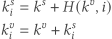
Monero users have two public/private keys pairs: one for viewing and one for spending. Let Ks and ks be the public and private spending keys, and let Kv and kv be the public and private viewing keys. Then the user’s ith subaddress is given by

\begin{align*} K^s_i &= K^s + H(k^v, i) G \\ K^v_i &= k^v K^s_i \end{align*}

Here G is a generator for the elliptic curve Ed25519 and H is a hash function. The hash function output and kv are integers; the public keys, denoted by capital Ks with subscripts and superscripts, are points on Ed25519. The corresponding private keys are

\begin{align*} k^s_i &= k^s + H(k^v, i) \\ k^v_i &= k^v + k^s_i \end{align*}

As with hierarchical wallets, the user scans the blockchain to see which of his addresses have received funds.

A user may choose to give a different subaddress for each transaction for added security, or to group transactions for accounting purposes.

Note that in addition to subaddresses, Monero uses stealth addresses. An important difference between subaddresses and stealth addresses is that recipients generate subaddresses, and senders generate stealth addresses. Someone could send you money to the same subaddress twice, failing to create a new stealth address. This is not possible if you give the sender a different subaddress each time.

Janus attacks

The possibility of a Janus attack is a fly in the subaddress ointment. If an attacker suspects that two subaddresses belong to the same wallet, they can confirm this suspicion by sending a transaction to one subaddress and making it look like it came from the other. If the recipient confirms receipt of the funds, they inform the attacker that his suspicion was correct. A cautious user might not confirm receipt of funds, but a cryptocurrency exchange would. You can read more about the details of a Janus attack here.

Related posts

How stealth addresses work in Monero

Suppose Alice runs a confidential restaurant. Alice doesn’t want there to be any record of who visited her restaurant but does want to get paid for her food. She accepts Monero, and instead of a cash register there are two QR codes on display, one corresponding to her public view key A and the other corresponding to her public spend key S.

How Bob buys his burger

A customer Bob walks into the restaurant and orders a burger and fries. When Bob pays Alice, here’s what’s going on under the hood.

Bob is using software that generates a random integer r and multiplies it by a point G on an elliptic curve, specifically ed25519, obtaining the point

R = rG

on the curve. The software also multiplies Alice’s view key A, a point on the same elliptic curve, by r, then runs a hash function H on the produce rA that returns an integer k.

kH(rA).

Finally, Bob’s software computes the point

PkGS

and sends Alice’s cash register, i.e. her crypto wallet, the pair of points (PR). The point P is a stealth address, an address that will only be used this one time and cannot be linked to Alice or Bob [1]. The point R is additional information that helps Alice receive her money.

How Alice gets paid

Alice and Bob share a secret: both know k. How’s that?

Alice’s public view key A is the product of her private view key a and the group generator G [2]. So when Bob computes rA, he’s computing r(aG). Alice’s software can multiply the point R by a to obtain a(rG).

rAr(aG) = a(rG) = aR.

Both Alice and Bob can hash this point—which Alice thinks of as aR and Bob thinks of as rA—to obtain k. This is ECDH: elliptic curve Diffie-Hellman key exchange.

Next, Alice’s software scans the blockchain for payments to

PkGS.

Note that P is on the blockchain, but only Alice and Bob know how to factor P into kGS because only Alice and Bob know k. And only Alice can spend the money because only she knows the private key s corresponding to the public spend key S where

SsG.

She knows

PkGsG = (ks)G

and so she has the private key (ks) corresponding to P.

Related posts

[1] Bob sends money to the address P, so there could be some connection between Bob and P on the Monero blockchain. However, due to another feature of Monero, namely ring signatures, someone analyzing the blockchain could only determine that Bob is one of 16 people who may have sent money to the address P, and there’s no way to know who received the money. That is, there is no way, using only information on the blockchain, who received the money. A private investigator who saw Bob walk into Alice’s restaurant would have additional information outside the blockchain.

[2] The key assumption of elliptic curve cryptography is that it’s computationally infeasible to “divide” on an elliptic curve, i.e. to recover a from knowledge of G and aG. You could recover a by brute force if the group were small, but the elliptic curve ed25519 has on the order of 2255 points, and a is some integer chosen randomly between 1 and the size of the curve.

Elliptic curve pairings in cryptography

Pairings can mean a variety of related things in group theory, but for our purposes a pairing is a bilinear mapping from two groups to a third group.

e: G1 × G2GT

Typically the group operation on G1 and G2 is written additively and the group operation on GT is written multiplicatively. In fact, GT will always be the multiplicative group of a finite field, i.e. GT consists of the non-zero elements of a finite field under multiplication. (The “T” stands for “target.”)

Here bilinear [1] means that if P is an element of G1 and Q is an element of G2, and a and b are nonnegative integers,

e(aPbQ) = e(P, Q)ab.

There are a few provisos …

Robin Williams imitating William F. Buckley

First, the pairing must be non-degenerate, i.e. e(PQ) ≠ 1 for some P and Q.

Second, the pairing must be efficiently computable.

Third, the embedding degree must not be “too high.” This means that if GT is the multiplicative group of a field with pk elements, k is not too big. We will look at two examples in which k = 12.

The second and third provisos are important even though they’re not stated rigorously.

Cryptography often speaks of pairing elliptic curves, but in fact it uses pairings of prime-order subgroups of the additive groups of elliptic curves. Because the subgroups have prime order, they are cyclic, and so the pairing is determined by its value on a generator from each subgroup.

Example: BN254

The previous post briefly mentioned a pairing between two elliptic curves, BN254 and alt_bn128, that is used in Ethereum and was used in Zcash in the original Sprout shielded protocol.

The elliptic curve BN254 is defined over the field Fp, the integers mod p, where

p = 21888242871839275222246405745257275088696311157297823662689037894645226208583.

and the elliptic curve alt_bn128 is defined over the field Fp[i], i.e. the field Fp, with an imaginary element i adjoined.

Both elliptic curves have a subgroup of order

r = 21888242871839275222246405745257275088548364400416034343698204186575808495617,

which is prime. So in the pairing the groups G1 and G2 are isomorphic to the integers mod r. The target group GT has order p12 − 1 and so the embedding degree k equals 12, and so the embedding degree is “not too high.”

Example: BLS12-381

Another example also comes from Ethereum and Zcash. Ethereum uses BN254 in smart contracts, but it uses BLS12-381 in its consensus layer. Zcash switched from BN254 to BLS12-381 in the Sapling release.

BLS12-381 is defined over a prime order field with on the order of 2381 elements and has embedding order 12, hence 12-381. The BLS stands for Paulo Barreto, Ben Lynn, and Michael Scott. Elliptic curve names often look mysterious, but they’re actually pretty descriptive. I discuss BLS12-381 in more detail here. As in the example above, BLS12-381 is defined over a field Fp and is paired with a curve over Fp[i], i.e. the same field with an imaginary element adjoined. The equation for BLS12-381 is

y² = x³ + 4

and the equation for the curve it is paired with is

y² = x³ + 4(1 + i)

As before the target group is the multiplicative group of a finite field of order p12.

Related posts

[1] You’ll also see bilinearity defined by

e(PQR) = e(PRe(QR)

and

e(PRS) = e(PRe(PS).

These definitions are equivalent. To see that the definition here implies the definition at the top, write out aP as PP + … + P etc.

Since we’re working in subgroups of prime order, there is a generator for each subgroup. Write out each element as a multiple of a generator, then the definition at the top implies the definition here.

Adding an imaginary unit to a finite field

Let p be a prime number. Then the integers mod p form a finite field.

The number of elements in a finite field must be a power of a prime, i.e. the order q = pn for some n. When n > 1, we can take the elements of our field to be polynomials of degree n − 1 with coefficients in the integers mod p.

Addition works just as you’d expect addition to work, adding coefficients mod p, but multiplication is a little more complicated. You multiply field elements by multiplying their polynomial representatives, but then you divide by an irreducible polynomial and take the remainder.

When n = 2, for some p you can define the field by adding an imaginary unit.

When you can and cannot adjoin an i

For some finite fields of order p, you can construct a field of order p² by joining an element i to the field, very much the way you form the complex numbers from the real numbers. For example, you can create a field with 49 elements by taking pairs of (a, b) of integers mod 7 and multiplying them as if they were abi. So

(ab) * (cd) = (ac − bdadbc).

This is equivalent to choosing the polynomial x² + 1 as your irreducible polynomial and following every polynomial multiplication by taking the remainder modulo x² + 1.

This works for a field with 49 elements, but not for a field of 25 elements. That’s because over the integers mod 5 the polynomial x² + 1 already has a root. Two of them in fact: x = 2 or x = 3. So you could say that mod 5, i = 2. Or i = 3 if you prefer. You can still form a field of 25 elements by taking pairs of elements from a field of 5 elements, but you have to choose a different polynomial as your irreducible polynomial because x² + 1 is not irreducible because

x² + 1 = (x − 2)(x + 2)

when working over the integers mod 5. You could use

x² + x + 1

as your irreducible polynomial. To prove that this polynomial is irreducible mod 5, plug in the numbers 0, 1, 2, 3, and 4 and confirm that none of them make the polynomial equal 0.

In general, you can create a field of order p² by adjoining an element i if and only if p = 3 mod 4.

Next we’ll look at an example of making a very large finite field even larger by adding an imaginary element.

Example from Ethereum

The Ethereum virtual machine has support for a pairing—more on that in a future post—of two elliptic curves, BN254 and alt_bn128. The BN254 curve is defined by

y² = x³ + 3

over the field Fp, the integers mod p, where

p = 21888242871839275222246405745257275088696311157297823662689037894645226208583.

The curve alt_bn128 is defined by

y² = x³ + 3/(9 + i)

over the field Fp[i], i.e. the field Fp, with an element i adjoined. Note the that last two digits of p are 83, and so p is congruent to 3 mod 4.

Special point on curve

The Ethereum documentation (EIP-197) singles out a particular point (xy) on alt_bn128:

xabi
ycdi

where

a = 10857046999023057135944570762232829481370756359578518086990519993285655852781
b = 11559732032986387107991004021392285783925812861821192530917403151452391805634
c = 8495653923123431417604973247489272438418190587263600148770280649306958101930
d = 4082367875863433681332203403145435568316851327593401208105741076214120093531.

We will show that this point is on the curve as an exercise in working in the field Fp[i]. We’ll write Python code from scratch, not using any libraries, so all the details will be explicit.

def add(pair0, pair1, p):
    a, b = pair0
    c, d = pair1
    return ((a + c) % p, (b + d) % p)

def mult(pair0, pair1, p):
    a, b = pair0
    c, d = pair1
    return ((a*c - b*d) % p, (b*c + a*d) % p)

p = 21888242871839275222246405745257275088696311157297823662689037894645226208583
a = 10857046999023057135944570762232829481370756359578518086990519993285655852781
b = 11559732032986387107991004021392285783925812861821192530917403151452391805634
c = 8495653923123431417604973247489272438418190587263600148770280649306958101930
d = 4082367875863433681332203403145435568316851327593401208105741076214120093531

# Find (e, f) such that (e, f)*(9, 1) = (1, 0).
# 9e - f = 1
# e + 9f = 0
# Multiply first equation by 9 and add.
e = (9*pow(82, -1, p)) % p
f = (-e*pow(9, -1, p)) % p
prod = mult((e, f), (9, 1), p)
assert(prod[0] == 1 and prod[1] == 0)

y2 = mult((c, d), (c, d), p)
x3 = mult((a, b), mult((a, b), (a, b), p), p)
rhs = add(x3, mult((3, 0), (e, f), p), p)

assert(y2[0] == rhs[0])
assert(y2[1] == rhs[1])

Related posts


Text case changes the size of QR codes

Let’s make a QR code out of a sentence two ways: mixed case and upper case. We’ll use Python with the qrcode library.

>>> import qrcode
>>> s = "The quick brown fox jumps over the lazy dog."
>>> qrcode.make(s).save("mixed.png")
>>> qrcode.make(s.upper()).save("upper.png")

Here are the mixed case and upper case QR codes.

The QR code creation algorithm interprets the mixed case sentence as binary data but it interprets the upper case sentence as alphanumeric data.

Alphanumeric data, in the context of QR codes, comes from the following alphabet of 45 characters:

0123456789ABCDEFGHIJKLMNOPQRSTUVWXYZ $%*+-./:

Since 45² = 2025 < 2048 = 211 two alphanumeric characters can be encoded in 11 bits. If text contains a single character outside this alphabet, such as a lower case letter, then the text is encoded as ISO/IEC 8859-1 using 8 bits per character.

Switching from mixed-case text to upper case text reduces the bits per character from 8 to 5.5, and so we should expect the resulting QR code to require about 30% fewer pixels. In the example above we go from a 33 × 33 grid down to a 29 × 29 grid, from 1089 pixels to 841.

Application to Bitcoin addresses

Bech32 encoding uses an alphabet of 32 characters while Base58 encoding uses an alphabet of 58 characters, and so the former needs about 17% more characters to represent the same data. But Bech32 uses a monocase alphabet, and base 58 does not, and so Bech32 encoding requires fewer QR code pixels to represent the same data as Base58 encoding.

(Bech32 encoding uses a lower case alphabet, but the letters are converted to upper case before creating QR codes.)

Related posts

Why and how Bitcoin uses Merkle trees

Yesterday’s post looked at a recently mined Bitcoin block, the 920,994th block in the blockchain, and verified that it contains the hash of the previous block. This post will look at the same block and verify its Merkle tree root.

Before getting down to the bytes, we’ll back up and say what a Merkle tree is and why Bitcoin uses one.

What is a Merkle tree?

A Merkle tree is a binary tree. The leaves of the tree are labeled with a hash of the data associated with each leaf. The label of each interior node is the hash of the concatenation of the two child hashes. The label of the root of the tree is the Merkle tree root.

The smallest change to any data in the tree will change the Merkle tree root [1]. If you weren’t concerned with efficiency, you wouldn’t need a Merkle tree. You could simply concatenate all the data in the leaves and compute a hash. But the Merkle tree makes it possible to verify a node without having to verify the whole tree.

To see this, imagine starting at the bottom of the tree and working your way up to compute the Merkle root. You need the hash value of the node you’re interested in and its sibling. Then you can compute the label of the parent node. If you know the label of the parent’s sibling node (you could call it the aunt or uncle) then you can compute the label of the grandparent node, and so forth until you get to the root. If you get the expected value for the root, the data is correct.

How Bitcoin uses Merkle trees

Bitcoin makes a Merkle tree with the data for each transaction being a leaf node. Simple Payment Verification (SPV) lets you verify a transaction knowing only the hash of the transaction, the hash of its sibling, and the hashes of the siblings moving up the tree: the aunts, great aunts, great great aunts etc.

If a block has 2n transactions, you only need n hash values to verify a single transaction. The binary tree has n levels, and you need two hashes at the bottom, and one hash for each of the levels between the bottom and the top. So in a block of 1024 transactions, you need 10 hash values. Note that this saves space two ways: you don’t need transaction data per se, only hashes of transaction data, and the number of hashes you need is log2 of the number of transactions.

What if the number of transactions is not a power of 2? If there is an odd number of nodes at a given level of the Merkle tree, the last node is paired with itself.

For example, the block that we’ll examine in detail contains 1279 transactions. At the bottom of our Merkle tree there are effectively 1280 nodes, with the 1280th node being a duplicate of the 1279th. Moving up the tree we have 640 nodes, 320 nodes, 160 nodes, … 10 nodes, and 5 nodes. The 5th node is paired with itself, and no the next level up has 3 nodes. The third node is paired with itself, making 2 nodes on the next level, and then the root above that.

Down to the bytes

The command

xxd -l 80 920994.dat

gives a hex dump of the block header:

0000 002e c2df b57e f582 75c2 7a64 33c5
edfd dfc1 af6a b9ae 708c 0000 0000 0000
0000 0000 bb15 accc 8940 3811 0b9b e1cf
b125 c0fa a65e fb1b 2fa4 61ed 989f 8d6f
e41e 04cf 5522 ff68 21eb 0117 f2bc ab1a

This time we’re looking at bytes 37 through 68, highlighted in orange. This is the Merkle tree root.

A miner verifying the block would recompute the Merkle tree root and confirm that it matches the value given in the header.

A Bitcoin block does not contain a Merkle tree per se, only its root. The hash of the data for each transaction, what Bitcoin calls a txid, is redundant since it can be computed. And if it were included in the block, a miner would need to recompute it to verify that it is correct.

We can fetch a list of txids for a block by calling

https://blockstream.info/api/block/{block_hash}/txids

with the hash of the block we want, which in our case is

00000000000000000001c2f89cee9f8c2fe88b4a93c2c2b75192918fc438ca32

This returns a JSON string with 1279 hash values:

fc1d784c62600565d4b4fbfe9cd45a7abc5f1c3273e294fd2b44450c5c9b9e9a
d4bce41744156a8f0e6588e42efef3519904a19169212c885930e908af1457ec
7bc6428c7d023108910a458c99359a2664de7c02343d96b133986825297e518d
…
c9132f178830d0c7a781e246bb5c2b3f4a9686c3d2b6f046b892a073d340eaff

Note that the API call did not pull the txids from the block; it computed them. Presumably the server computed the list of txids once and cached the results rather than computing them when we called the API.

We can compute the Merkle tree root by concatenating pairs of txids and hashing the results. Since the number of transactions is odd, the last txid is paired with itself. So moving one level up the tree, the first node is labeled with the hash of

fc1…e9ad4b…7ec

and the last node is labeled with the hash of

c91…affc91…aff

We continue this process until we compute the Merkle tree root. Then we can confirm that it matches the value given in the header. As with the block hash in the previous post, the Merkle tree root is stored in the header in little endian form.

Related posts

[1] There is a vanishingly small chance that a change in the data would not change the root. With a 256-bit hash, the chances of a change in the data not changing the root are 1 in 2256.