
This post began as a thread on X last night. I’ve edited the thread to turn it into a blog post, making some additions and corrections.
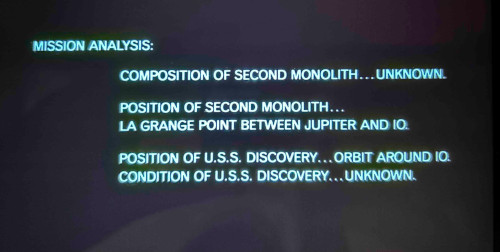
I’m watching 2010: The Year We Make Contact. The movie opens saying the monolith is located at the Lagrange point between Jupiter and Io. I got nerd sniped and wondered where that was.
There are five Lagrange points, but presumably the movie refers to L1 or L2 because these are near Io. Lagrange points L3, L4, and L5 are essentially in the orbit of Io, but 60, 180, and 300 degrees out of phase, all far from Io. (The book says the monolith is at L1.)
Lagrange points L1 and L2 are unstable. Maybe this is a plot hole in the movie, unless there’s an explanation coming.
(In general L1, L2, and L3 are unstable. If the ratio of the masses is large enough, L4 and L5 will be stable. More on that here. The Lagrange points L4 and L5 are indeed stable for the Jupiter-Io system. For the Sun-Earth system L1 is moderately stable over a short time span, but L1 is far less stable for the Jupiter-Io system.)
Here’s a plot of the Lagrange points.
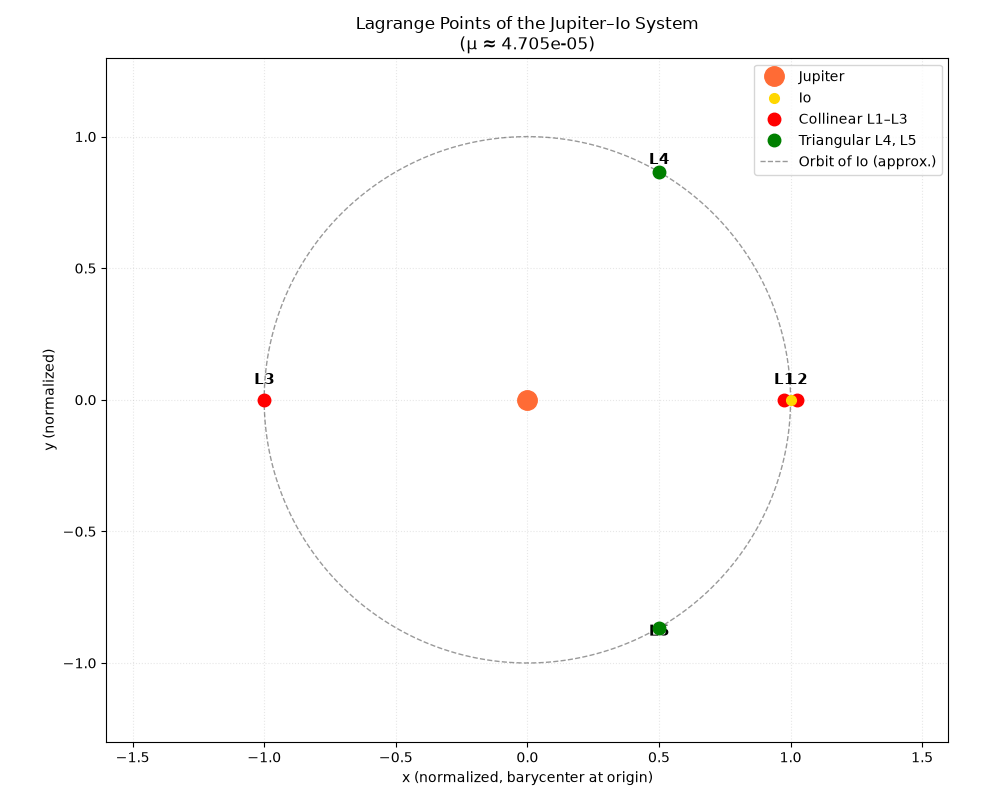
Note that L1 and L2 are very close to Io, about 10,000 km from the moon. The L1 and L2 Lagrange points for the Earth-Sun system are not so close to Earth.
(That’s half true. Yes, Io’s L1 point is closer to it than Earth’s L1 point, in absolute distance. But in relative terms, Io’s L1 point is actually further away. I had been mislead by seeing an illustration that exaggerated the distance from Earth to L1.)