
It’s obvious that you could cover a cube with smaller cubes. You could, for example, take a cube with side 1 and cover it a cube of side ½ centered on each corner.
It’s not as obvious how you would cover a ball with smaller balls, but you could cover the unit ball with balls of radius ½√3 centered at the points (±½, ±½, ±½). In fact, you could cover a ball with four smaller balls [1].
Now consider an arbitrary convex shape K in three dimensions with non-empty interior. Is it possible to cover K by copies of itself? Since K has non-empty interior, you could cover K by putting a smaller version of K around every point. And if K is compact, then this cover has a finite subcover. But there might be a lot of elements in this finite cover. What’s the minimum number possible in general? It takes eight cubes to cover a cube, so the minimum is at least 8. But could some odd shape take more?
Hadwiger’s covering conjecture says that K can be covered by eight copies of itself. That is, there exists a scaling constant 0 < λ < 1 and shift vectors vi such that
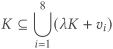
Dror Aiger, Sariel Har-Peled, and Goran Žužić posted a proof of Hadwiger’s conjecture on arXiv yesterday. The abstract to their paper says “The proof was discovered using an experimental harness on top of Gemini 4 Carbon and formally verified in Lean 4.”
I’ve heard good things about the Google’s new Carbon model. This is the first announcement of a major theorem proved with the assistance of a Google model that I’ve noticed.
Related posts
- Splitting a convex set through its center
- Convex hull of zeros
- Separation of Convex Sets in Linear Topological Spaces
[1] Inscribe the vertices of regular tetrahedron on the unit sphere, then multiply the vectors representing the vertices by ⅓. Center spheres of radius ⅔√2 at each vertex.