
Block designs are ways of grouping elements of a set into blocks that have some sort of specified pattern. More on the patterns below.
I recently ran across quantum block designs and couldn’t imagine what that could mean. I saw Gerhard Zauner’s thesis “Quantum Designs: Foundations of a non-commutative Design Theory” and wondered what, in this setting, does or does not commute.
Analogy
The key to understanding the quantum connection is to think about the matrices that represent block designs rather than the block designs per se. These matrices have a connection to the matrices (or more generally, linear operators) of interest in quantum mechanics, and it is these matrices that may not commute under multiplication.
A combinatorial design consists of a set of points V and a set of blocks B, where a block is a subset of V. So if V has v elements and B has b elements, you can represent the design (V, B) as an v by b matrix, with a 1 in row i column j if the ith point is in the jth block and a 0 otherwise.
Example
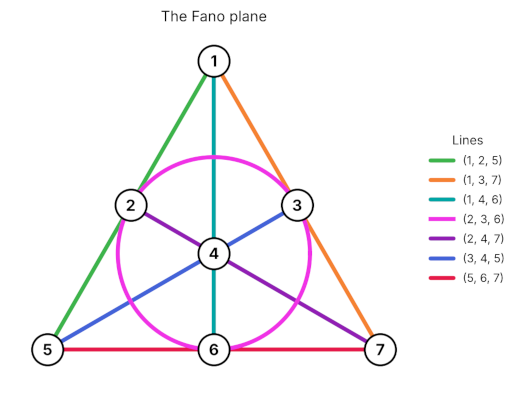
The Fano plane is a well-known example of a block design. It is a model for a finite projective plane if you interpret the blocks as lines. The incidence matrix corresponding to the Fano plane above would have rows corresponding to the numbered points and columns corresponding to the colored lines. The column corresponding to the green line would have 1s in rows 1, 2, and 5 and 0s elsewhere. Every column would have three 1s because every line has three points. And every row would have three 1s because every point lies on three lines.
Requirements
A couple weeks ago I wrote a series of posts starting with finite projective planes, like the Fano plane above, gradually increasing in generality up to combinatorial designs, then specializing slightly to balanced incomplete block designs (BIBD) with parameters v, k, and λ.
This means the set of points V has v elements, every block contains k elements of V, and every pair of points in V is contained in λ blocks. For example, the Fano plane above is a BIBD with parameters (7, 3, 1).
The number of blocks b can be computed as a function of the parameters, as can the number r of blocks each point appears in. See how here.
Requirements in matrix form
Since the set of points V has v elements and the set of blocks B has b elements, the incidence matrix M has v rows and b columns.
Since every block contains k elements, the columns of M each sum to q.
Since every point is contained in r blocks, the rows of M each sum to r.
The (i, j) element of MMT equals the number of blocks containing the ith and jth points. When i = j, this is r. When i ≠ j, this is λ.
Quantum
I won’t go into quantum designs here, but having read this post you’re prepared to read Zauner’s thesis.
In case you’re interested, there is a categorical framework that unifies classical and quantum block designs.