A few days ago I wrote a post entitled Does additional data always reduce posterior variance?. In a nutshell, the answer is no, not always.
That led the previous post which looked at posterior means for three Bayesian models, showing how the posterior mean is a weighted average of the prior mean and the mean of the new data. The weights are precisions, which means something different for each model.
For the beta-binomial model, variance may increase when seeing unexpected data (details here), but precision always increases.
For the normal-normal model precision is the reciprocal of variance. Every new data point makes precision go up and posterior variance go down.
The Poisson-gamma model may be the most interesting. As stated in the previous post, if data has a Poisson distribution with parameter λ, and λ has a gamma(α0, β0) prior distribution, then the posterior distribution on λ after observing k events over time t has a gamma(α0 + k, β0 + t) posterior distribution. Therefore the posterior variance is
(α0 + k) / (β0 + t)².
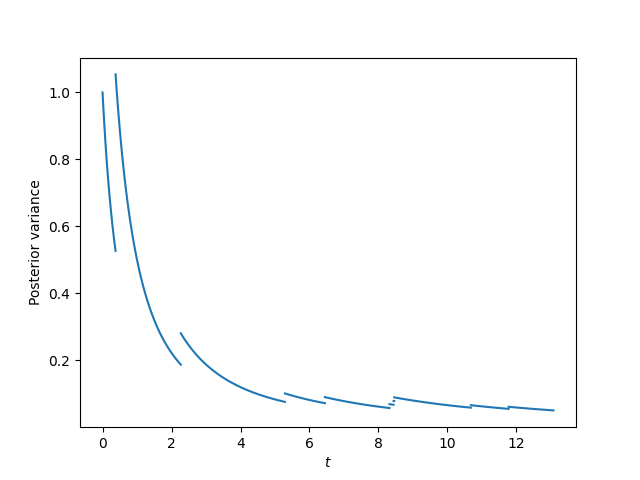
Note the posterior variance is an increasing function of k and a decreasing function of t. This means that the posterior variance increases every time an event is observed, and it decreases quadratically between observations.
Here’s an illustration. I simulated data from a Poisson process with λ and used a gamma(1, 1) prior on λ. Here’s a plot of the posterior variance.