The Navigational Triangle

The previous post introduced the idea of finding your location by sighting a star. There is some point on Earth that is directly underneath the star at any point in time, and that location is called the star’s GP (geographic position). That is one vertex of the navigational triangle. The other two vertices are your position and the North Pole.

Unless you’re at Santa’s workshop and observing a star nearly directly overhead, the navigational triangle is a big triangle, so big that you need to use spherical geometry rather than plane geometry. We will assume the Earth is a sphere [1].

Let a be the side running from your position to the GP. In the terminology of the previous post a is the radius of the line of position (LOP).

Let b be the side running from the GP to the North Pole. This is the GP’s lo-latitude, the complement of latitude.

Let c be the side running from your location to the North Pole. This is your co-latitude.

Let AB, and C be the angles opposite ab, and c respectively. The angle A is known as the local hour angle (LHA) because it is proportional to the time difference between noon at your location and noon at the GP.

Given three items from the set {abcABC} you can solve for the other three [2]. Note that one possibility is knowing the three angles. This is where spherical geometry differs from plane geometry: you can’t have spherical triangles that are similar but not congruent because the triangle excess determines the area.

If you know the current time, you can look up the GP coordinates in a table. The complement of the GP’s latitude is the side b.

Also from the current time you can determine your longitude, and from that you can find the LHA (angle A).

As described in the previous post, the altitude of the star, along with its GP, determines the LOP. From the LOP you can determine the arc between you and the GP, i.e. side a. We haven’t said how you could determine a, only that you could.

If you know two sides (in our case a and b) and the angle opposite one of the sides (in our case A) you can solve for the rest.

Adding detail

This post is more detailed than the previous, but still talks about what can be calculated but now how. We’re adding detail as the series progresses.

To motivate future posts, note that just because something can in theory be computed from an equation, that doesn’t mean it’s best to use that equation. Maybe the equation is sensitive to measurement error, or is numerically unstable, or is hard to calculate by hand.

Since we’re talking about navigating by the stars rather than GPS, we’re implicitly assuming that you’re using pencil and paper because for some reason you can’t use GPS.

Related posts

[1] To first approximation, the Earth is a sphere. To second approximation, it’s an oblate spheroid. If you want to get into even more detail, it’s not exactly an oblate spheroid. How much difference does all this make? See this post.

[2] In some cases there are two solutions for one of the missing elements and you’ll need to use additional information, such as your approximate location, to rule out one of the possibilities. More on when solutions are unique here.

Line of position (LOP)

The previous post touched on how Lewis and Clark recorded celestial observations so that the data could be turned into coordinates after they returned from their expedition. I intend to write a series of posts about celestial navigation, and this post will discuss one fundamental topic: line of position (LOP).

Pick a star that you can observe [1]. At any particular time, there is exactly one point on the Earth’s surface directly under the star, the point where a line between the center of the Earth and the star crosses the Earth’s surface. This point is called the geographical position (GP) of the star.

This GP can be predicted and tabulated. If you happen to be standing at the GP, and know what time it is, these tables will tell your position. Most likely you’re not going to be standing directly under the star, and so it will appear to you as having some deviation from vertical. The star would appear at the same angle from vertical for ring of observers. This ring is called the line of position (LOP).

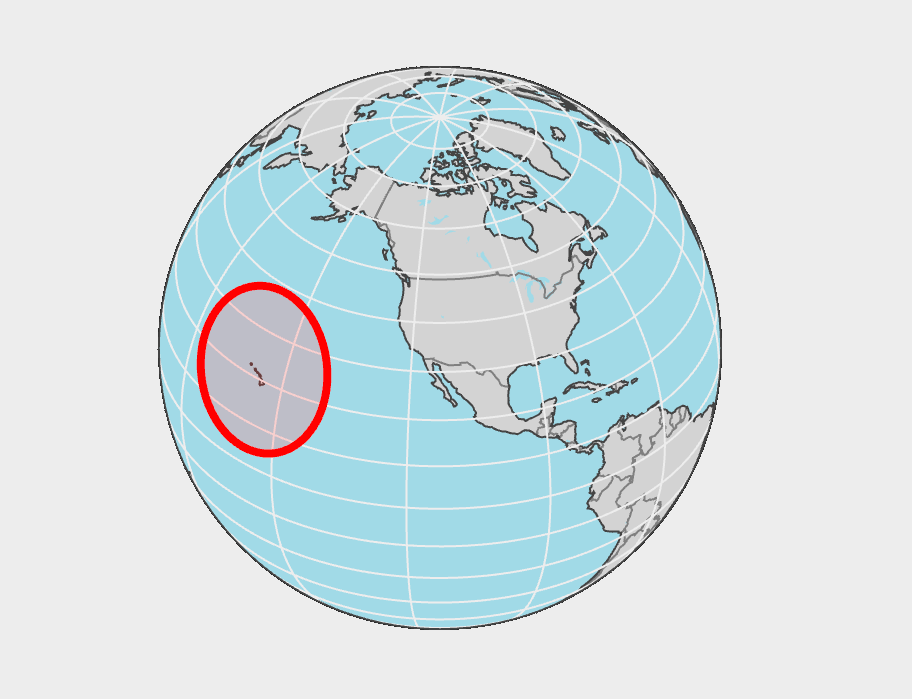
An LOP of radius 1200 miles centered at a GP at Honolulu

The LOP is a “small circle” in a technical sense. A great circle is the intersection of the Earth’s surface with a plane through the Earth’s center, like a line of longitude. A small circle is the intersection of the surface with a plane that does not pass through the center, like a line of latitude.

The LOP is a small circle only in contrast to a great circle. In fact, it’s typically quite large, so large that it matters that it’s not in the plane of the GP. You have to think of it as a slice through a globe, not a circle on a flat map, and therein lies some mathematical complication, a topic for future poss. The center of the LOP is the GP, and the radius of the LOP is an arc. This radius is measured along the Earth’s surface, not as the length of a tunnel.

One observation of a star reduces your set of possible locations to a circle. If you can observe two stars, or the same star at two different times, you know that you’re at the intersection of the two circles. These two circles will intersect in two points, but if you know roughly where you are, you can rule out one of these points and know you’re at the other one.


[1] At the time of the Lewis and Clark expedition, these were the stars of interest for navigation in the northern hemisphere: Antares, Altair, Regulus, Spica, Pollux, Aldeberan, Formalhaut, Alphe, Arieties, and Alpo Pegas. Source: Undaunted Courage, Chapter 9.

Lewis & Clark geolocation

I read Undaunted Courage, Stephen Ambrose’s account of the Lewis and Clark expedition,  several years ago [1], and now I’m listening to it as an audio book. The first time I read the book I glossed over the accounts of the expedition’s celestial observations. Now I’m more curious about the details.

The most common way to determine one’s location from sextant measurements is Hilare’s method [2], developed in 1875. But the Lewis and Clark expedition took place between 1804 and 1806. So how did the expedition calculate geolocation from their astronomical measurements? In short, they didn’t. They collected data for others to turn into coordinates later. Ambrose explains

With the sextant, every few minutes he would measure the angular distance between the moon and the target star. The figures obtained could be compared with tables show how those distances appeared at the same clock time in Greenwich. Those tables were too heavy to carry on the expedition, and the work was too time-consuming. Since Lewis’s job was to make the observations and bring them home, he did not try to do the calculations; he and Clark just gathered the figures.

The question remains how someone back in civilization would have calculated coordinates from the observations when the expedition returned. This article by Robert N. Bergantino addresses this question in detail.

Calculating latitude from measurements of the sun was relatively simple. Longitude was more difficult to obtain, especially without an accurate way to measure time. The expedition had a chronometer, the most expensive piece of equipment on the expedition that was accurate enough to determine the relative time between observations, but not accurate enough to determine Greenwich time. A more accurate chronometer would have been too expensive and too fragile to carry on the voyage.

For more on calculating longitude, see Dava Sobel’s book Longitude.

Related posts

[1] At least 17 years ago. I don’t keep a log of what I read, but I mentioned Undaunted Courage in a blog post from 2008.

[2] More formally known as Marcq Saint-Hilaire’s intercept method.

Tracking and the Euler rotation theorem

Suppose you are in an air traffic control tower observing a plane moving in a straight line and you want to rotate your frame of reference to align with the plane. In the new frame the plane is moving along a coordinate axis with no component of motion in the other directions.

You could do this in two steps. First, imagine the line formed by projecting the plane’s flight path onto the ground, as if the sun were directly overhead and you were watching the shadow of the plane move. The angle that this line makes with due north is the plane’s heading. You turn your head so that you’re looking horizontally along the projection of the plane’s path. Next, you look up so that you’re looking at the plane. The angle you lift your head is the elevation angle.

You’ve transformed your frame of reference by composing two rotations. Turning your head is a rotation about the vertical z-axis. Lifting your head is a rotation about the y-axis, if you label the plane’s heading the x-axis.

By Euler’s rotation theorem, the composition of two rotations can be expressed as a single rotation about an axis known as the Euler axis, often denoted e. How could you find the Euler axis and the angle of rotation about this axis that describes your change of coordinates?

You can find this calculation worked out in [1]. If the heading angle is α and the elevation angle is β then the Euler axis is

\mathbf{e} = \left( -\sin\frac{\alpha}{2} \sin \frac{\beta}{2},\,\, \cos \frac{\alpha}{2} \sin \frac{\beta}{2},\,\, \sin\frac{\alpha}{2} \cos\frac{\beta}{2} \right)

and the angle ϕ of rotation about e is given by

\phi = \arccos\left(\frac{\cos\alpha\cos\beta + \cos\alpha + \cos\beta - 1}{2}\right)

Related posts

[1] Jack B. Kuipers. Quaternions and Rotation Sequences. Princeton University Press. If I remember correctly, earlier editions of this book had a fair number of errors, but I believe these have been corrected in the paperback edition from 2002.

Dutton’s Navigation and Piloting

This morning Eric Berger posted a clip from The Hunt for Red October as a meme, and that made me think about the movie.

I watched Red October this evening, for the first time since around the time it came out in 1990, and was surprised by a detail in one of the scenes. I recognized one of the books: Dutton’s Navigation and Piloting.

Screen shot with Dutton's Navigation and Piloting

I have a copy of that book, the 14th edition. The spine looks exactly the same. The first printing was in 1985, and I have the second printing from 1989. So it is probably the same edition and maybe even the same printing as in the movie. I bought the book last year because it was recommended for something I was working on. Apparently it’s quite a classic since someone thought that adding a copy in the background would help make a realistic set for a submarine.

My copy has a gold sticker inside, indicating that the book came from Fred L. Woods Nautical Supplies, though I bought my copy used from Alibris.

Here’s a clip from the movie featuring Dutton’s.

Dutton’s has a long history. From the preface:

Since the first edition of Navigation and Nautical Astronomy (as it was then titled) was written by Commander Benjamin Dutton, U. S. Navy, and published in 1926, this book has been updated and revised. The title was changed after his death to more accurately reflect its focus …

The 14th edition contains a mixture of classical and electronic navigation, navigating by stars and by satellites. It does not mention GPS; that is included in the latest edition, the 15th edition published in 2003.

Related posts