
Kepler’s third law
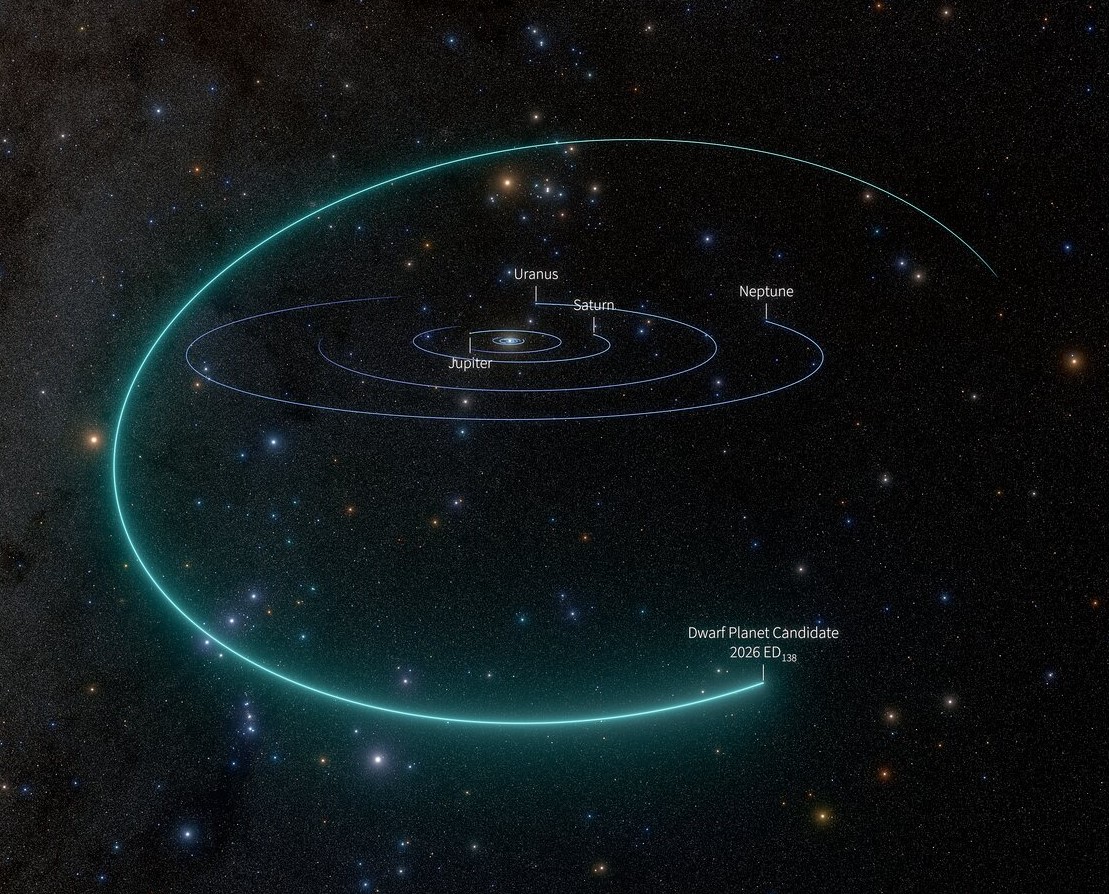
A recent article from Smithsonian magazine says a new dwarf planet candidate is 46 times further from the sun as earth is, and it takes 281.1 years to orbit the sun.
I did a back-of-the-envelope calculation and thought something was wrong. Kepler’s third law says
T² = c a³.
Here T is the orbital period and a is the semimajor axis. If T is measured in years and a is measured in astronomical units (AU) then the proportionality constant c equals 1.
If T = 281.1 years, then a = 42.91 AU, not 46 AU.
Eccentricity
The difference between 46 AU and 42.91 AU is only a contradiction if we assume the dwarf planet is in a circular orbit. The semimajor axis a is the the maximum distance to the center of the orbit, not the distance to the sun. In an elliptical orbit, the focus of the ellipse where the sun sits is not at the center. The orbit is eccentric, meaning off-center.
Assume the dwarf planet candidate ED138 is in an orbit with semimajor axis 42.91 AU. What does the article mean when it says ED138 is “46 times farther from the sun than Earth is”? Does is mean that it is currently 46 AU from the sun, or that its maximum distance from the sun at aphelion is 46 AU? Presumably the latter.
If the distance to the dwarf at aphelion is 46 AU and the semimajor axis is 42.91 AU, then the distance between the sun and the center of the dwarf’s elliptical orbit is c = 3.09 AU. The eccentricity is then
e = c/a = 3.09/46 = 0.067
making the orbit more eccentric than that of Saturn but less than that of Mars. This would make the semiminor axis, the minimum distance to the center of the orbit,
b = a √(1 – e²) = 45.9.
The orbit isn’t far from circular, but far enough to account for the substantial difference between the distance to the sun and the distance to the center of the ellipse.
This touches on something that has come up before, and that is eccentricity doesn’t affect the shape of an orbit so much as the position of the sun in that orbit. The orbit of ED138 isn’t far from being circular, but the sun is significantly off-center in that orbit.
Related posts
- Planetary orbits are very nearly circular
- Mean distance to the sun
- Max and min orbital speed
- GPS satellite orbits
- Monoliths and Lagrange points
Image credit: NSF-DOE Vera C. Rubin Observatory / NOIRLab / SLAC /AURA / R. Proctor