
Poverty versus squalor

In his interview on EconTalk, Paul Graham made a distinction between poverty and squalor. He says that most poor people live like rich people, but with cheap imitations. A rich person might have something made of gold and a poor person might have the same thing except made of plastic. But the creative poor, such as the proverbial starving artist, live differently. They live in poverty but not in squalor. They achieve a pleasant lifestyle by not trying to imitate the rich.

For example, the wealthy have large beautiful houses. The poor have small and usually not-so-beautiful houses. The rich have new expensive cars and the poor have old cheap cars. But the starving artist might not have a house or a car. He or she might live in a converted warehouse with a few nice furnishings and ride a bicycle.

The point of his discussion of poverty was to make an analogy for small software companies. It makes no sense for a tiny start-up to try to be a scaled-down version of Microsoft. They need to have an entirely different strategy. They can be poor without living in squalor.

I don’t know what I think of Graham’s assertion that the poor live cheap imitations of the lifestyles of the rich. There’s probably some truth to it, though I’m not sure how much. And I’m not sure how much truth there is in the romantic image of the bohemian starving artist. But I agree that it makes no sense for a small company to be a miniature version of a huge corporation.
Related posts

Subtle variations on familiar themes

I was skimming through George Leonard’s little book Mastery the other night and ran across this quote:

… the essence of boredom is to be found in the obsessive search for novelty. Satisfaction lies in … the discovery of endless riches and subtle variations on familiar themes.

This is a theme I’ve written about several times before. For example, see the post Six quotes on digging deep. I often think about one of the quotes in that post. Richard Feynman said that

… nearly everything is really interesting if you go into it deeply enough …

In the post God is in the details I talk about how that applies to statistics. Rote application of statistics is mind-numbingly dull, but statistics can be quite interesting when you dig down to the foundations.

When I was in new faculty orientation years ago I remember a chemistry professor exhorting us to volunteer to teach freshman courses. Most people want to teach the more advanced courses, but he said that some of his best inspiration came from teaching the most foundational courses.

Focusing on basics is hard work and few people want to do it. George Leonard describes this as America’s “anti-mastery” culture. Seth Godin uses the image of a starving woodpecker in his book The Dip.

A woodpecker can tap twenty times on a thousand trees and get nowhere, but stay busy. Or he can tap twenty thousand times on one tree and get dinner.

Sometimes I feel like the woodpecker tapping on a thousand trees, staying busy but getting nowhere. But then I also think about a line from W. C. Fields:

If at first you don’t succeed, try, try again. Then quit. No use being a damn fool about it.

Related posts

How Michelangelo worked

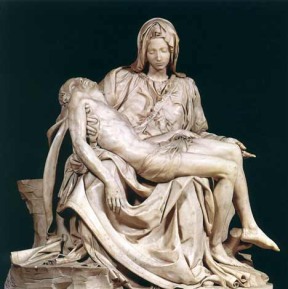
Michelangelo's Pieta</ins>

The following quote from Irving Stone describes how Michelangelo worked on his Pietà.

He carved in a fury from first light to dark, then threw himself across his bed, without supper and fully clothed, like a dead man. He awoke around midnight, refreshed, his mind seething with sculptural ideas, craving to get at the marble.

Create offline, analyze online

Sitting at a computer changes the way you think. You need to know when to walk away from the computer and when to come back.

I think mind mapping software is a bad idea. Mind maps are supposed to capture free associations. But the very act of sitting down at a computer puts you in an analytical frame of mind. In other words, mind mapping is a right-brain activity, but sitting at a computer encourages left-brain thinking. Mind mapping software might be a good way to digitize a map after you’ve created it on paper, but I don’t think it’s a good way to create a map.

When I need to sort out projects and priorities, I do it on paper. After that I may type up the results. I like to capture ideas on paper or on my voice recorder but then store them online.

When I do math, I scribble on paper, then type up my results in LaTeX. Scribbling helps me generate ideas; LaTeX helps me find errors. I’ve found that fairly short cycles of scribbling and typing work best for me, a few cycles a day.

In the past, we did a lot of things on paper because we had no choice. Today we do a lot of things on computers today just because we can. It’s going to take a while to sift through the new options and decide which ones are worthwhile and which are not.

Recommended books

Daniel Pink’s book A Whole New Mind has a good discussion of left-brain versus right-brain thinking. As he points out, the specialization between the left and right hemispheres of the brain is more complicated than once thought. However, the terms “left-brain” and “right-brain” are still useful metaphors even if they’re not precise neuroscience.

Also, to read more on how computers influence our thinking, see Andy Hunt’s book Pragmatic Thinking and Learning.

Related posts

Simplicity in old age

Quote from Julian Barnes:

There is something infinitely touching when an artist, in old age, takes on simplicity. The artist is saying: display and bravura are tricks for the young, and yes, showing off is part of ambition; but now that we are old, let us have the confidence to speak simply.

HT: Signal vs. Noise

More on simplicity

Don’t standardize education, personalize it

I just finished reading Ken Robinson’s book The Element. The title comes from the idiom of someone being in his or her “element.” The book is filled with stories of people who have discovered and followed their passions.

Here are a couple quotes from the book regarding standardized education.

The fact is that given the challenges we face, education doesn’t need to be reformed — it needs to be transformed. The key to this transformation is not to standardize education but to personalize it, to build achievement on discovering the individual talents of each child, to put students in an environment where they want to learn and where they can naturally discover their true passions.

Learning happens in the minds and souls of individuals — not in the databases of multiple-choice tests. I doubt there are many children who leap out of bed in the morning wondering what they can do to raise the reading score for their state. Learning is a personal process …

Here is a talk (link died) Ken Robinson gave at TED in 2006 that led to his writing The Element. The video is entertaining as well as thought-provoking.

Related posts:

The Medici Effect

I was reading a chapter from The Element this evening that reminded me of The Medici Effect.

ACM Ubiquity had an interview with Frans Johansson, author of The Medici Effect, around the time the book came out. The title comes from the idea that it takes more than just genius to create a Leonardo da Vinci. It also takes the community of a Renaissance Florence, made possible by patrons like the Medici family.

I thought it was a great premise for a book and bought the book shortly after reading the interview. Unfortunately, the book didn’t live up to my expectations. I recommend the interview, but I’m not as enthusiastic in my recommendation of the book.

Related post: Don’t standardize education, personalize it

Searching for John Francis

There was an odd story in NA Digest a couple days ago, John Francis of QR found. When I saw that someone was found, I assumed he had lost as in lost at sea, like Jim Gray. But that wasn’t the case.

John Francis developed the QR algorithm, an algorithm for finding the eigenvalues and eigenvectors of a matrix. Some experts regard the QR algorithm as one of the 10 most important numerical algorithms of the 20th century. He developed the algorithm in 1959 but then left the numerical analysis community three years later. The NA Digest article doesn’t say whether Francis became a recluse or simply moved on to a job outside mathematics. No one in numerical analysis knew anything about him until a couple folks tracked him down recently. He is doing well. He remembers his earlier work clearly but was unaware of the impact it had had.

Related post: Simple legacy (how people often underestimate the importance of their most useful work)

When discoveries stay discovered

In what sense did Christopher Columbus discover America? Obviously he wasn’t the first human to step foot on the New World. Columbus wasn’t even the first European. Norwegian explorer Leif Erikson seems to have arrived 500 years before Columbus. But as Stephen Mills famously stated,

There have been other people before Columbus, but when Columbus discovered the New World, it stayed discovered.

The same principle could be used to resolve debates about priorities in mathematical discoveries.There is some debate over whether John Tukey or Carl Gauss discovered the Fast Fourier Transform (FFT). But there is no doubt that after Tukey discovered it, the FFT stayed discovered. The algorithm is now used in digital signal processing applications everywhere.

Gauss and Tukey were both brilliant mathematicians. Tukey, however, also had an aptitude for creating memorable names. For example, you may have heard of “software,” a term he coined.

More creativity posts

Redbelt problem solving

In the movie Redbelt, Chiwetel Ejiofor plays Mike Terry, a Jiu Jitsu instructor who will fight but will not compete. He will fight in a real fight if necessary, but he won’t fight in a ring because competitions have arbitrary rules. He is a skilled fighter because he is creative, and competitions take away that creativity. At one point in the movie, someone Terry if he teaches people to win. He says no, he teaches people to prevail. In his mind, you can’t “win” a fight. A fight is a problem to be solved.

Mike Terry’s distinction between fights and contests makes me think of the distinction between practical and academic problem solving. Practical problem solving does not have arbitrary constraints whereas academic problems often do: you can use this technique but not that one, you can use this reference but not that one, etc. These academic limitations serve a purpose in their context, but sometimes we can imagine these constraints are still on us after we leave the classroom.

Sometimes we’ll struggle mightily to solve a problem analytically that could be easily be solved numerically (or vice versa). Or we’ll imagine that a problem must be solved using a particular programming language even though it could be done more easily using a different language. It feels like “cheating” to go for the easier solution. But if you’re not in an academic setting, you can’t “cheat.” (Of course I’m not talking about violating ethical standards to solve a problem, only dismissing artificial restrictions. Where there is no law, there is no sin.)

There may be good reasons for pursuing the more difficult solution, such as entertainment value. But often we do things the hard way for no good reason other than not having examined our self-imposed limitations. Maybe we’re trying to win rather than solve the problem.

Related post: Try the simplest thing that could possibly work