ICD-10 chapters and code letters

I’ve been thinking about ICD-10 codes; they come up a lot in my work.

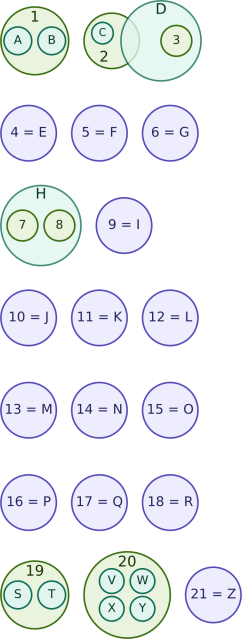
The ICD-10-CM standard is divided into 21 chapters, which generally correspond to the first letter of a code. However, a chapter may contain blocks beginning with more than one letter, and codes starting with a single letter, namely D, can span two chapters.

Here’s a diagram I made to visualize the relationship between chapters and initial letters of codes.

Notice there’s no letter U on the diagram. That’s because U is reserved for special/provisional codes.

Related posts

National Provider Identifier (NPI) and its checksum

Healthcare providers in the United States are required to have an ID number known as the NPI (National Provider Identifier). This is a 10-digit unique identifier which serves as the primary key in a publicly available database. You can use the NPI number to look up a provider’s name, credentials, their practice location, etc. The use of NPI numbers was required by HIPAA.

The specification for the NPI number format says that the first digit must be either 1 or 2. Currently every NPI in the database starts with 1. There are about 8.4 million NPIs currently, so it’ll be a while before they’ll need to roll the first digit over to 2.

The last digit of the NPI is a check sum. The check sum uses the Luhn algorithm, the same check sum used for credit cards and other kinds of identifiers. The Luhn algorithm was developed in 1954 and was designed to be easy to implement by hand. It’s kind of a quirky algorithm, but it will catch all single-digit errors and nearly all transposition errors.

The Luhn algorithm is not applied to the NPI itself but by first prepending 80840 to the (first nine digits of) the NPI.

For example, let’s look at 1993999998. This is not (currently) anyone’s NPI, but it has a valid NPI format because the Luhn checksum of 80840199399999 is 8. We will verify this with the code below.

Python code for Luhn checksum

The following code computes the Luhn checksum.

    def checksum(payload):
        digits = [int(c) for c in reversed(str(payload))]
        s = 0
        for i, d in enumerate(digits):
            if i % 2 == 0:
                t = 2*d
                if t > 9:
                    t -= 9
                s += t
            else:
                s += d
        return (s*9) % 10

And the following checks whether the last digit of a number is the checksum of the previous digits.

    def verify(fullnumber):
        payload = fullnumber // 10
        return checksum(payload) == fullnumber % 10

And finally, the following validates an NPI number.

    def verify_npi(npi):
        return verify(int("80840" + str(npi)))

Here we apply the code above to the hypothetical NPI number mentioned above.

    assert(checksum(80840199399999) == 8)
    assert(verify(808401993999998))
    assert(verify_npi(1993999998))

Related posts

Regex to match ICD-11 code

ICD codes are diagnostic codes created by the WHO. (Three TLAs in just the opening paragraph!)

The latest version, ICD-11, went into effect in January of this year. A few countries are using ICD-11 now; it’s expected to be at least a couple years before the US moves from ICD-10 to ICD-11. (I still see ICD-9 data even though ICD-10 came out in 1994.)

One way that ICD-11 codes differ from ICD-10 codes is that the new codes do not use the letters I or O in order to prevent possible confusion with the digits 1 and 0. In the code below, “alphabetic” and “alphanumeric” implicitly exclude the letters I and O.

Another way the codes differ is the that the second character in an ICD-10 is a digit whereas the second character in an ICD-11 code is a letter.

What follows is a heavily-commented regular expression for matching ICD-11 codes, along with a few tests to show that the regex matches things it should and does not match things it should not.

Of course you could verify an ICD-11 code by searching against an exhaustive list of such codes, but the following is much simpler and may match some false positives. However, it is future-proof against false negatives: ICD-11 codes added in the future will conform to the pattern in the regular expression.

import re

icd11_re = re.compile(r"""
    ^                  # beginning of string
    [A-HJ-NP-Z0-9]     # alphanumeric
    [A-HJ-NP-Z]        # alphabetic
    [0-9]              # digit
    [A-HJ-NP-Z0-9]     # alphanumeric
    ((\.               # optional starting with .
    [A-HJ-NP-Z0-9])    # alphanumeric
    [A-HJ-NP-Z0-9]?)?  # optional further refinement
    $                  # end of string
    """, re.VERBOSE)

good = [
    "ND52",   # fracture of arm, level unspecified
    "9D00.3", # presbyopia
    "8B60.Y", # other specified increased intercranial pressure
    "DB98.7Z" # portal hypertension, unspecified
]

bad = [
    "ABCD",    # third character must be digit
    "AB3D.",   # dot must be followed by alphanumeric
    "9D0O.3",  # letter 'O' should be number 0
    "DB9872",  # missing dot
    "AB3",     # too short
    "DB90.123" # too long
]

for g in good:
    assert(icd11_re.match(g))
for b in bad:
    assert(icd11_re.match(b) == None)

Related posts

HCPCS (“hick pics”) codes


HCPCS stands for Healthcare Common Procedure Coding System. HCPCS codes are commonly pronounced like “hick pics.”

Searching for medical codes

I occasionally need to search for medical codes—ICD-9 codes, ICD-10 codes, SNOMED codes, etc.—including HCPCS codes. Here’s some data that is supposed to contain a certain kind of code; does it? Or, more importantly, this text is supposed to have been scrubbed of medical codes; was it?

The most accurate way to search for HCPCS codes would be to have a complete list of codes and search for each one. There are a couple reasons why this isn’t so useful. First of all, I’m doing a quick scan, not writing data validation software. So a quick-and-dirty regular expression is fine. In fact, it’s better: I may be more interested in finding things that look like HCPCS codes than actual HCPCS codes. The former would include some typos or codes that were added after my script was written.

Copyright

Another advantage of using a regular expression that approximates HCPCS codes is that HCPCS codes are copyrighted. I don’t know whether a script using a list of HCPCS codes would be fair use, but it doesn’t matter if I’m using a regular expression.

According to Wikipedia, “CPT is a registered trademark of the American Medical Association, and its largest single source of income.” CPT is part of HCPCS, namely Level I. It is controversial that CPT codes are a commercial product whose use is required by law.

Code patterns

There are three levels of HCPCS codes. Level I is synonymous with CPT and consists of five-digit numbers. It’s easy to search for five-digit numbers, say with the regular expression \d{5}, but of course many five-digit numbers are not medical codes. But if text that has supposedly been stripped of medical codes (and zip codes) has a lot of five-digit numbers, it could be something to look into.

Level II and Level III codes are five-character codes consisting of four digits and either an F or a T. So you might search on \d{4}[FT]. While a five-digit number is likely to be a false positive when searching for HCPCS codes, four-digits following by an F or T is more likely to be a hit.

Related posts

New ICD-10 diagnosis code weirdness

In October 2020 there were 619 new codes added to the list of ICD-10 diagnosis codes. Some of these make sense, such as four codes added for COVID:

  • U07.1 COVID-19
  • Z11.52 Encounter for screening for COVID-19
  • Z20.822 Contact with and (suspected) exposure to COVID-19
  • Z86.16 Personal history of COVID-19

There are also 24 new codes related to fentanyl. I could see that.

But as I’ve written before some ICD-10 codes are bizarrely specific.

There are only so many ICD-10 codes, around 55,000 at the moment, and so all these hyper-specific codes mean there are fewer codes to devote to refining more common diagnoses.

In the new codes, 4 are related to COVID-19 and 170 are related to pedestrian injuries while standing on an electric scooter or other “micro-mobility pedestrian conveyance.” There are 170 shades of “I hurt myself on a scooter.”

Thanks to the new codes, medical practices can now distinguish, for example, between “Pedestrian on standing electric scooter injured in collision with pedal cycle in nontraffic accident” (V01.031) and “Pedestrian on other standing micro-mobility pedestrian conveyance injured in collision with pedal cycle in nontraffic accident” (V01.038).

Of all the codes introduced in 2020, 27% describe variations on a scooter injury.

More diagnosis code posts

National Drug Code (NDC)

The US Food and Drug Administration tracks drugs using an identifier called the NDC or National Drug Code. It is described as a 10-digit code, but it may be more helpful to think of it as a 12-character code.

An NDC contains 10 digits, separated into three segments by two dashes. The three segments are the labeler code, product code, and package code. The FDA assigns the labeler codes to companies, and each company assigns its own product and package codes.

Format

The segments are of variable length and so the dashes are significant. The labeler code could be 4 or 5 digits. The product code could be 3 or 4 digits, and the package code could be 1 or 2 digits. The total number of digits is must be 10, so there are three possible combinations:

  • 4-4-2
  • 5-3-2
  • 5-4-1.

There’s no way to look at just the digits and know how to separate them into three segments. My previous post looked at self-punctuating codes. The digits of NDC codes are not self-punctuating because they require the dashes. The digit combinations are supposed to be unique, but you can’t tell how to parse a set of digits from the digits alone.

Statistics

I downloaded the NDC data from the FDA to verify whether the codes work as documented, and to see the relative frequency of various formats.

(The data change daily, so you may get different results if you do try this yourself.)

Format

All the codes were 12 characters long, and all had the documented format as verified by the regular expression [1]

    \d{4,5}-\d{3,4}-\d{1,2}

Uniqueness exception

I found one exception to the rule that the sequence of digits should be unique. The command

    sed "s/-//g" ndc.txt | sort | uniq -d

returned 2950090777.

The set of NDC codes contained both 29500-907-77 and 29500-9077-7.

Distribution

About 60% of the codes had the form 5-3-2. About 30% had the form 5-4-1, and the remaining 10% had the form 4-4-2.

There were a total of 252,355 NDC codes with 6,532 different lablelers (companies).

There were 9448 NDC codes associated with the most prolific labeler. The 1,424 least prolific labelers had only one DNC code. In Pareto-like fashion, the top 20% of labelers accounted for about 90% of the codes.

Related posts

[1] Programming languages like Python or Perl will recognize this regular expression, but by default grep does not support \d for digits. The Gnu implementation of grep with the -P option will. It will also understand notation like {4,5} to mean a pattern is repeated 4 or 5 times, with or without -P, but I don’t think other implementations of grep necessarily will.

Regular expression for ICD-9 and ICD-10 codes

Suppose you’re searching for medical diagnosis codes in the middle of free text. One way to go about this would be to search for each of the roughly 14,000 ICD-9 codes and each of the roughly 70,000 ICD-10 codes. A simpler approach would be to use regular expressions, though that may not be as precise.

In practice regular expressions may have some false positives or false negatives. The expressions given here have only false positives. That is, no valid ICD-9 or ICD-10 codes will go unmatched, but the regular expressions may match things that are not diagnosis codes. The latter is inevitable anyway since a string of characters could coincide with a diagnosis code but not be used as a diagnosis code. For example 1234 is a valid ICD-9 code, but 1234 in a document could refer to other things, such as a street address.

ICD-9 diagnosis code format

Most ICD-9 diagnosis codes are just numbers, but they may also start with E or V.

Numeric ICD-9 codes are at least three digits. Optionally there may be a decimal followed by one of two more digits.

An E code begins with E and three digits. These may be followed by a decimal and one more digit.

A V code begins with a V followed by two digits. These may be followed by a decimal and one or two more digits.

Sometimes the decimals are left out.

Here are regular expressions that summarize the discussion above.

    N = "\d{3}\.?\d{0,2}"
    E = "E\d{3}\.?\d?"
    V = "V\d{2}\.?\d{0,2}"
    icd9_regex = "|".join([N, E, V])

Usually E and V are capitalized, but they don’t have to be, so it would be best to do a case-insensitive match.

ICD-10 diagnosis code format

ICD-10 diagnosis codes always begin with a letter (except U) followed by a digit. The third character is usually a digit, but could be an A or B [1]. After the first three characters, there may be a decimal point, and up to three more alphanumeric characters. These alphanumeric characters are never U. Sometimes the decimal is left out.

So the following regular expression would match any ICD-10 diagnosis code.

    [A-TV-Z][0-9][0-9AB]\.?[0-9A-TV-Z]{0,4}

As with ICD-9 codes, the letters are usually capitalized, but not always, so it’s best to do a case-insensitive search. In addition to the pattern above, “special codes” may begin with U.

Testing the regular expressions

As mentioned at the beginning, the regular expressions here may have false positives. However, they don’t let any valid codes slip by. I downloaded lists of ICD-9 and ICD-10 codes from the CDC and tested to make sure the regular expressions here matched every code.

Regular expression features used

Character ranges are supported everywhere, such as [A-TV-Z] for the letters A through T and V through Z.

Not every regular expression implementation supports \d to represent a digit. In Emacs, for example, you would have to use[0-9] instead since it doesn’t support \d.

I’ve used \.? for an optional decimal point. (The . is a special character in regular expressions, so it needs to be escaped to represent a literal period.) Some people wold write [.]? instead on the grounds that it may be more readable. (Periods are not special characters in the context of a character classes.)

I’ve used {m} for a pattern that is repeated exactly m times, and {m,n} for a pattern that is repeated between m and n times. This is supported in Perl and Python, for example, but not everywhere. You could write \d\d\d instead of \d{3} and \d?\d? instead of \d{0,2}.

Related posts

[1] The only ICD-10 codes with a non-digit in the third position are those beginning with C4A, C7A, C7B, D3A, M1A, O9A, and Z3A.

Rare and strange ICD-10 codes

ICD-10 is a set of around 70,000 diagnosis codes. ICD stands for International Statistical Classification of Diseases and Related Health Problems. The verbosity of the name is foreshadowing.

Some of the ICD-10 codes are awfully specific, and bizarre.

For example,

  • V95.4: Unspecified spacecraft accident injuring occupant
  • V97.33XA: Sucked into jet engine, initial encounter
  • V97.33XD: Sucked into jet engine, subsequent encounter

As I understand it, V97.33XD refers to a subsequent encounter with a health care professional, not a subsequent encounter with a jet engine. But you have to wonder how many people who have been sucked into a jet engine survive to have one, much less two, medical visits.

There is a specific code, Y92.146, for injuries in a prison swimming pool. It seems strange to combine a medical diagnosis and its location into a single code. Is a swimming injury in a prison pool medically different than a swimming injury in a YMCA pool?

I understand that the circumstance of a diagnosis is not recorded strictly for medical reasons. But while 70,000 is an unwieldy large set of codes, it’s kinda small when it has to account for both malady and circumstance. Surely there are 70,000 circumstances alone that are more common than being in a spacecraft, for instance.

Is there a code for being at the opera? Why yes there is: Y92.253. However, there are no codes that are unique to being at a Costco, Walmart, or Jiffy Lube.

Update: Here’s one I ran across recently. X96.2XXA: Assault by letter bomb, initial encounter.

Related posts