
From Ike Pigott:
Build a better mousetrap, and cats will beat a path to your door to picket.
Related post: It takes more than a better mousetrap
From Ike Pigott:
Build a better mousetrap, and cats will beat a path to your door to picket.
Related post: It takes more than a better mousetrap
My previous post began with a story about a performance by John Coltrane. Douglas Groothuis left a comment saying that he used the same story in his book Truth Decay. Before telling the Coltrane story, Groothuis compares the philosophies of Kenny G and John Coltrane.
Kenny G’s philosophy is as shallow as his music.
I just play for myself, the way I want to play, and it comes out sounding like me.
Coltrane’s philosophy, like his music, is more ambitious.
Overall, I think the main thing a musician would like to do is give a picture to the listener of the many wonderful things he knows and senses in the universe. That’s what music is to me — it’s just another way of saying this is a big, wonderful universe we live in, that’s been given to us, and here’s an example of just how magnificent and encompassing it is. That’s what I would like to do. I think that’s one of the greatest things you can do in life, and we all try to do it in some way. The musician’s is through his music.
As Groothuis comments, Kenny G only spoke of expressing himself, while Coltrane “expressed a yearning to represent objective realities musically.”
My post Why programmers are not paid in proportion to their productivity has been getting a lot of buzz today. One of the arguments in that post is that the most productive programmers know where they can find software to do parts of their job. When they reuse existing code rather than writing their own from scratch, nobody notices. They probably don’t even notice themselves, at least not often.
The work you don’t do is a sort of negative space, like the shape formed by the empty space in a painting or the silence in a piece of music. It’s hard to appreciate what’s not there. It’s hard for a business to reward the unnecessary work that someone avoids doing.
Venkatesh Rao has a different take on what makes some people far more effective than others. In his post Thrust, Drag, and the 10x Effect, he says that the people who are 10x more productive are the those who allocate large, uninterrupted blocks of time to work on difficult creative tasks.
Rao’s observation would also help explain why super programmers do not earn super wages, and it ties into the idea of negative space. People who fracture their time putting out fires seem more productive, or at least more responsive, than the people who block out time to think. It’s harder to notice someone not being frantic. Thinkers don’t fare well in environments that reward activity more than accomplishment.
Related post:
Kurt Vonnegut’s short story Harrison Bergeron begins “The year was 2081, and everybody was finally equal.” Beautiful people are required to wear ugly masks, strong people are required to carry weights, etc. Every excellence is handicapped.
But how do you handicap intelligence? With interruptions. In Vonnegut’s story, those deemed too intelligent are required to wear a device in their ear that regularly interrupts their thoughts with a loud noise.
From Tristan Gylberd:
The smaller, the odder, the more out of the way, and the more specialized, the better. That is my philosophy on bookshops. Come to think of it, that is my philosophy on everything else too — it makes for a very interesting life unconstrained by the smothering expectations of the tyranny of fashion or popularity.
Related post: Small, local, old, and particular
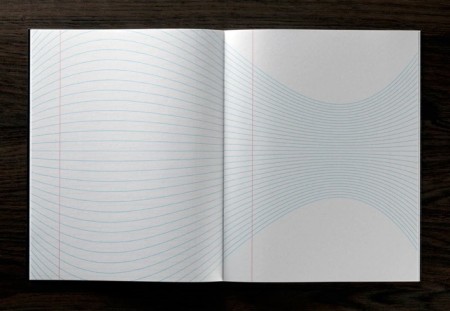
This notebook made me think of the quote from William Carlos Williams:
“If they give you lined paper, write the other way.”
Research In Motion (RIM) is best known for making the BlackBerry. In the early days of the company, RIM focused on reducing the BlackBerry’s power consumption. The engineers put up a sign:
Have you saved a milliwatt today?
This was a specific, reasonable challenge. Instead of some nebulous exhortation to corporate greatness, something worthy of a Dilbert cartoon, they asked engineers to reduce power consumption by a milliwatt.
What’s your equivalent of saving a milliwatt?
Related post: Don’t try to be God, try to be Shakespeare
Donald Knuth explains how he combines theory and practice:
This has always been the main credo of my professional life. I have always tried to develop theories that shed light on the practical things I do, and I’ve always tried to do a variety of practical things so that I have a better chance of discovering rich and interesting theories. It seems to me that my chosen field, computer science — information processing — is a field where theory and practice come together more than in any other discipline, because of the nature of computing machines. …
History teaches us that the greatest mathematicians of past centuries combined theory and practice in their own careers. …
The best theory is inspired by practice. The best practice is inspired by theory.
Taken from Selected Papers on Computer Science.
Related post:
The third-system effect describes a simple system rising like a phoenix out of the ashes of a system that collapsed under its own complexity.
A notorious ‘second-system effect’ often afflicts the successors of small experimental prototypes. The urge to add everything that was left out the first time around all too frequently leads to huge and overcomplicated design. Less well known, because less common, is the ‘third-system effect’: sometimes, after the second system has collapsed of its own weight, there is a chance to go back to simplicity and get it right.
From The Art of Unix Programming by Eric S. Raymond. Available online here.
Raymond says that Unix was such a third system. What are other examples of the third-system effect?
From Paul Graham:
When you’re forced to be simple, you’re forced to face the real problem. When you can’t deliver ornament, you have to deliver substance.