Post-quantum RSA with gargantuan keys

If and when practical scalable quantum computers become available, RSA encryption would be broken, at least for key sizes currently in use. A quantum computer could use Shor’s algorithm factor n-bit numbers in time on the order of n². The phrase “quantum leap” is misused and overused, but this would legitimately be a quantum leap.

That said, Shor’s method isn’t instantaneous, even on a hypothetical machine that does not yet exist and may never exist. Daniel Bernstein estimates that RSA encryption with terabyte public keys would be secure even in a post-quantum world.

Bernstein said on a recent podcast that he isn’t seriously suggesting using RSA with terabyte keys. Computing the necessary key size is an indirect way of illustrating how impractical post-quantum RSA would be.

Related posts

Silent Payments

Bitcoin transactions appear to be private because names are not attached to accounts. But that is not sufficient to ensure privacy; if it were, much of my work in data privacy would be unnecessary. It’s quite possible to identify people in data that does not contain any direct identifiers.

I hesitate to use the term pseudonymization because people define it multiple ways, but I’d say Bitcoin addresses provide pseudonymization but not necessarily deidentification.

Privacy and public ledgers are in tension. The Bitcoin ledger is superficially private because it does not contain user information, only addresses [1]. However, transaction details are publicly recorded on the blockchain.

To add some privacy to Bitcoin, addresses are typically used only once. Wallet software generates new addresses for each transaction, and so it’s not trivial to track all the money flowing between two people. But it’s not impossible either. Forensic tools make it possible to identify parties behind blockchain transactions via metadata and correlating information on the blockchain with information available off-chain.

Silent Payments

Suppose you want to take donations via Bitcoin. If you put a Bitcoin address on your site, that address has to be permanent, and it’s publicly associated with you. It would be trivial to identify (the addresses of) everyone who sends you a donation.

Silent payments provide a way to work around this problem. Alice could send donations to Bob repeatedly without it being obvious who either party is, and Bob would not have to change his site. To be clear, there would be no way to tell from the addresses that funds are moving between Alice and Bob. The metadata vulnerabilities remain.

Silent payments are not implemented in Bitcoin Core, but there are partial implementations out there. See BIP 352.

The silent payment proposal depends on ECDH (elliptic curve Diffie-Hellman) key exchange, so I’ll do a digression on ECDH before returning to silent payments per se.

ECDH

The first thing to know about elliptic curves, as far as cryptography is concerned, is that there is a way to add two points on an elliptic curve and obtain a third point. This turns the curve into an Abelian group.

You can bootstrap this addition to create a multiplication operation: given a point g on an elliptic curve and an integer nng means add g to itself n times. Multiplication can be implemented efficiently even when n is an enormous number. However, and this is key, multiplication cannot be undone efficiently. Given g and n, you can compute ng quickly, but it’s practically impossible to start with knowledge of ng and g and recover n. To put it another way, multiplication is efficient but division is practically impossible [2].

Suppose Alice and Bob both agree on an elliptic curve and a point g on the curve. This information can be public. ECDH lets Alice and Bob share a secret as follows. Alice generates a large random integer a, her private key, and computes a public key A = ag. Similarly, Bob generates a large random integer b and computes a public key Bbg. They’re shared secret is

aBbA.

Alice can compute aB because she (alone) knows a and B is public information. Similarly Bob can compute bA. The two points on the curve aB and bA are the same because

aBabgbagbA.

Back to silent payments

ECDH lets Alice and Bob share a secret, a point on a (very large) elliptic curve. This is the heart of silent payments.

In its simplest form, Alice can send Bob funds using the address

PB + hash(aBg.

A slightly more complicated form lets Alice send Bob funds multiple times. The kth time she sends money to Bob she uses the address

PB + hash(aB || kg

where || denotes concatenation.

But how do you know k? You have to search the blockchain to determine k, much like the way hierarchical wallets search the blockchain. Is the address corresponding to k = 0 on the blockchain? Then try again with k = 1. Keep doing this until you find the first unused k. Making this process more efficient is one of the things that is being worked on to fully implement silent payments.

Note that Bob needs to make B public, but B is not a Bitcoin address per se; it’s information needed to generate addresses via the process described above. Actual addresses are never reused.

Related posts

[1] Though if you obtain your Bitcoin through an exchange, KYC laws require them to save a lot of private information.

[2] Recovering n from ng is known as the discrete logarithm problem. It would be more logical to call it the discrete division problem, but if you write the group operation on an elliptic curve as multiplication rather than addition, then it’s a discrete logarithm, i.e. trying to solve for an unknown exponent. If and when a large-scale quantum computer exists, the discrete logarithm problem will be practical to solve, but presumably not until then.

Measuring cryptographic strength in liters of boiling water

I was listening to a podcast with Bill Buchanan recently in which he demonstrated the difficulty of various cryptographic tasks by the amount of energy they would use and how much water that would boil. Some tasks would require enough energy to boil a teaspoon of water, some a swimming pool, and some all the world’s oceans.

This is a fantastic way to compare the difficulty of various operations. There’s an old saying “you can’t boil the ocean,” and so it’s intuitively clear that encryption that you would need to boil an ocean to break is secure for all practical purposes [1]. Also, using energy rather than time removes the question of how much work is being done in parallel.

Buchanan credits Lenstra et al [2] with the idea of using units of boiling water.

The new approach was inspired by a remark made by the third author during his presentation of the factorization of the 768-bit RSA challenge at Crypto 2010: We estimate that the energy required for the factorization would have sufficed to bring two 20° C Olympic size swimming pools to a boil. This amount of energy was estimated as half a million kWh.

In the paper’s terminology, 745-bit RSA encryption and 65-bit symmetric key encryption both have “pool security” because the energy required to break them would boil an Olympic pool.

Security is typically measured in terms of symmetric encryption, so 65-bit security is “pool security.” Similarly, 114-bit security is “global security,” meaning that breaking it would require an amount of energy that could boil all the water on planet Earth, about 1.4 billion cubic kilometers of water.

World energy production is around 30,000 TWh per year, so one year of energy production could break 91-bit symmetric encryption or boil the water in Lake Geneva.

Because the difficulty in breaking symmetric encryption is an exponential function of the key length n, we can reverse engineer the formula the paper used to convert key lengths to water volumes, i.e. n bits of security requires the energy to boil

6.777 × 10⁻¹⁴ 2n

liters of water.

[1] If all the assumptions that go into your risk model are correct: the software is implemented correctly, there are no unforeseen algorithmic improvements, keys were generated randomly, etc.

[2] Arjen Lenstra, Thorsten Kleinjung, and Emannuel Thomé. Universal security: from bits to mips to pools, lakes, and beyond.


How quantum computing would affect Bitcoin

Bitcoin relies on two kinds of cryptography: digital signatures and hash functions. Quantum computing would be devastating to the former, but not the latter.

To be more specific, the kind of digital signatures used in Bitcoin could in theory be broken by quantum computer using Shor’s algorithm. Digital signatures could use quantum-resistant algorithms [1], but these algorithms are not used in Bitcoin (or much of anything else) at this time.

A quantum computer could use Grover’s algorithm to reduce the time required to reverse hash functions, but this is a much smaller threat. For this post, we will simply assume a quantum computer could break digital signatures but not hash functions.

Digital signatures rely on public key cryptography, but Bitcoin uses something you might call not-so-public key cryptography. Public keys are not necessarily made public. You can receive funds sent to a hash of your public key, but to spend funds you have to reveal your unhashed public key.

This asymmetry means that presumably you could receive funds and be safe from quantum computers as long as you never spend the funds. But once you spend the funds, your public key really is public, published on the blockchain, and a quantum computer could derive your private key from your public key. This is because digital signatures are verified when money is spent, not when it is received.

It is widely believed that practical quantum computing is at least several years away. Maybe large-scale quantum computing is decades away, and maybe it will never happen. Nobody knows. But if quantum computing becomes practical before the world shifts to quantum-resistant cryptography, it would be a catastrophe. It’s hard to appreciate how thoroughly public key cryptography is woven into contemporary life.

Could there be a quantum computer sitting in the basement of the NSA right now? I doubt the NSA could be a decade ahead of public quantum computing efforts, but this is just speculation. Classified cryptography research has historically been ahead of open research. For example, differential cryptanalysis was discovered long before it was made public. I expect the gap between classified and open research is smaller now that there is much more public research in cryptography, but presumably there is still some gap.

Related posts

[1] NIST recommends ML-DSA (Dilithium) and SLH-DSA (SPHINCS+) for post-quantum digital signature algorithms. See FIPS 204 and FIPS 205.

Misleading plots of elliptic curves

The elliptic curves used in cryptography are over finite fields. They’re not “curves” at all in the colloquial sense of the word. But they are defined by analogy with continuous curves, and so most discussions of elliptic curves in cryptography start by showing a plot of a real elliptic curve.

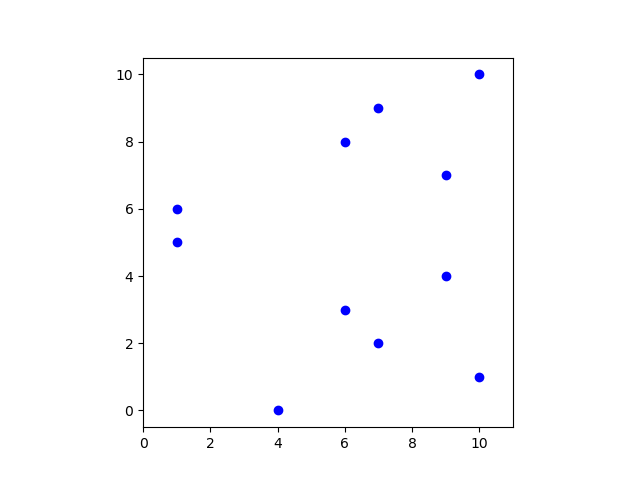
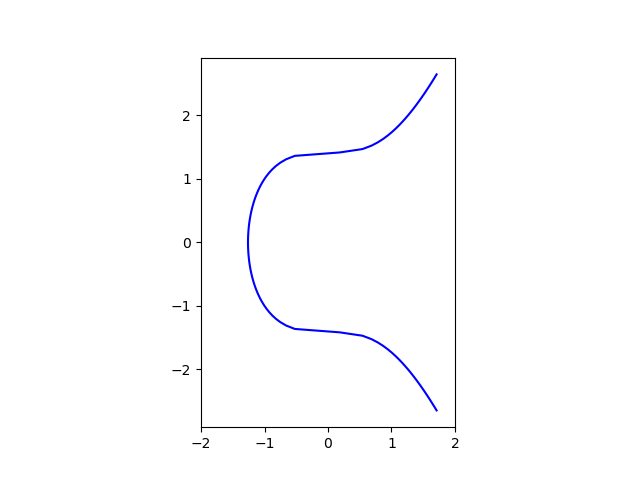
Here’s a plot of y² = x³ + 2 for real x and y.

That’s fine as far as it goes. Resources quickly go on to say that the curves they’ll be looking at are discrete, and so they may then add something like the following. Here’s the same elliptic curve as above over the integers mod 11.

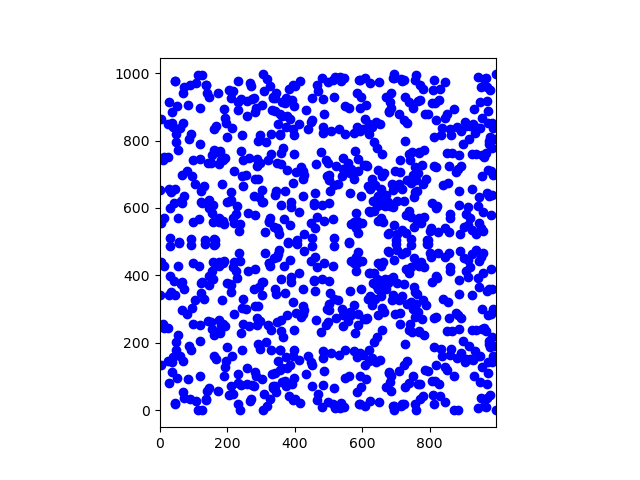
And again mod 997.

These plots are informative in a couple ways. First, they show that the elements of the curve are discrete points. Second, they show that the points are kinda randomly distributed, which hints at why elliptic curves might be useful in cryptography.

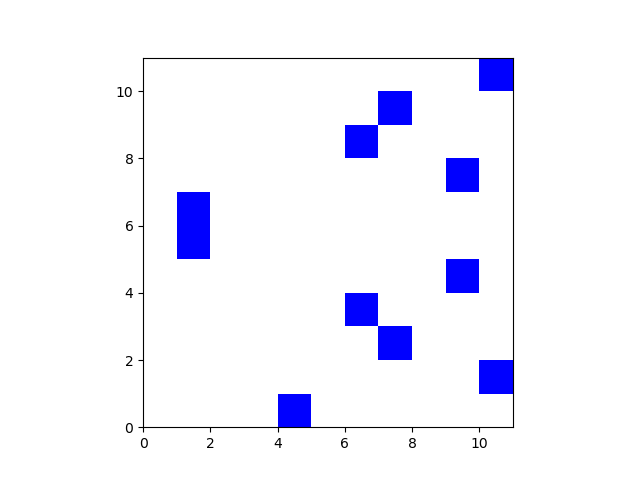
But the implied density of points is entirely wrong. It implies that the density of elliptic curve points increases with the field size increases, when in fact the opposite is true. The source of the confusion is using dots of constant size. A checkerboard graph would be better. Here’s a checkerboard plot for the curve mod 11.

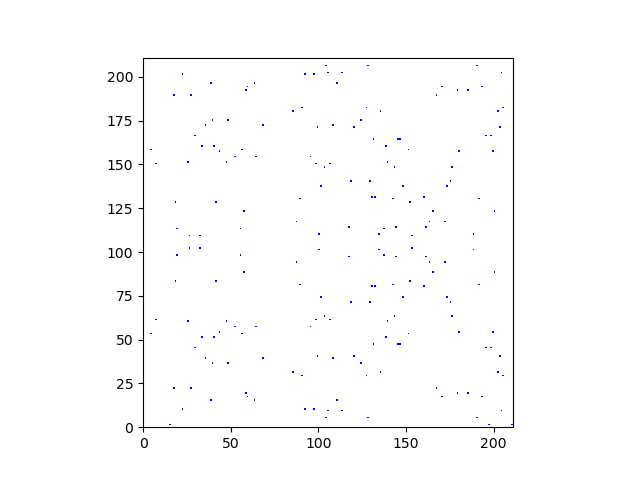
If we were to do the same for the curve mod 997 we’d see nothing. The squares would be too small and too few to see. Here’s a plot for the curve mod 211 that gives a hint of the curve elements as dust in the plot.

An elliptic curve over the integers modulo a prime p lives in a p by p grid, and the number of points satisfying the equation of an elliptic curve is roughly p. So the density of points in the grid that belong to the curve is 1/p.

The elliptic curves used in cryptography are over fields of size 2255 or larger, and so the probability that a pair of x and y values chosen at random would be on the curve is on the order of 2−255, virtually impossible.

We can be more precise than saying the number of points on the curve is roughly p. If p isn’t too large, we can count the number of points on an elliptic curve. For example, the curve

y² = x³ + 2 mod p

has 12, 199, and 988 points when p = 11, 211, and 997. (If you count the points in the plots above for p = 11 you’ll get 11 points. Elliptic curves always have an extra point at infinity not shown.)

Hasse’s theorem gives upper and lower bounds for the number of points N on an elliptic curve over a field of p elements with p prime:

|N − (p + 1)| ≤ 2 √p.

The heuristic for this is that the right hand side of the equation defining an elliptic curve

x³ + ax + b

is a square mod p above half the time. When it is a square, it corresponds to two values of y and when it is not it corresponds to zero points. So on average an elliptic curve mod p has around p ordinary points and one point at infinity.

Related posts

Looking back at Martin Gardner’s RSA article

Public key cryptography came to the world’s attention via Martin Gardner’s Scientific American article from August 1977 on RSA encryption.

The article’s opening paragraph illustrates what a different world 1977 was in regard to computation and communication.

… in a few decades … the transfer of information will probably be much faster and much cheaper by “electronic mail” than by conventional postal systems.

Gardner quotes Ron Rivest [1] saying that breaking RSA encryption by factoring the product of two 63-digit primes would take about 40 quadrillion years. The article included a challenge, a message encrypted using a 129-digit key, the product of a 64-digit prime and a 65-digit prime. Rivest offered a $100 prize for decrypting the message.

Note the tension between Rivest’s estimate and his bet. It’s as if he were saying “Based on the factoring algorithms and computational hardware now available, it would take forever to decrypt this message. But I’m only willing to bet $100 that that estimate remains valid for long.”

The message was decrypted 16 years later. Unbeknownst to Gardner’s readers in 1977, the challenge message was

THE MAGIC WORDS ARE SQUEAMISH OSSIFRAGE

encoded using 00 for space, 01 for A, 02 for B, etc.  It was decrypted in 1993 by a group of around 600 people using around 1600 computers. Here is a paper describing the effort. In 2015 Nat McHugh factored the key in 47 minutes using 8 CPUs on Google Cloud.

The RSA algorithm presented in Gardner’s article is much simpler than it’s current implementation, though the core idea remains unchanged. Now we use much larger public keys, the product of two 1024 bit (308 digit) primes or larger. Also, RSA isn’t used to encrypt messages per se; RSA is used to exchange symmetric encryption keys, such as AES keys, which are then used to encrypt messages.

RSA is still widely used, though elliptic curve cryptography (ECC) is taking its place, and eventually both RSA and ECC will presumably be replaced with post-quantum methods.

More RSA posts

[1] I met Ron Rivest at the Heidelberg Laureate Forum in 2013. When he introduced himself I said something like “So you’re the ‘R’ in RSA?” He’s probably tired of hearing that, but if so he was too gracious to show it.

Lewis Carroll and Zero Knowledge Proofs

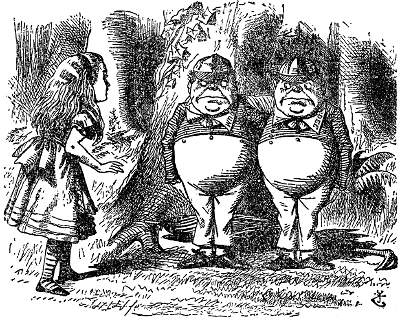
Illustration from Through the Looking Glass

Elliptic curves are often used in cryptography, and in particular they are used in zero-knowledge proofs (ZKP). Cryptocurrencies such as Zcash use ZKP to protect the privacy of users.

Several of the elliptic curves used in ZKP have whimsical names taken from characters by Lewis Carroll. This post will look at these five elliptic curves:

  • Jubjub
  • Baby Jubjub
  • Bandersnatch
  • Tweedledee
  • Tweedledum

Charles Dodgson was a mathematician, and perhaps there’s some connection from his mathematical work to elliptic curves and ZKP, the connection explored here is with his literary works written under the name Lewis Carroll.

Jabberwocky names

The first three curves—Jubjub, Baby Jubjub, and Bandersnatch—all get their name from Lewis Carroll’s poem Jabberwocky.

“Beware the Jabberwock, my son!
The jaws that bite, the claws that catch!
Beware the Jubjub bird, and shun
The frumious Bandersnatch!”

These curves all have a twisted Edwards curve form and a Montgomery curve form, just like the relationship between Ed25519 and Curve25519 that I wrote about a few days ago.

As its name suggests, the Baby Jubjub elliptic curve is related to the Jubjub curve but smaller.

Bandersnatch is similar to Jubjub, but arithmetic over this curve can be implemented more efficiently.

Looking Glass names

The last two curves—Tweedledum and Tweedledee—take their names from Through the Looking Glass.

And as their names suggest, Tweedledum and Tweedledee and very closely related. Both have the equation

y² = x³ + 5

but over different fields. Tweedledum is defined over the integers mod p and has q elements. Tweedledee is defined over the integers mod q and has p elements. (Mind your ps and qs!)

Here

p = 2254 + 4707489545178046908921067385359695873
q = 2254 + 4707489544292117082687961190295928833

Note that Tweedledum and Tweedledee are a “pair” of curves used together, but they do not form a pairing in the technical sense of that word.

More Lewis Carroll posts

More elliptic curve posts

Equivalence between commonly used elliptic curves

The elliptic curves Curve25519 and Ed25519 are both commonly used in applications. For example, Curve25519 is used in Proton Mail and Ed25519 is used in SSH.

The two curves are related, as the numerical parts in their names suggest. The two curves are equivalent in some sense that we will describe below.

An algebraic geometer would say that Curve25519 and Ed25519 are not isomorphic, but a cryptographer would say that they are isomorphic. That’s because the algebraic geometer cares about more structure than the cryptographer does.

Curve25519 is given by

M: v² = u³ + 486662u² + u

over the field Fq where q = 2255 − 19.

Ed25519 is given by

E: y² − x² = 1 − (121665/121666) x² y²

over the same field. The “25519” part of both names comes from q.

We use M for Curve25519 because it is a Montgomery curve, named after Peter Montgomery. We use E for Ed25519 because it is a twisted Edwards curve, named after Harold Edwards.

The algebraic geometer would say M and E are not isomorphic as algebraic curves [1] because the curves are not the same in all their structure. However, the cryptographer isn’t interested in elliptic curves per se, only the additive group that is defined on elliptic curves, and these groups are isomorphic. The isomorphism can be given by

x = √486664 u/v

y = (u − 1)/(u + 1)

Here √486664 is a square root mod q and division means multiplication by the multiplicative inverse mod q.

Even though the group isomorphism is simple and explicit, it’s not simple to prove that it is a group isomorphism. For a proof, see [2].

So if the additive groups of the two curves are isomorphic, why use one in some applications rather than the other? Each is used where its implementation is more efficient. Ed25519 is typically used in digital signatures (for example, in Monero) and Curve25519 is typically used in key exchange (for example, in secure web pages).

Related posts

[1] The map between (uv) and (xy) does serve as an isomorphism between the group structures. But it is a “birational equivalence” rather than an isomorphism because it has singularities at (−1, 0) and (0, 0).

[2] Daniel J. Bernstein, Tanja Lange, Faster addition and doubling on elliptic curves, in Asiacrypt 2007 [49] (2007), 29–50. URL: http://eprint.iacr.org/2007/286.

Monero’s elliptic curve

Monero logo
Digital signatures often use elliptic curves. For example, Bitcoin and Ethereum use the elliptic curve secp256k1 [1]. This post will discuss the elliptic curve Ed25519 [2] using in Monero and in many other applications.

Ed25519 has the equation

y² − x² = 1 + d x² y²

over the finite field Fq where q = 2255 − 19 and d = −121665/121666. The general form of the equation above makes Ed25519 a “twisted Edwards curve.”

The expression for d is not the rational number it appears to be. Think of it as

d = −121665 × 121666−1

where the multiplication and the multiplicative inverse are calculated mod q.

We could calculate d in Python as follows.

>>> q = 2**255 - 19
>>> d = (-121665*pow(121666, -1, q)) % q
>>> d 
37095705934669439343138083508754565189542113879843219016388785533085940283555

The equation above does not look like an elliptic curve if you think of an elliptic curve having the form

y² = x³ + ax + b.

But that form, known as Weierstrass form, is not the most general definition of an elliptic curve. Elliptic curves can be written in that form [3] but they do not have to be. There are computational advantages to writing curves in the form

y² − x² = 1 + d x² y²

when possible rather than in Weierstrass form [4].

Elliptic curve digital signatures require a specified base point. The Monero whitepaper describes the base point simply as

G = (x, −4/5).

That’s leaving out a fair bit of detail. First of all, 4/5 is interpreted as 4 times the multiplicative inverse of 5 mod q, similar to the calculation for d above.

>>> y = (-4*pow(5, -1, q)) % q; y
11579208923731619542357098500868790785326998466564056403945758400791312963989

Now we have two tasks. How do we solve for x, and which solution do we take?

We need to solve

x² = (y² − 1)/(1 + d y²) mod q.

We can do this in Python as follows.

>>> from sympy import sqrt_mod
>>> roots = sqrt_mod((y**2 - 1)*pow(1 + d*y**2, -1, q), q, all_roots=True)
>>> roots 
[15112221349535400772501151409588531511454012693041857206046113283949847762202,
42783823269122696939284341094755422415180979639778424813682678720006717057747]

So which root to we choose? The convention is to use the even solution, the first one above. (The two roots add to 0 mod q; one will be odd and one will be even because q is odd.)

We can verify that (x, y) is on the Ed25519 elliptic curve:

>>> ((y**2 - x**2) - (1 + d*x**2 * y**2)) % q
0

Related posts

[1] The name secp256k1 was created as follows. The “sec” comes from “Standards for Efficient Cryptography,” referring to the group that specified the curve parameters. The “p” means the curve is over a finite field of prime order. The order of the curve is slightly less than 2256. The “k” indicates that this is a Koblitz curve.

[2] The “Ed” part of the name refers to Harold Edwards, the mathematician who studied the family of elliptic curves now known as Edwards curves. The “25519” part of the name refers to the fact that the curve is over the finite field with 2255 − 19 elements.

[3] Provided the elliptic curve is not over a field of characteristic 2 or 3.

[4] Group operations can be implemented more efficiently and the point at infinity can be handled without exception logic.

Legendre and Ethereum

What does an eighteenth century French mathematician have to do with the Ethereum cryptocurrency?

A pseudorandom number generator based on Legendre symbols, known as Legendre PRF, has been proposed as part of a zero knowledge proof mechanism to demonstrate proof of custody in Ethereum 2.0. I’ll explain what each of these terms mean and include some Python code.

The equation x² = a mod p is solvable for some values of a and not for others. The Legendre symbol

\left(\frac{a}{p}\right)

is defined to be 1 if a has a square root mod p, and −1 if it does not. Here a is a positive integer and p is a (large) prime [1]. Note that this is not a fraction, though it looks like one.

As a varies, the Legendre symbols vary randomly. Not literally randomly, of course, but the act random enough to be useful as a pseudorandom number generator.

Legendre PRF

Generating bits by computing Legendre symbols is a lot more work than generating bits using a typical PRNG, so what makes the Legendre PRF of interest to Ethereum?

Legendre symbols can be computed fairly efficiently. You wouldn’t want to use the Legendre PRF to generate billions of random numbers for some numerical integration computation, but for a zero knowledge proof you only need to generate a few dozen bits.

To prove that you know a key k, you can generate a string of pseudorandom bits that depend on the key. If you can do this for a few dozen bits, it’s far more likely that you know the key than that you have guessed the bits correctly. Given k, the Legendre PRF computes

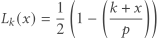
L_k(x) = \frac{1}{2}\left( 1 - \left( \frac{k+x}{p}\right) \right)

for n consecutive values of x [2].

One reason this function is of interest is that it naturally lends itself to multiparty computation (MPC). The various parties could divide up the range of x values that each will compute.

The Legendre PRF has not been accepted to be part of Ethereum 2.o. It’s only been proposed, and there is active research into whether it is secure enough.

Python code

Here’s a little Python scrypt to demonstrate using Lk(x).

    from sympy import legendre_symbol

    def L(x, k, p):
        return (1 - legendre_symbol(x + k, p)) // 2

    k = 20250626
    p = 2**521 - 1
    print([L(x, k, p) for x in range(10)])

This produces the following.

    [1, 1, 1, 1, 0, 0, 1, 0, 0, 1]

Related posts

[1] There is a third possibility: the Legendre symbol equals 0 if a is a multiple of p. We can safely ignore this possibility for this post.

[2] The Legendre symbol takes on the values ±1 and so we subtract this from 1 to get values {0, 2}, then divide by 2 to get bits {0, 1}.