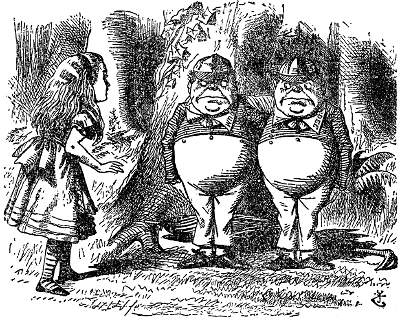
Lewis Carroll and Zero Knowledge Proofs

Illustration from Through the Looking Glass

Elliptic curves are often used in cryptography, and in particular they are used in zero-knowledge proofs (ZKP). Cryptocurrencies such as Zcash use ZKP to protect the privacy of users.

Several of the elliptic curves used in ZKP have whimsical names taken from characters by Lewis Carroll. This post will look at these five elliptic curves:

  • Jubjub
  • Baby Jubjub
  • Bandersnatch
  • Tweedledee
  • Tweedledum

Charles Dodgson was a mathematician, and perhaps there’s some connection from his mathematical work to elliptic curves and ZKP, the connection explored here is with his literary works written under the name Lewis Carroll.

Jabberwocky names

The first three curves—Jubjub, Baby Jubjub, and Bandersnatch—all get their name from Lewis Carroll’s poem Jabberwocky.

“Beware the Jabberwock, my son!
The jaws that bite, the claws that catch!
Beware the Jubjub bird, and shun
The frumious Bandersnatch!”

These curves all have a twisted Edwards curve form and a Montgomery curve form, just like the relationship between Ed25519 and Curve25519 that I wrote about a few days ago.

As its name suggests, the Baby Jubjub elliptic curve is related to the Jubjub curve but smaller.

Bandersnatch is similar to Jubjub, but arithmetic over this curve can be implemented more efficiently.

Looking Glass names

The last two curves—Tweedledum and Tweedledee—take their names from Through the Looking Glass.

And as their names suggest, Tweedledum and Tweedledee and very closely related. Both have the equation

y² = x³ + 5

but over different fields. Tweedledum is defined over the integers mod p and has q elements. Tweedledee is defined over the integers mod q and has p elements. (Mind your ps and qs!)

Here

p = 2254 + 4707489545178046908921067385359695873
q = 2254 + 4707489544292117082687961190295928833

Note that Tweedledum and Tweedledee are a “pair” of curves used together, but they do not form a pairing in the technical sense of that word.

More Lewis Carroll posts

More elliptic curve posts

Equivalence between commonly used elliptic curves

The elliptic curves Curve25519 and Ed25519 are both commonly used in applications. For example, Curve25519 is used in Proton Mail and Ed25519 is used in SSH.

The two curves are related, as the numerical parts in their names suggest. The two curves are equivalent in some sense that we will describe below.

An algebraic geometer would say that Curve25519 and Ed25519 are not isomorphic, but a cryptographer would say that they are isomorphic. That’s because the algebraic geometer cares about more structure than the cryptographer does.

Curve25519 is given by

M: v² = u³ + 486662u² + u

over the field Fq where q = 2255 − 19.

Ed25519 is given by

E: y² − x² = 1 − (121665/121666) x² y²

over the same field. The “25519” part of both names comes from q.

We use M for Curve25519 because it is a Montgomery curve, named after Peter Montgomery. We use E for Ed25519 because it is a twisted Edwards curve, named after Harold Edwards.

The algebraic geometer would say M and E are not isomorphic as algebraic curves [1] because the curves are not the same in all their structure. However, the cryptographer isn’t interested in elliptic curves per se, only the additive group that is defined on elliptic curves, and these groups are isomorphic. The isomorphism can be given by

x = √486664 u/v

y = (u − 1)/(u + 1)

Here √486664 is a square root mod q and division means multiplication by the multiplicative inverse mod q.

Even though the group isomorphism is simple and explicit, it’s not simple to prove that it is a group isomorphism. For a proof, see [2].

So if the additive groups of the two curves are isomorphic, why use one in some applications rather than the other? Each is used where its implementation is more efficient. Ed25519 is typically used in digital signatures (for example, in Monero) and Curve25519 is typically used in key exchange (for example, in secure web pages).

Related posts

[1] The map between (uv) and (xy) does serve as an isomorphism between the group structures. But it is a “birational equivalence” rather than an isomorphism because it has singularities at (−1, 0) and (0, 0).

[2] Daniel J. Bernstein, Tanja Lange, Faster addition and doubling on elliptic curves, in Asiacrypt 2007 [49] (2007), 29–50. URL: http://eprint.iacr.org/2007/286.

Monero’s elliptic curve

Monero logo
Digital signatures often use elliptic curves. For example, Bitcoin and Ethereum use the elliptic curve secp256k1 [1]. This post will discuss the elliptic curve Ed25519 [2] using in Monero and in many other applications.

Ed25519 has the equation

y² − x² = 1 + d x² y²

over the finite field Fq where q = 2255 − 19 and d = −121665/121666. The general form of the equation above makes Ed25519 a “twisted Edwards curve.”

The expression for d is not the rational number it appears to be. Think of it as

d = −121665 × 121666−1

where the multiplication and the multiplicative inverse are calculated mod q.

We could calculate d in Python as follows.

>>> q = 2**255 - 19
>>> d = (-121665*pow(121666, -1, q)) % q
>>> d 
37095705934669439343138083508754565189542113879843219016388785533085940283555

The equation above does not look like an elliptic curve if you think of an elliptic curve having the form

y² = x³ + ax + b.

But that form, known as Weierstrass form, is not the most general definition of an elliptic curve. Elliptic curves can be written in that form [3] but they do not have to be. There are computational advantages to writing curves in the form

y² − x² = 1 + d x² y²

when possible rather than in Weierstrass form [4].

Elliptic curve digital signatures require a specified base point. The Monero whitepaper describes the base point simply as

G = (x, −4/5).

That’s leaving out a fair bit of detail. First of all, 4/5 is interpreted as 4 times the multiplicative inverse of 5 mod q, similar to the calculation for d above.

>>> y = (-4*pow(5, -1, q)) % q; y
11579208923731619542357098500868790785326998466564056403945758400791312963989

Now we have two tasks. How do we solve for x, and which solution do we take?

We need to solve

x² = (y² − 1)/(1 + d y²) mod q.

We can do this in Python as follows.

>>> from sympy import sqrt_mod
>>> roots = sqrt_mod((y**2 - 1)*pow(1 + d*y**2, -1, q), q, all_roots=True)
>>> roots 
[15112221349535400772501151409588531511454012693041857206046113283949847762202,
42783823269122696939284341094755422415180979639778424813682678720006717057747]

So which root to we choose? The convention is to use the even solution, the first one above. (The two roots add to 0 mod q; one will be odd and one will be even because q is odd.)

We can verify that (x, y) is on the Ed25519 elliptic curve:

>>> ((y**2 - x**2) - (1 + d*x**2 * y**2)) % q
0

Related posts

[1] The name secp256k1 was created as follows. The “sec” comes from “Standards for Efficient Cryptography,” referring to the group that specified the curve parameters. The “p” means the curve is over a finite field of prime order. The order of the curve is slightly less than 2256. The “k” indicates that this is a Koblitz curve.

[2] The “Ed” part of the name refers to Harold Edwards, the mathematician who studied the family of elliptic curves now known as Edwards curves. The “25519” part of the name refers to the fact that the curve is over the finite field with 2255 − 19 elements.

[3] Provided the elliptic curve is not over a field of characteristic 2 or 3.

[4] Group operations can be implemented more efficiently and the point at infinity can be handled without exception logic.

Previous digital signature standard expires next month

The Digital Signature Standard (DSS) FIPS 184-4, first published in 2013, expires a few days from now, on February 3, 2024. It is superseded by NIST FIPS 184-5. This new version was published on February 3, 2023, giving everyone a year to adopt the new standard before it became required.

The differences between the two standards are summarized in Appendix E of the new standard. Here I’ll point out three differences, then expand a little on the third difference.

First of all, the Digital Signature Algorithm (DSA) from earlier versions of FIPS 184 is withdrawn.

Second, RSA keys have gotten longer. The previous minimum key length was 1024 bits. Now it is 2048.

Third, elliptic curve cryptography has matured quite a bit since 2013.

The 2013 version of the standard gave users a lot more freedom in choosing elliptic curves and base points on those curves. Now it appears that much of this freedom hasn’t turned out so well.

The binary curves and Koblitz curves that were approved in 2013 are now deprecated. These are the curves whose names begin with B– or K– as described in this post on elliptic curve naming conventions. But the P– curves P-224, P-256P-384, and P-521 are still recommended.

While the binary and Koblitz curves have been removed, Edwards curves were added. Specifically Ed25519 and Ed448 have been added for the Edwards Digital Signature algorithm (EdDSA).

Related posts

Is there an elliptic curve with 2024 points?

On New Year’s Day I posted about groups of order 2024. Are there elliptic curves of order 2024?

The Hasse-Weil theorem relates the number of points on an elliptic curve over a finite field to the number of elements of the field. Namely, an elliptic curve E over a field with q elements must have cardinality

q + 1 − t

where

|t| ≤ 2√q.

So if there is an elliptic curve with 2024 points, the curve must be over a field with roughly 2024 points.

The condition on t above is necessary for the existence of an elliptic curve of a certain size, but is it sufficient? Sorta.

The order of a finite field must be a prime power, i.e. q = pd for some prime p. There is a theorem ([1], Theorem 13.30) that there exists a curve of the size indicated in the Hasse-Weil theorem if t ≠ 0 mod p. The theorem also lists a couple more sufficient conditions that are more complicated.

So, for example, we could take q = p = 2027 and t = 4.

Now that we know the search isn’t futile, we can search for an elliptic curve over the integers mod 2027 that has 2024 points. After a brief brute force search I found

y² = x³ + 4x + 28

over the field with 2027 elements is such a curve .

Related posts

[1] Henri Coghen and Gerhard Frey. Handbook of Elliptic and Hyperelliptic Curve Cryptography. Chapman & Hall/CRC. 2006.

Finite projective planes

Given a field F, finite or infinite, you can construct a projective plane over F by starting with pairs of elements of F and adding “points at infinity,” one point for each direction.

Motivation: Bézout’s theorem

A few days ago I mentioned Bézout’s theorem as an example of a simple theorem that rests on complex definitions. Bézout (1730–1783) stated that in general a curve of degree n and a curve of degree m intersect in nm points. There are a lot of special cases excluded by the phrase “in general” that go away when you state Bézout’s theorem in a sophisticated context.

To make Bézout’s theorem rigorous you have to work over an algebraically complete field (e.g. the complex numbers rather than the real numbers), you have to count intersections with multiplicity, and you have to add points at infinity, i.e. you have to work in a projective plane.

Motivation: Elliptic curves

Bézout’s theorem involves infinite field ℂ, but this post is about finite projective planes. Elliptic curves over finite fields provide a motivating example of working in finite projective planes.

This blog is served over HTTPS and so serving up its pages involves public key cryptography. And depending on what protocol your browser negotiates with my server, you may be using elliptic curve cryptography to view this page.

An elliptic curve over a finite field is not an ellipse and not a curve, at least not a curve in the sense of a continuum of points. Elliptic curves over ℝ really are curves in the usual sense, but the definition is then abstracted in a way that extends to any field, including finite fields.

Homogeneous coordinates

In order to make this idea of “points at infinity” rigorous, we have to introduce a new coordinate system. We now describe points by (equivalence classes of) triples of field elements rather than pairs of field elements. The benefit of this added complexity is that points at infinity can be handled perfectly rigorously. Often the third coordinate can be ignored, but then you pay attention to it when you need to be careful.

In homogeneous coordinates, we consider two points (x, y, z) and (x′, y′, z′) equivalent if there is a λ ≠ 0 such that

(x, y, z) = (λx′, λy′, λz′).

Also, we require that not all three coordinates are 0, i.e. (0, 0, 0) is not an element of the projective plane.

We associate a point (x, y) with the triple (x, y, 1) and all its equivalents, i.e. all triples of the form (λx, λy, λ) with λ ≠ 0.

Points at infinity

A point at infinity is simply a point with third coordinate 0.

In the post mentioning Bézout’s theorem I said in passing that the lines y = 5 and y = 6 meet at infinity. Here’s how we can make this rigorous. The line y = 5 in the finite plane is the set of points of the form (x, 5), which embed in the projective plane as

(x, 5, 1)

and these points are equivalent to the set of points

(1, 5/x, 1/x)

Now take the limit as x → ∞ and we get (1, 0, 0). We consider this addition point to be part of the line y = 5 when the line is considered part of the projective plane. You can see that the line y = 6 contains the same point. So we can be very specific about where the lines y = 5 and y = 6 intersect: they intersect at (1, 0, 0).

You can go through a similar exercise to show that the lines y = x and y = x – 57 also intersect “at infinity” but at a different point at infinity, namely at (1, 1, 0) and its equivalents.This also shows that although the lines y = 5 and y = x both go off to infinity, they “reach” infinity at different points. The former goes to the point at infinity associated with horizontal lines and the latter goes to the point at infinity associated with 45 degree lines.

Note also that parallel lines meet at one point at infinity, not two. You might want to say, for example, that y = 5 and y = 6 meet twice, once at positive infinity and once at negative infinity. You could construct a system that works that way, but that’s not now projective planes work. Since non-zero multiples of a point are equivalent, (1, 0, 0) and (-1, 0, 0) are in the same equivalence class.

See this post for practical examples of when you might choose to have one or two points at infinity depending on your application.

Finite projective planes

We can construct projective planes containing a finite number of points by repeating the construction above using a finite field F. Finding finite projective planes not isomorphic to one constructed this way is hard [1].

Let F be a finite field with q elements. Then q is necessarily either a prime or a power of a prime, though that fact isn’t needed here.

The points of the finite projective plane over F are the points of the finite plane over F, i.e. pairs of elements of F, and the additional “points at infinity.” We can say exactly what these points at infinity are and count them.

A point (x, y) is embedded in the projective plane as (x, y, 1) and all points in its equivalence class. So for starters we have at least q² points in the finite projective plane, one for each pair (x, y).

First consider the case x ≠ 0. Then (x, y, 1) is equivalent to (1, y/x, 1/x) and so without loss of generality we can assume x = 1 (the multiplicative identity of the field). So for each y, (1, y, 0) is a point at infinity. That gives us q more elements of the finite projective plane.

Next consider the case x = 0. Then (0, y, 0) is another point at infinity as long as y ≠ 0. It’s only one point, because all non-zero multiples of (0, 1, 0) are in the same equivalence class.

So all together we have q² + q + 1 points, represented by the following elements of their equivalence classes:

  • (x, y, 0) for all x, y in F,
  • (1, y, 0) for all y, and
  • (0, 1, 0).

Related posts

[1] There are for non-isomorphic finite projective planes of order 9, i.e. planes with 9² + 9 + 1 = 91 points. And there are other examples of finite projective planes not isomorphic to planes constructed as outlined here. However, so far all such planes have the same number of points as a finite projective plane constructed as above.

Benefits of redundant coordinates

Since you can describe a point in the plane with two numbers, why would you choose to use three numbers? Why would you ever want to use a coordinate system with more coordinates than necessary?

Barycentric coordinates

One way to indicate the location of a point inside a triangle is to give the distance to each of the vertices. These three distances are called barycentric coordinates. Why would you use three numbers when two would do?

Barycentric coordinates make some things much simpler. For example, the coordinates of the three vertices are (1, 0, 0), (0, 1, 0), and (0, 0, 1) for any triangle. The points inside are written as convex combinations of the vertices. The coordinates of the center of mass, the barycenter, are (1/3, 1/3, 1/3). The vertices are treated symmetrically, even if the triangle is far from symmetric.

Barycentric coordinates are useful in applications, such as computer graphics and finite element analysis, because they are relative coordinates. When a triangle moves or is rescaled, you only need to keep track of where the vertices went; the coordinates of the points inside relative to the vertices haven’t changed.

This can be generalized to more dimensions. For example, you could describe a point in a tetrahedron with four coordinates, more in higher dimensions you could describe a point in an n-simplex by the convex combination coefficients of the n vertices.

Barycentric coordinates are related to Dirichlet probability distributions. When you have n probabilities that sum to 1, you’ve got n-1 degrees of freedom. But it often simplifies things to work with n variables. As with the discussion of triangles above, the extra variable makes expressions more symmetric.

Quaternions and rotations

A point in three dimensional space can be described with three numbers, but it’s often useful to think of the usual three coordinates as the vector part of a quaternion, a set of four numbers.

Suppose you have a point

a = (x, y, z)

and you want to rotate it by an angle θ around an axis given by a unit vector

b = (u, v, w).

You can compute the rotation by associating the point a with the quaternion

p = (0, x, y, z)

and the axis b with the quaternion

q = (cos(θ/2), sin(θ/2) u, sin(θ/2) v, sin(θ/2) w)

The image of a is then given by the quaternion

q p q−1.

This quaternion will have zero real part, and so the Euclidean coordinates are given by the vector part, the last three components.

Of course the product above is a quaternion product, which is not commutative. That’s why the q and the q−1 don’t cancel out.

Using quaternions for rotations has several advantages over using rotation matrices. First, the quaternion representation is more compact, describing a rotation with four real numbers rather than nine. Second, the quaternion calculation can be better behaved numerically. But most importantly, the quaternion approach avoids gimbal lock, a sort of singularity in representing rotations.

Projective planes

In applications of algebra, such as elliptic curve cryptography, you often need to add “points at infinity” to make things work out. To formalize this, you add an extra coordinate. So while an elliptic curve is usually presented as an equation such as

y² = x³ + ax + b,

it’s more formally an equation in three variables

y²z = x³ + axz² + bz³.

Points in the projective plane have coordinates (x, y, z) where points are considered equivalent if they differ by a non-zero multiple, i.e. (x, y, z) is considered the same point as (λx, λy, λz) for any non-zero λ.

You can often ignore the z, choosing λ so that the z coordinate is 1. But when you need to work with the point at infinity in a uniform way, you bring out the full coordinates. Now the “point at infinity” is not some mysterious entity, but simply the point (0, 1, 0).

Common themes

Projective coordinates, like barycentric coordinates, introduce symmetry. With the addition of an extra coordinate, the three coordinates all behave similarly, with no reason to distinguish any coordinate as special. And as with quaternion rotations, projective coordinates make singularities go away, which is consequence of symmetry.

Related posts

Elliptic curve P-384

The various elliptic curves used in elliptic curve cryptography (ECC) have different properties, and we’ve looked at several of them before. For example, Curve25519 is implemented very efficiently, and the parameters were transparently chosen. Curve1174 is interesting because it’s an Edwards curve and has a special addition formula.

This post looks at curve P-384. What’s special about this curve? It’s the elliptic curve that the NSA recommends everyone use until post-quantum methods have been standardized. It provides 192 bits of security, whereas more commonly used curves provide 128 bits.

Does the NSA recommend this method because they know how to get around it? Possibly, but they also need to recommend methods that they believe foreign governments cannot break.

The equation of the P-384 curve is

y² = x³ + ax + b

working over the field of integers modulo a prime p. We will go into each of the specific parameters ab, and p, and discuss how they were chosen.

Modulus p

Consisting with the naming conventions for elliptic curves used in cryptography, the name “P-384” tells you that the curve is over a prime field where the prime is a 384-bit integer. Specifically, the order of the field is

p = 2384 − 2128 − 296 + 232 − 1

For a given number of bits, in this case 384, you want to pick a prime that’s relatively near the maximum size for that number of bits. In our case, our prime p is a prime near 2384 with a convenient bit pattern. (The special pattern allows implementation tricks that increase efficiency.)

Hasse’s theorem says that the number of points on a curve modulo a large prime is on the order of magnitude equal to the prime, so P-384 contains approximately 2384 points. In fact, the number of points n on the curve is

39402006196394479212279040100143613805079739270465446667946905279627659399113263569398956308152294913554433653942643

or approximately 2384 − 2190. The number n is a prime, and so it is the order of P-384 as a group.

Linear coefficient a

According to a footnote in the standard defining P-384, FIPS PUB 186-4,

The selection a ≡ −3 for the coefficient of x was made for reasons of efficiency; see IEEE Std 1363-2000.

All the NIST elliptic curves over prime fields use a = −3 because this makes it possible to use special algorithms for elliptic curve arithmetic.

Constant coefficient b

The curve P-384 has Weierstrass form

y² = x³ − 3x + b

where b is

27580193559959705877849011840389048093056905856361568521428707301988689241309860865136260764883745107765439761230575.

The parameter b is between 2383 and 2384 but doesn’t have any particular binary pattern:

101100110011000100101111101001111110001000111110111001111110010010011000100011100000010101101011111000111111100000101101000110010001100000011101100111000110111011111110100000010100000100010010000000110001010000001000100011110101000000010011100001110101101011000110010101100011100110001101100010100010111011010001100111010010101010000101110010001110110111010011111011000010101011101111

The specification says that b was chosen at random. How can you convince someone that you chose a parameter at random?

The standard gives a 160-bit seed s, and a hash-based algorithm that s was run through to create a 384-bit parameter c. Then b is the solution to

b² c = −27 mod p.

The algorithm going from the s to c is given in Appendix D.6 and is a sort of key-stretching algorithm. The standard cites ANS X9.62 and IEEE Standard 1363-2000 as the source of the algorithm.

If b was designed to have a back door, presumably a tremendous amount of computation had to go into reverse engineering the seed s.

Koblitz and Menezes wrote a paper in which they suggest a way that the NSA might have picked seeds that lead to weak elliptic curves, but then argue against it.

It is far-fetched to speculate that the NSA would have deliberately selected weak elliptic curves in 1997 for U.S. government usage … confident that no one else would be able to discover the weakness in these curves in the ensuing decades. Such a risky move by the NSA would have been inconsistent with the Agency’s mission.

Related posts

Isogeny-based encryption

If and when large quantum computers become practical, all currently widely deployed methods for public key cryptography will break. Even the most optimistic proponents of quantum computing believe such computers are years away, maybe decades. But it also takes years, maybe decades, to develop, test, and deploy new encryption methods, and so researchers are working now to have quantum-resistant encryption methods in place by the time they are needed.

What’s special about isogeny-based encryption?

One class of quantum-resistant encryption methods is isogeny-based encryption. This class stands out for at least a couple methods:

  • it uses the shortest keys, and
  • it uses the most sophisticated math.

Most post-quantum encryption schemes require much longer keys to maintain current levels of protection, two or three orders of magnitude longer. Isogeny-based encryption uses the shortest keys of any proposed post-quantum encryption methods, requiring keys roughly the same size as are currently in use.

The mathematics behind isogeny-based cryptography is deep. Even a high-level description requires quite a bit of background. I’ll take a shot at exploring the prerequisites starting with this blog post.

Elliptic curves

Elliptic curve cryptography is widely used today, and partly for one of the reasons listed above: short keys. To achieve a level of security comparable to 128-bit AES, you need a 256-bit key using elliptic curve cryptography, but a 3072-bit key using RSA.

Quantum computers could solve the elliptic curve discrete logarithm problem efficiently, and so elliptic curve cryptography as currently practiced is not quantum resistant. Isogeny-based encryption is based on elliptic curves, but not as directly as current ECC methods. While current ECC methods perform computations on elliptic curves, isogeny methods are based on networks of functions between elliptic curves.

SIKE

NIST is sponsoring a competition for post-quantum encryption methods, and only one of the contestants is related to elliptic curves, and that’s SIKE. The name stands for Supersingular Isogeny Key Encapsulation. “Supersingular” describes a class of elliptic curves, and SIKE is based on isogenies between these curves.

Future posts

This post raises a lot of questions. First and foremost, what is an isogeny? That’s the next post. And what are “supersingular” elliptic curves? I hope to go over that in a future post. Then after exploring the building blocks, where does encryption come in?

Past posts

I’ve written several related blog posts leading up to this topic from two directions: post-quantum encryption and elliptic curves.

Post-quantum encryption links

Elliptic curve links

All elliptic curves over fields of order 2 and 3

Introductions to elliptic curves often start by saying that elliptic curves have the form

y² = x³ + ax + b.

where 4a³ + 27b² ≠ 0. Then later they say “except over fields of characteristic 2 or 3.”

What does characteristic 2 or 3 mean? The order of a finite field is the number of elements it has. The order is always a prime or a prime power. The characteristic is that prime. So another way to phrase the exception above is to say “except over fields of order 2n or 3n.”

If we’re looking at fields not just of characteristic 2 or 3, but order 2 or 3, there can’t be that many of them. Why not just list them? That’s what I plan to do here.

General form of elliptic curves

All elliptic curves over a finite field have the form

y² + a1xy + a3y = x³ + a2x² + a4x + a6,

even over fields of characteristic 2 or 3.

When the characteristic of the field is not 2, this can be simplified to

y² = 4x³ + b2x² + 2b4x + b6

where

b2 = a1² + 4a4,
b4 = 2a4 + a1a3, and
b6 = a3² + 4a6.

When the characteristic is at least 5, the form can be simplified further to the one at the top with just two parameters.

General form of the discriminant

The discriminant of an elliptic curve is something like the discriminant of a quadratic equation. You have an elliptic curve if and only if it is not zero. For curves of characteristic at least five, the condition is 4a³ + 27b², but it’s more complicated for characteristic 2 and 3. To define the discriminant, we’ll need to use b2, b4, and b6 from above, and also

b8 = a1²a6 + 4a2a6a1a3a4 + a2a3² − a4².

Now we can define the discriminant Δ in terms of all the b‘s.

Δ = −b2²b8 − 8b4³ − 27b6² + 9b2b4b6.

See Handbook of Finite Fields page 423.

Enumerating coefficients

Now we can enumerate which parameter combinations yield elliptic curves with the following Python code.

from itertools import product

def discriminant(a1, a2, a3, a4, a6):
    b2 = a1**2 + 4*a4
    b4 = 2*a4 + a1*a3
    b6 = a3**2 + 4*a6
    b8 = a1**2*a6 + 4*a2*a6 - a1*a3*a4 + a2*a3**2 - a4**2
    delta = -b2**2*b8 - 8*b4**3 - 27*b6**2 + 9*b2*b4*b6
    return delta

p = 2
r = range(p)
for (a1, a2, a3, a4, a6) in product(r,r,r,r,r):
    if discriminant(a1, a2, a3, a4, a6)%p != 0:
        print(a1, a2, a3, a4, a6)

The code above does return the values of the a‘s that yield an elliptic curve, but in some sense it returns too many. For example, there are 32 possible combinations of the a‘s when working over GF(2), the field with two elements, and 16 of these lead to elliptic curves. But some of these must lead to the same set of points because there are only 4 possible (x, y) affine points on the curve, plus the point at infinity.

Now we get into a subtle question: when are two elliptic curves the same? Can two elliptic curves have the same set of points and yet be algebraically different? Sometimes, but not usually. Lenstra and Pila [1] proved that two elliptic curves can be equal as sets but not equal as groups if and only if the curve has 5 points and the field has characteristic 2. [2]

Lenstra and Pila give the example of the two equations

y² + y = x³ + x²

and

y² + y = x³ + x

over GF(2). Both determine the same set of points, but the two curves are algebraically different because (0,0) + (0,0) equals (1,1) on the first curve and (1,0) on the second.

Enumerating points on curves

The following Python code will enumerate the set of points on a given curve.

def on_curve(x, y, a1, a2, a3, a4, a6, p):
    left = y**2 + a1*x*y + a3*y
    right = x**3 + a2*x**2 + a4*x + a6
    return (left - right)%p == 0

def affine_points(a1, a2, a3, a4, a6, p):
    pts = set()
    for x in range(p):
        for y in range(p):
            if on_curve(x, y, a1, a2, a3, a4, a6, p):
                pts.add((x,y))
    return pts

We can use this code, along with Lenstra and Pila’s result, to enumerate all elliptic curves of small order.

All elliptic curves over GF(2)

Now we can list all the elliptic curves over the field with two elements.

Curves of order 5

The two curves in the example of Lendstra and Pila are the only ones over GF(2) with five points. So the two curves of order 5 over GF(2) are

y² + y = x³ + x²
y² + y = x³ + x.

They determine the same set of points but are algebraically different.

Curves of order 4

There are four curves of order 4.They contain different sets of points, i.e. each omits a different one of the four possible affine points.

y² + xy = x³ + 1
y² + xy = x³ + x² + x
y² + xy + y = x³ + x²
y² + xy + y = x³ + x² + x

Curves of order 3

There are two distinct curves of order 3, each determined by two equations.

The first curve is determined by either of

y² + y = x³
y² + y = x³ + x² + x

and the second by either of

y² + xy + y = x³ + 1
y² + y = x³ + x² + x + 1

Curves of order 2

There are 4 curves of order two; each contains a different affine point.

y² + xy + y = x³ + 1
y² + xy + y = x³ + x + 1
y² + xy = x³ + x² + 1
y² + xy = x³ + x² + x

Curves of order 1

These are curves containing only the point at infinity

y² + y = x³ + x + 1
y² + y = x³ + x² + 1

There are no affine points because the left side is always 0 and the right side is always 1 for x and y in {0, 1}.

All elliptic curves over GF(3)

There are too many elliptic curves over GF(3) to explore as thoroughly as we did with GF(2) above, but I can report the following results that are obtainable using the Python code above.

An elliptic curve over GF(3) contains between 1 and 7 points. Here are the number of parameter combinations that lead to each number of points.

    1:  9
    2: 22
    3: 26
    4: 15
    5: 26
    6: 22
    7:  9

Obviously there’s only one curve with one point, the point at infinity, so the nine coefficient combinations that lead to a curve of order 1 determine the same curve.

There are 9 distinct curves of order 2 and 12 distinct curves of order 3. All the curves of orders 4, 5, 6, and 7 are distinct.

Related posts

[1] H. W. Lenstra, Jr and J. Pila. Does the set of points of an elliptic curve determine the group? Computational Algebra and Number Theory, 111-118.

[2] We are not considering isomorphism classes here. If two curves have a different set of points, or the same set of points but different group properties, we’re considering them different.