
Music
Amazing jazz musician
Brian Lopes is amazing. I’d never heard of him until he was featured on the Eclectic Mix podcast a few days ago. The podcast describes his music “a high energy expedition crossing from jazz to R&B to funk and back again.” On his website, Brian Lopes lists as his influences John Coltrane, Michael Brecker, Wayne Shorter, David Sanborn, and Cannonball Adderly. These are some of my favorite musicians, and listening to Lopes is like listening to all of these at once.
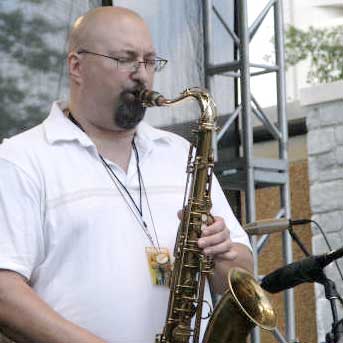
Apparently he only recently started recording with his own group, the Brian Lopes Trio. According to the podcast, Brian Lopes has played with Chick Corea, Frank Sinatra, Aretha Franklin, Ray Charles, and other well known musicians. Finding his music is difficult, but you can buy his first CD at Blue Canoe Records. (Apparently you can’t actually buy a physical CD, but you can buy the MP3 files, sans DRM, that make up the CD.)
Image credit: Eclectic Mix podcast
Related posts
Music recommendations
[This page has been removed.]
Best podcast intro music
Here are three of my favorite podcast intro themes.
.NET Rocks by Carl Franklin and Richard Campbell.
Carl Franklin composed the intro theme, Toy Boy, and recorded the song with his brother Jay. The tune is catchy, the words are clever, and Carl’s a great musician. Richard and Carl talk over the intro, but you can hear these odd phrases poking out, such as “got a transmitter banned by the FCC.” After listening to the podcast for a while, I decided I had to find the theme song and listen to Toy Boy without the voice overs. Here’s more music by Carl Franklin.
Hanselminutes by Scott Hanselman.
The theme song is just a short loop, but it’s fun music. I wrote Scott a note asking him about the intro. I was hoping the loop taken from a longer song I could buy somewhere and thought I’d like to find more music by the same composer. Scott said that his theme song was written for his podcast by Carl Franklin. I was surprised that Carl came up again, but this isn’t totally unexpected since Carl’s company Pwop Productions produces Hanselminutes.
Accidental Creative by Todd Henry.
The theme song is My City In Healing from A Slave Left Dreaming by Joshua Seurkamp. The song is a blend of Eastern and Western music, appropriate for a podcast that emphasizes creatively combining ideas.
I also wanted to mention the theme from the Science Magazine podcast. It’s not music I particularly enjoy listening to, but it is written in 5/4 time, something that has come up for discussion on this blog.
Related post: Interview with Carl Franklin
Dave Brubeck mass
Judging from the comments on previous posts, it seems a good number of Dave Brubeck fans read this blog. Everyone familiar with Dave Brubeck knows about Take Five from his album Time Out.
But I wonder how many know about his album “To Hope! A Celebration.”
The album is a Roman Catholic mass containing beautiful mixture of classical and jazz music. It features the Cathedral Choral Society Chorus & Orchestra as well as the Dave Brubeck Quartet. It was recorded live at Washington National Cathedral on June 12, 1995.
According to Wikipedia, Brubeck was not a Catholic when the mass was commissioned but joined the Catholic church shortly after the piece was finished.
More Dave Brubeck posts
Name that tune
There’s a tune I heard at a concert when I was growing up that has stuck in my head ever since. If you know the name of the tune, please let me know.
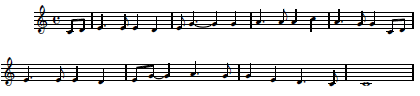
Full size sheet music
Thanks, Paul, for making the audio file.
The sheet music was created using LilyPond.
Sharps and flats in HTML
Apparently there’s no HTML entity for the flat symbol, ♭. In my previous post, I just spelled out B-flat because I thought that was safer; it’s possible not everyone would have the fonts installed to display B♭ correctly.
So how do you display music symbols for flat, sharp, and natural in HTML? You can insert any symbol if you know its Unicode value, though you run the risk that someone viewing the page may not have the necessary fonts installed to view the symbol. Here are the Unicode values for flat, natural, and sharp.
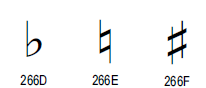
Since the flat sign has Unicode value U+266D, you could enter ♭ into HTML to display that symbol.
The sharp sign raises an interesting question. I’m sure most web pages referring to G-sharp would use the number sign # (U+0023) rather than the sharp sign ♯ (U+266F). And why not? The number sign is conveniently located on a standard keyboard and the sharp sign isn’t. It would be nice if people used sharp symbols rather than number signs. It would make it easier to search on specifically musical terms. But it’s not going to happen.
Update: See this post on font support for Unicode. Most people can see all three symbols, but some, especially Android users, might not see the natural sign.
Related posts
Typesetting music with LilyPond
I tried typesetting music in LaTeX some time ago and gave up. The packages I found were hard to install, the examples didn’t work, etc. This weekend I decided to try again. I tried plowing through the MusiXTeX documentation and got no further than I did last time.
I posted a note on StackOverflow and got some good responses. Nikhil Chelliah suggested I look at LilyPond. I had looked at LilyPond before, and @jleedev explained how to integrate LaTeX and LilyPond.
Here’s some sheet music I included in my previous post, March in 7/4 time.
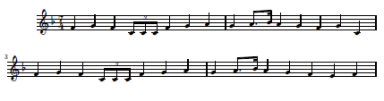
Here’s a full-sized PDF file version of the music above. And here’s the LilyPond source code used to create the music.
\relative c' {
\time 7/4
\key f \major
\clef treble
f g f \times 2/3{ c8 c c} f4 g a
g a8. bes16 a4 g f g c,
f g f \times 2/3{ c8 c c} f4 g a
g a8. bes16 a4 g f e f
}
The notation looks cryptic at first, but it makes sense after a few minutes. The command relative c' means that the following pitches will be relative to middle C. For example, the first note, F, is the F closest to middle C. Each note is the same length as the previous note by default, and the first note is a quarter note by default. The notation c8 means that the C is an eighth note, except it’s in the context of a triplet (times 2/3) and so it’s an eighth note triplet. The next F is denoted f4 to indicate that we’re back to quarter notes.
The notation a8. says that the A is a dotted eighth note. For the next note, bes16 means a B-flat sixteenth note. The suffix “es” stands for “flat” and “is” stands for “sharp.” (The documentation says it’s Dutch. I’ve never seen it before.) I don’t understand why I had to tell it that the B was flat. The code specified earlier that the key was F major, which implies B’s are flat. I suppose the code for individual notes is decoupled from the code to draw the key signature. That would make entering music painful in keys that have lots of sharps or flats. Maybe there’s a way to specify default sharps or flats.
The comma in c, gives the absolute pitch of the C. In relative mode, LilyPond assumes by default that each pitch name refers to the pitch closest to its predecessor. The C closest to the previous note, F, would have been the C up one fourth rather than down one fifth, so the comma was necessary to tell LilyPond to go down.
If I were to do a lot of music processing, I’d probably look at a commercial package such as Sibelius. But for now I’m just interested in producing small excerpts like that above, and it looks like LilyPond may be fine.
Update: I double checked the rules about flats etc. Yes, I do have to specify explicitly that the B in this example is B-flat. If I just say b rather than bes, LilyPond will add a natural sign in front of the B! It’s strange. It is aware of the key signature: when I tell it the B is flat, it says “OK, then I don’t have to mark that specially since it’s implicit in the key signature.” And if I don’t tell it the B is flat, it says “Oh, that’s an exception to the key signature. Better mark it with a natural sign.”
March in 7/4 time
After writing my post on music in 5/4 time, I remembered a march in 7/4 time that I played in band many years ago. Here’s an excerpt, about all I can remember.
In case the music above is too hard to read, here’s a full-sized PDF file version.
Marches are always in even meters: your left foot has to come down on the first beat of every measure when you’re marching. And yet this odd meter tune comes across as a convincing march. (It was a concert march. Actually marching to it would have been odd, pun intended.)
This march had a 4/4 + 3/4 feel, emphasis on the first and fifth beats of each 7/4 measure.
I’ve just started blogging about music recently, and I’ve got a lot to learn. I’m not set up to record audio clips. My next post will describe the software I used to post the sheet music above.
Update: Many thanks to
Related post: Blue Rondo à la Turk
Beatbox flute
Greg Pattillo plays beatbox flute. It’s hard to imagine what that means until you hear it. Here’s a video of Pattillo playing the theme from Sesame Street.
And here’s a video of Pattillo playing Peter and the Wolf.