Poetic description of privacy-preserving analysis

Erlingsson et al give a poetic description of privacy-preserving analysis in their RAPPOR paper [1]. They say that the goal is to

… allow the forest of client data to be studied, without permitting the possibility of looking at individual trees.

Related posts

[1] Úlfar Erlingsson, Vasyl Pihur, and Alexsandra Korolova. RAPPOR: Randomized Aggregatable Privacy-Preserving Ordinal Response. Available here.

Rényi Differential Privacy

Differential privacy, specifically ε-differential privacy, gives strong privacy guarantees, but it can be overly cautious by focusing on worst-case scenarios. The generalization (ε, δ)-differential privacy was introduced to make ε-differential privacy more flexible.

Rényi differential privacy (RDP) is a new generalization of ε-differential privacy by Ilya Mironov that is comparable to the (ε, δ) version but has several advantages. For instance, RDP is easier to interpret than (ε, δ)-DP and composes more simply.

Rényi divergence

My previous post discussed Rényi entropyRényi divergence is to Rényi entropy what Kullback-Leibler divergence is to Shannon entropy.

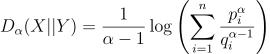
Given two random variables X and Y that take on n possible values each with positive probabilities pi and qi respectively, the Rényi divergence of X from Y is defined by

D_\alpha(X || Y) = \frac{1}{\alpha -1} \log\left( \sum_{i=1}^n \frac{p_i^\alpha}{q_i^{\alpha -1}}\right)

for α > 0 and not equal to 1. The definition extends to α = 0, 1, or ∞ by taking limits.

As α converges to 1, Dα converges to the Kullback-Leibler divergence.

Rényi differential privacy

A couple weeks ago I wrote an introduction to differential privacy that started by saying

Roughly speaking, a query is differentially private if it makes little difference whether your information is included or not.

The post develops precisely what it means for a query to be differentially private. The bottom line (literally!) was

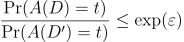
An algorithm A satisfies ε-differential privacy if for every t in the range of A, and for every pair of neighboring databases D and D’,

\frac{\mbox{Pr}(A(D) = t)}{\mbox{Pr}(A(D') = t)} \leq \exp(\varepsilon)

Here it is understood that 0/0 = 1, i.e. if an outcome has zero probability under both databases, differential privacy holds.

It turns out that this definition is equivalent to saying the Rényi divergence of order ∞ between A(D) and A(D‘) is less than ε. That is,

D_\alpha\big(A(D) || A(D')\big) \leq \varepsilon

where α = ∞. The idea of Rényi differential privacy (RDP) is to allow the possibility that α could be finite [1]. That is, an algorithm is (α, ε)-RDP if the Rényi divergence of order α between any two adjacent databases is no more than ε.

One of the nice properties of RDP is how simply algorithms compose: The composition of an (α, ε1)-RDP algorithm and an (α, ε2)-RDP algorithm is a (α, ε1 + ε2)-RDP algorithm. This leads to simple privacy budget accounting.

Comparison to (ε, δ)-differential privacy

The composition of ε-DP algorithms is simple: just substitute α = ∞ in the result above for composing RDP algorithms. However, the resulting bound may be overly pessimistic.

The composition of (ε, δ)-DP algorithms is not as simple: both ε and δ change. With RDP, the order α does not change, and the ε values simply add.

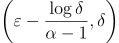
Mironov proves in [1] that every RDP algorithm is also (ε, δ)-DP algorithm. Specifically, Proposition 3 says

If f is an (α, ε)-RDP mechanism, it also satisfies

\left(\varepsilon - \frac{\log \delta}{\alpha - 1}, \delta\right)

differential privacy for any 0 < δ < 1.

This tells us that Rényi differential privacy gives us privacy guarantees that are somewhere between ε-differential privacy and (ε, δ)-differential privacy.

More differential privacy posts

[1] Ilya Mironov, Rényi Differential Privacy. arXiv 1702.07476

International internet privacy law

world map

Scott Hanselman interviewed attorney Gary Nissenbaum in show #647 of Hanselminutes. The title was “How GDPR is effecting the American Legal System.”

Can Europe pass laws constraining American citizens? Didn’t we settle that question in 1776, or at least by 1783? And yet it is inevitable that European law effects Americans. And in fact Nissembaum argues that every country has the potential to pass internet regulation effecting citizens of every other country in the world.

Hanselman: Doesn’t that imply that we can’t win? There’s two hundred and something plus countries in the world and if any European decides to swing by a website in Djibouti now they’re going to be subject to laws of Europe?

Nissenbaum: I’ll double down on that. It implies that any country that has users of the internet can create a more stringent law than even the Europeans, and then on the basis of that being the preeminent regulatory body of the world, because it’s a race to who can be the most restrictive. Because the most restrictive is what everyone needs to comply with.

So if Tanzania decides that it is going to be the most restrictive country in terms of the laws … that relate to internet use of their citizens, theoretically, all websites around the world have to be concerned about that because there are users that could be accessing their website from Tanzania and they wouldn’t even know it.

Will the “world wide web” someday not be worldwide at all? There has been speculation, for example, that we’ll eventually have at least two webs, one Chinese and one non-Chinese. The web could tear into a lot more pieces than that.

As Nissenbaum says toward the end of the podcast

If anyone assumes there’s a simple way of handling this, they’re probably wrong. It is complicated, and you just have to live with that, because that’s the world we’re in.

More data privacy posts

Big data and privacy

patient survey

How does big data impact privacy? Which is a bigger risk to your privacy, being part of a little database or a big database?

Rows vs Columns

People commonly speak of big data in terms of volume—the “four v’s” of big data being volume, variety, velocity, and veracity—but what we’re concerned with here might better be called “area.” We’ll think of our data being in one big table. If there are repeated measures on an individual, think of them as more columns in a denormalized database table.

In what sense is the data big: is it wide or long? That is, if we think of the data as a table with rows for individuals and columns for different fields of information on individuals, are there a lot of rows or a lot of columns?

All else being equal, your privacy goes down as columns go up. The more information someone has about you, the more likely some of it may be used in combination to identify you.

How privacy varies with the number of rows is more complicated. Your privacy could go up or down with the number of rows.

The more individuals in a dataset, the more likely there are individuals like you in the dataset. From the standpoint of k-anonymity, this makes it harder to identify you, but easier to reveal information about you.

Group privacy

For example, suppose there are 50 people who have all the same quasi-identifiers as you do. Say you’re a Native American man in your 40s and there are 49 others like you. Then someone who knows your demographics can’t be sure which record is yours; they’d have a 2% chance of guessing the right one. The presence of other people with similar demographics makes you harder to identify. On the other hand, their presence makes it more likely that someone could find out something you all have in common. If the data show that middle aged Native American men are highly susceptible to some disease, then the data imply that you are likely to be susceptible to that disease.

Because privacy measures aimed at protecting individuals don’t necessarily protect groups, some minority groups have been reluctant to participate in scientific studies. The Genetic Information Nondiscrimination Act of 2008 (GINA) makes some forms of genetic discrimination illegal, but it’s quite understandable that minority groups might still be reluctant to participate in studies.

Improving privacy with size

Your privacy can improve as a dataset gets bigger. If there are a lot of rows, the data curator can afford a substantial amount of randomization without compromising the value of the data. The noise in the data will not effect statistical conclusions from the data but will protect individual privacy.

With differential privacy, the data is held by a trusted curator. Noise is added not to the data itself but to the results of queries on the data. Noise is added in proportion to the sensitivity of a query. The sensitivity of a query often goes down with the size of the database, and so a differentially private query of a big dataset may only need to add a negligible amount of noise to maintain privacy.

If the dataset is very large, it may be possible to randomize the data itself before it enters the database using randomized response or local differential privacy. With these approaches, there’s no need for a trusted data curator. This wouldn’t be possible with a small dataset because the noise would be too large relative to the size of the data.

Related privacy posts

East Coast Code and West Coast Code

In 1999, Harvard law professor Lawrence Lessig stated that software is a kind of law. The algorithms of tech giants have an influence comparable to, and maybe in some ways greater than, statutory law.

The code is law. … Activists concerned with defending liberty, privacy or access must watch the code coming from the Valley—call it West Coast Code—as much as the code coming from Congress—call it East Coast Code.

I imagine more people would agree with him now than did when he said this a couple decades ago.

If you can call statutory law “code” then you could also call algorithms “law” and speak of East Coast Law and West Coast Law.

Source: The Architecture of Privacy

Related: Data privacy consulting

What is differential privacy?

Differential privacy is a strong form of privacy protection with a solid mathematical definition.

Roughly speaking, a query is differentially private if it makes little difference whether your information is included or not. This intuitive idea can be made precise as follows.

Queries and algorithms

First of all, differential privacy is something that applies to queries, not to databases. It could apply to a database if your query is to select everything in the database, but typically you want to run far more specific queries. Differential privacy adds noise to protect privacy, and the more intrusive the query, the more noise must be added, so typically you want queries to be more narrow than “Tell me everything about everything.”

Generally the differential privacy literature speaks of algorithms rather than queries. The two are the same if you have a general idea of what a query is, but using the word algorithm emphasizes that the query need not be a simple SQL query.

Opt-out and neighboring databases

To quantify the idea of “whether your information is included or not” we look at two versions of a database, D and D‘, that differ by one row, which you can think of as the row containing your data. Our formalism is symmetric, so we do not specify which database, D or D‘, is the one which contains your row and which is missing your row.

We should mention some fine print here. The paragraph above implicitly assumes that your database is just a simple table. In general we can speak of neighboring databases. In the case of a more complex database design, the notion of what it means for two databases to be neighboring is more complex. Differential privacy can be defined whenever a notion of neighboring databases can be defined, so you could, for example, consider differential privacy for a non-relational (“No SQL”) database. But for the simple case of a single table, two databases are neighboring if they differ by a row.

However, there’s a subtlety regarding what it means even for two tables to “differ by one row.” Unbound differential privacy assumes one row has been removed from one of the databases. Bound differential privacy assumes the two databases have the same number of rows, but the data in one row has been changed. In practice the difference between bound and unbound differential privacy doesn’t often matter.

Quantifying difference

We said it “makes little difference” whether an individual’s data is included or not. How to we quantify that statement? Differential privacy is a stochastic procedure, so we need to measure difference in terms of probability.

Whenever mathematicians want to speak of two things being close together, we often use ε as our symbol. While in principle ε could be large, the choice of symbol implies that you should think of it as a quantity you can make as small as you like (though there may be some cost that increases as ε decreases).

We’re going to look at ratios of probabilities, so we want these ratios to be near 1. This means we’ll work with eε = exp(ε) rather than ε itself. A convenient property that falls out of the Taylor series for the exponential function is that if ε is small then exp(ε) is approximate 1+ε. For example, exp(0.05) = 1.0513, and so if the ratio of two probabilities is bounded by exp(0.05), the probabilities are roughly within 5% of each other.

Definition of differential privacy

Now we can finally state our definition. An algorithm A satisfies ε-differential privacy if for every t in the range of A, and for every pair of neighboring databases D and D‘,

\frac{\mbox{Pr}(A(D) = t)}{\mbox{Pr}(A(D') = t)} \leq \exp(\varepsilon)

Here it is understood that 0/0 = 1, i.e. if an outcome has zero probability under both databases, differential privacy holds.

Update: See a follow-on post about Rényi differential privacy, a generalization of differential privacy that measures the difference between output probability distributions using information theory rather than bounding ratios. This includes the definition above a special case.

Help with differential privacy

If you’d like help understanding and implementing differential privacy, let’s talk.

Related posts

Earth mover distance and t-closeness

airport crowd

There’s an old saying that if you want to hide a tree, put it in a forest. An analogous principle in privacy is that a record preserves privacy if it’s like a lot of other records.

k-anonymity

The idea of k-anonymity is that every database record appears at least k times when you restrict your attention to quasi-identifiers [1]. If you have a lot of records and few fields, your value of k could be high. But as you get more fields, it becomes more likely that a combination of fields is unique. If k = 1, then k-anonymity offers no anonymity. Even when k is large, k-anonymity might prevent re-identification but still suffer from attribute disclosure.

Another problem with k-anonymity is that it doesn’t offer group privacy. A database could be k-anonymous but reveal information about a group if that group is homogeneous with respect to some field. That is, the method is subject to a homogeneity attack.

Or going the other way around, if you know already know something that stands about a group, this could help you identify the record belonging to an individual. That is, the method is subject to a background knowledge attack.

One way to address this shortcoming is l-diversity. This post won’t go into l-diversity because it’s an intermediate step to where we want to go, which is t-closeness.

t-closeness

The idea of t-closeness is that the distribution of sensitive data in every group is not too far from the distribution in the full population. The “t” comes from requiring that the distributions be no more than a distance t apart in a sense that we’ll define below [2]. If the sensitive data in a group doesn’t stand out, this thwarts the homogeneity attack and the background knowledge attack.

Earth mover distance

When we say that the distribution on sensitive data within a group is not far from the distribution in the full data, how do we quantify what “far” means? That is, how do we measure the distance between two distributions?

There are a lot of ways to measure the similarity of two probability distributions. A common choice is the Kullback-Leiler divergence, though that’s not what we’ll use here. Instead, t-closeness uses the so-called earth mover distance (EMD), also known as the Wasserstein metric.

The idea of EMD is to imagine both probability distributions as piles of dirt and calculate the minimum amount of work needed to reshape the first pile so that it has the same shape as the second. The key attribute of EMD is that it takes distance into account.

Suppose your data is some ordered response, 1 through 5. Suppose distribution X has probability 0.8 at 1 and 0.05 for the rest of the responses. Distributions Y and Z are the same except they have 80% of their probability mass at 2 and at 5 respectively. By some measures, X is equally far from Y and Z, but the earth mover distance would say that X is closer to Y than to Z, which is more appropriate in our setting.

We can calculate the EMD for the example above. To transform X into Y, we need to move a probability mass of 0.75 from 1 to 2, and so the EMD is 0.75. To transform X into Z we need to move the same amount of mass, but we need to move it 4x further, and so the EMD is 3.

Related posts

[1] What exactly is a quasi-identifier? That’s hard to say precisely. An identifier is something that clearly identifies an individual. A phone number, for example, is an identifier. A quasi-identifier is something that helps narrow down who a person is, but isn’t an identifier. For example, someone’s birthday would be a quasi-identifier. But in general “quasi-identifier” is not a precisely defined concept.

[2] It’s common in math to use a variable name as an adjective, as with k-anonymity, l-diversity, and t-closeness. This is unfortunate because it isn’t descriptive and locks in a variable naming convention. Someone used the variable k to count the number of redundant database tables, and the name stuck. Similarly the l in l-diversity counts something.

As a sidenote, the variable names here follow the old FORTRAN convention that variables i through n represent integers by default, and that all other variables represent real (floating point) numbers by default. The t in t-closeness is a continuous measure, so the t is a real value, while k and l are integers.

Format-preserving encryption (FPE) for privacy

The idea of format-preserving encryption is to encrypt data while keeping its form, a sort of encryption in kind. An encrypted credit card number would look like a credit card number, a string of text would be replaced with a string of text, etc.

Format preserving encryption (FPE) is useful in creating a test or demo database. You want realistic data without having accurate data (at least for sensitive data fields), and using FPE on real data might be the way to go.

If a field is supposed to contain a 10-digit number, say a phone number, you want the test data to also contain a 10-digit number. Otherwise validation software might break. And if that number is a key that links tables together, simply substituting a random number would break the relationships unless the same random replacement was used everywhere. Also, two clear numbers could be replaced with the same randomly chosen value. FPE would be a simple way to avoid these problems.

FPE is a two-edged sword. It may be desirable to preserve formatting, but it could also cause problems. Using any form of encryption, format-preserving or not, to preserve the database structure could reveal information you don’t intend to reveal.

It’s quite possible to encrypt data and still compromise privacy. If you encrypt data, but not metadata, then you might keep enough information to re-identify individuals. For example, if you encrypt someone’s messages but retain the time stamp on the messages, that might be enough to identify that person.

The meaning of “format-preserving” can vary, and that could inadvertently leak information. What does it mean to encrypt English text in a format-preserving way? It could mean that English words are replaced with English words. If this is done simplistically, then the number of words in the clear text is revealed. If a set of English words is replaced with a variable number of English words, you’re still revealing that the original text was English.

FPE may not reveal anything that wasn’t already known. If you know that a field in a database contains a 9-digit number, then encrypting it as a 9-digit number doesn’t reveal anything per se. But it might be a problem if it reveals that two numbers are the same number.

What about errors? What happens if a field that is supposed to be a 9-digit number isn’t? Maybe it contains a non-digit character, or it contains more than 9 digits. The encryption software should report an error. But if it doesn’t, maybe the encrypted output is not a 9-digit number, revealing that there was an error in the input. Maybe that’s a problem, maybe not. Depends on context.

Related: Data privacy consulting


PHI and offshore data processing

eastern hemisphere

The US government does not prohibit the transfer of PHI (protected health information) offshore [1], but it does subject offshore data processing to extra reporting [2] and more scrutiny in general. The CMS (Centers for Medicare & Medicaid Services, part of the Department of Health and Human Services) has said

Given the unique risks associated with the use of contractors operating outside the jurisdiction of the United States, CMS encourages sponsors using offshore subcontractors to take extraordinary measures to ensure that offshore arrangements protect beneficiary privacy [3, emphasis added].

Why are the risks unique? For one thing, subcontractors outside the US may not be familiar with US law or held accountable for complying with that law.

What are the necessary “extraordinary measures”? The CMS does not say because the answer depends very much on context. The probability of being able to identify someone from a set of data fields depends on what those fields are. It also can change over time, and so the conclusion needs to be reviewed periodically.

It is legal to give a third party access to PHI if there is a BAA in place. For example, if a hospital outsources billing, the company doing the billing must see personal information in order to carry out their business function. But with offshore processing, it seems safest, if practical, to proceed as if there were no BAA in place and deidentify the data before it leaves the US.

If you’d like help with privacy regulation compliance or data de-identification, let’s talk.

Related

[1] Nothing in this blog post is legal advice. Compliance with privacy regulation is both a legal and statistical matter. I address statistical questions and let lawyers address legal questions. I have a lawyer specializing in healthcare law who I recommend if clients don’t have their own legal expert.

[2] CMS memo September 16, 2011. Contract Year (CY) 2012 Medicare Advantage and Part D Readiness Checklist. Available here.

[3] Allen Briskin, Lisa C. Earl, Gerry Hinkley, and Joseph E. Kendall. Offshoring Health Information: Issues and Lingering Concerns. Journal of Health & Life Sciences Law. Vol. 8, No. 1.

Generating Laplace random variables

Differential privacy adds Laplace-distributed random noise to data to protect individual privacy. Although it’s simple to generate Laplacian random values, the Laplace distribution is not always one of the built-in options for random number generation libraries.

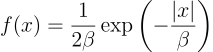
The Laplace distribution with scale β has density

f(x) = \frac{1}{2\beta} \exp\left(-\frac{|x|}{\beta} \right )

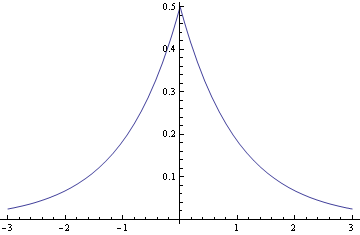
The Laplace distribution is also called the double exponential because it looks like two mirror-image exponential distributions glued together.

Note that the scale β is not the standard deviation. The standard deviation is √2 β.

To generate samples from a Laplace distribution with scale β, generate two independent exponential samples with mean β and return their difference.

If you don’t have an API for generating exponential random values, generate uniform random values and return the negative of the log. That will produce exponential values with mean 1. To make random values with mean β, just multiply the results by β.

If you want to generate Laplace values in Python, you could simply use the laplace function in scipy.stats. But I’ll write a generator from scratch just to show what you might do in another environment where you didn’t have exponential or Laplace generators.

    from math import log
    from random import random

    def exp_sample(mean): 
        return -mean*log(random())

    def laplace(scale):
        e1 = exp_sample(scale)
        e2 = exp_sample(scale)
        return e1 - e2

Related: Stand-alone numerical code, useful when you need a few common mathematical functions but are in an environment that doesn’t provide them, or when you want to avoid adding a library to your project.