Blog Archives

The rise and fall of binomial coefficients

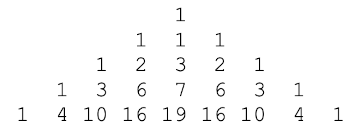
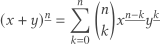
When you expand (x + y)n, the coefficients increase then decrease. The largest coefficient is in the middle if n is even; it’s the two in the middle if n is odd. For example, the coefficients for (1 + x)4

Tagged with: ,
Posted in Math

Looking in both directions

From David Mumford’s May 2013 interview in SIAM News: The applied mathematician has the difficult job of looking at a problem in context with no explicit mathematics and trying to see what kinds of mathematical ideas are under the surface

Tagged with:
Posted in Math

Mutually odd functions

The floor of a real number x is the largest integer n ≤ x, written ⌊x⌋. The ceiling of a real number x is the smallest integer n ≥ x, written ⌈x⌉. The floor and ceiling have the following symmetric

Tagged with:
Posted in Math

Recognizing numbers

I was playing around with SymPy, a symbolic math package for Python, and ran across nsimplify. It takes a floating point number and tries to simplify it: as a fraction with a small denominator, square root of a small integer,

Tagged with: ,
Posted in Math, Python

Why j for imaginary unit?

Electrical engineers use j for the square root of -1 while nearly everyone else uses i. The usual explanation is that EE’s do this because they use i for current. But here’s one advantage to using j that has nothing

Tagged with:
Posted in Math

Social networks in fact and fiction

SIAM News arrived this afternoon and had an interesting story on the front page: Applying math to myth helps separate fact from fiction. In a nutshell, the authors hope to get some insight into whether a myth is based on

Tagged with: ,
Posted in Math

Physical versus medical modeling

Modeling is more fun when you have some confidence in your modeling assumptions. I’ve been working with models of physical systems lately and it’s been more enjoyable than the medical modeling I’ve done over the last few years. I have

Tagged with: ,
Posted in Math

An incomplete post about sphere volumes

This is an incomplete blog post. Maybe you can help finish it. One of the formulas I’ve looked up the most is the volume of a ball in n dimensions. I needed it often enough to be aware of it,

Tagged with:
Posted in Math

That makes it invertible

How can you know when a matrix is invertible? Here’s a video from a college friend of mine that answers the question.

Tagged with:
Posted in Math

Five post on computing pi

In honor of Pi Day, here are five posts I’ve written on calculating pi. Oldest series for pi Calculating pi with AGM and mpmath Ramanujan pi approximation Algorithm for pi world records A Ramanujan series for calculating pi

Tagged with:
Posted in Math

Fractal-like phase plots

Define f(z) = iz*exp(-z/sin(iz)) + 1 and g(z) = f(f(z)) + 2 for a complex argument z. Here’s what the phase plots of g look like. The first image lets the real and imaginary parts of z range from -10

Tagged with:
Posted in Math

Wallpaper and phase portraits

Suppose you want to create a background image that tiles well. You’d like it to be periodic horizontally and vertically so that there are no obvious jumps when the image repeats. Functions like sine and cosine are period along the

Tagged with: ,
Posted in Math, Python

How mathematicians see physics

From the preface to Physics for Mathematicians: In addition to presenting the advanced physics, which mathematicians find so easy, I also want to explore the workings of elementary physics, and mysterious maneuvers — which physicists seem to find so natural

Tagged with: ,
Posted in Math, Science

Fourier series before Fourier

I always thought that Fourier was the first to come up with the idea of expressing general functions as infinite sums of sines and cosines. Apparently this isn’t true. The idea that various functions can be described in terms of

Tagged with: , ,
Posted in Math

Generalized Fourier transforms

How do you take the Fourier transform of a function when the integral that would define its transform doesn’t converge? The answer is similar to how you can differentiate a non-differentiable function: you take a theorem from ordinary functions and

Tagged with:
Posted in Math