Simple approximation for Gamma function

I find simple approximations more interesting than highly accurate approximations. Highly accurate approximations can be interesting too, in a different way. Somebody has to write the code to compute special functions to many decimal places, and sometimes that person has been me. But somewhat ironically, these complicated approximations are better known than simple approximations.

One reason I find simple approximations interesting is that they suggest further exploration. For example, the approximation for the perimeter of an ellipse here is interesting because of the connection to r-means. There are more accurate approximations, but not more interesting approximations, in my opinion.

Another reason I find simple approximations interesting is that if they are simple enough to be memorable and easy to evaluate, they’re useful for quick mental calculations.

I’ve written several posts about simple approximations, and this may be the last one, at least for a while. I’ve covered trig functions, logs and exponents. The most commonly used function I haven’t discussed is the gamma function, which I cover now.

Gamma

The most important function that’s not likely to be on a calculator is the gamma function Γ(x). This function comes up all the time in probability and statistics, as well as in other areas of math.

The gamma function satisfies

Γ(x + 1) = x Γ(x),

and so you can evaluate the function anywhere if you can evaluate it on an interval of length 1. For example, the next section gives an approximation on the interval [2, 3]. We could reduce calculating Γ(4.2) to a problem on that interval by

Γ(4.2) = 3.2 Γ(3.2) = 3.2 × 2.2 Γ(2.2)

Simple approximation

It turns out that

Γ(x) ≈ 2/(4 − x)

for 2 ≤ x ≤ 3. The approximation is exact on the end points, and the relative error is less than 0.9% over the interval.

An even simpler approximation over the interval [2, 3] is

Γ(x) ≈ x − 1.

It has a maximum relative error of about 13%, so it’s far less accurate, but it’s trivial to compute in your head.

Derivation

The way I found the rational approximation was to use Mathematica to find the best bilinear approximation using

    MiniMaxApproximation[Gamma[x], {x, {2, 3}, 1, 1}]

and rounding the coefficients. In hindsight, I could have simply used bilinear interpolation. I did use linear interpolation to derive the approximation x − 1.
More gamma function posts

Mentally computing e^x

A few days ago I wrote about how to estimate 10x. This is an analogous post for

exp(x) = ex.

We will assume -0.5 ≤ x ≤ 0.5. You can bootstrap your way from there to other values of x. For example,

exp(1.3) = exp(1 + 0.3) = e exp(0.3)

and

exp(0.8) = exp(1 – 0.2) = e / exp(0.2).

I showed here that

loge(x)≈ (2x − 2)/(x + 1)

for x between exp(-0.5) and exp(0.5).

Inverting both sides of the approximation shows

exp(x) ≈ (2 + x)/(2 − x)

for x between −0.5 and 0.5.

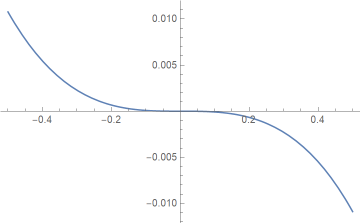
The maximum relative error in this approximation is less than 1.1% and occurs at x = 0.5. For x closer to the middle of the interval [−0.5, 0.5] the relative error is much smaller.

Here’s a plot of the relative error.

This was produced with the following Mathematica code.

    re[x_] := (Exp[x] - (2 + x)/(2 - x))/Exp[x]
    Plot[re[x], {x, -0.5, 0.5}]

Update: The approximations from this post and several similar posts are all consolidated here.

More approximation posts

What makes the log10 trick work?

In my post on mentally calculating logarithms, I showed that

log10 x ≈ (x − 1)/(x + 1)

for 1/√10 ≤ x ≤ √10. You could convert this into an approximation for logs in any base by multiplying by the right scaling factor, but why does it work out so simply for base 10?

Define

m(x) = (x − 1)/(x + 1).

Notice that m(1) = 0 and m(1/x) = −m(x), two properties that m shares with logarithms. This is a clue that there’s a connection between m and logs.

Now suppose we want to approximate logb by k m(x) over the interval 1/√ bx ≤ √b. How do we pick k? If we choose

k = 1/(2m(√b))

then our approximation error will be zero at both ends of our interval.

If b = 10, k = 0.9625, i.e. close to 1. That’s why the approximation rule is particularly simple when b = 10. And although it’s good enough to round 0.9625 to 1 for rough calculations, our approximation for logs base 10 would be a little better if we didn’t.

More bases

In the process of asking why base 10 was special, we came up with a general way of constructing logarithm approximations for any base.

Using the method above we find that

loge ≈ 2.0413 (x − 1)/(x + 1)

over the interval 1/√ex ≤ √e and that

log2 ≈ 2.9142 (x − 1)/(x + 1)

over the interval 1/√2 ≤ x ≤ √2.

These rules are especially convenient if you round 2.0413 down to 2 and round 2.9142 up to 3. These changes are no bigger than rounding 0.9625 up to 1, which we did implicitly in the rule for logs base 10.

Curiosities

The log base 100 of a number is half the log base 10 of the number. So you could calculate the log of a number base 100 two ways: directly using b = 100 with the method above, or indirectly by setting b = 10 and dividing your result by 2. Do these give you the same answer? Nope! Our scaling is not linear in the (logarithm of) the base.

Well, then which is better? Taking the log base 10 first and dividing by 2 is better. In general, the smaller the base, the more accurate the result.

This seems strange at first, like something for nothing, but realize than when b is smaller, so is the interval we’re working over. You’ve done more work in reducing the range when you use a smaller base, and your reward is that you get a more accurate result. Since 2 is the smallest logarithm base that comes up with any regularity, the approximation for log base 2 is the most accurate of its kind that is likely to come up.

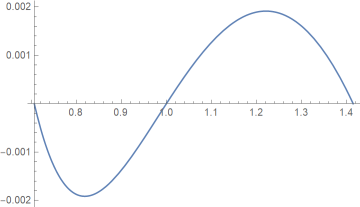
For every base b, we’ve shown that the approximation error is zero at 1/√b, 1, and √b. What we haven’t shown is that we have what’s known as “equal ripple” error. For example, here’s a plot of the error for our rule for approximating log base 2.


The error goes exactly as far negative on the left of 1 as it goes positive on the right of 1. The minimum is −0.00191483 and the maximum is 0.00191483. This follows from the property

m(1/x) = −m(x)

mentioned above. The location of the minimum (signed) error is the reciprocal location of the maximum error, and the value of that minimum is the negative of the maximum.

Update: The approximations from this post and several similar posts are all consolidated here.

Mentally calculating 10^x

This is the last in a sequence of three posts on mental calculation. The first looked at computing sine, cosine, and tangent in degrees. The second looked at computing logarithms, initially in base 10 but bootstrapping from there to other bases as well.

In the previous post, we showed that

log10 x ≈ (x − 1)/(x + 1)

for x between 0.3 and 3.

If we take the inverse of the functions on both sides we get

10x ≈ (1 + x)/(1 − x).

for x between −0.5 and 0.5.

If the fractional part of x is not between −0.5 and 0.5 use

10x + 0.5 = 10x 100.5

to reduce it to that case.

For example, suppose you want a rough estimate of 102.7. Then

102.7 = 102 100.5 100.2 ≈ 100 × 3 × 1.2/0.8 = 450

This calculation approximates the square root of 10 as 3. Obviously you’ll get a better answer if you use a better approximation for square root of 10. Incidentally, π is not a bad approximation to √10; using 3.14 would be better than using 3.

Plots and error

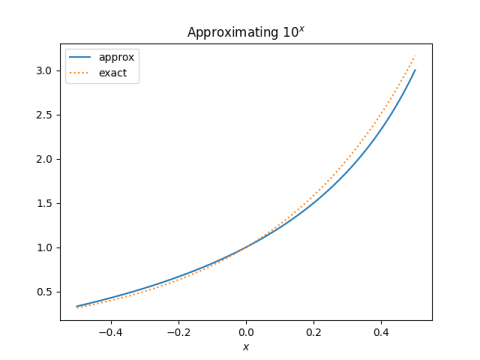
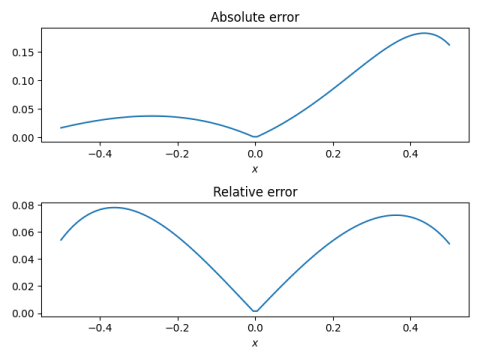
The graph below shows how good our approximation is. You can see that the error increases with x.

But the function we’re approximating also grows with x, and the relative error is nearly symmetric about zero.

Relative error is more important than absolute error if you’re going to multiply the result by something else, as we do when the fractional part of x has absolute value greater than 0.5.

Improvement

The virtue of the approximation above is that it is simple, and moderately accurate, with relative error less than 8%. If you want more accuracy, but still want something easy enough to calculate manually, a couple tweaks make the approximation more accurate.

The approximation

10x ≈ (1 + x)/(1 − x)

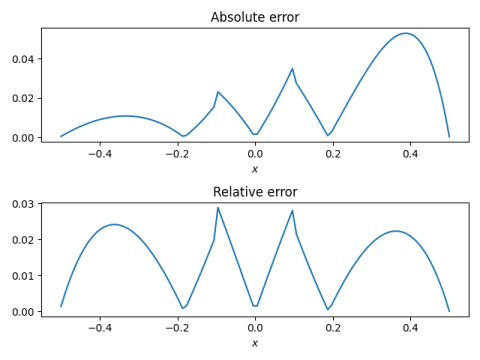
is a little high on the left of zero, and a little low on the right. You can do a little better by using

10x ≈ 0.95 (1 + x)/(1 − x)

for −0.5 < x < −0.1, and

10x ≈ 1.05 (1 + x)/(1 − x)

for 0.1 < x < 0.5.

Now the relative error stays below 0.03. The absolute error is a little high on the right end, but we’ve optimized for relative error.

In case you’re wondering where the factors of 0.95 and 1.05 came from, they’re approximately 3/√10 and √10/3 respectively.

Update: The approximations from this post and several similar posts are all consolidated here.

Mentally calculating logarithms

The previous post looked at approximations for trig functions that are simple enough to compute without a calculator. I wondered whether I could come up with something similar for logarithms. I start with log base 10. Later in the post I show how to get to find logs in other bases from logs base 10.

Let

x = m × 10p.

where 1 ≤ m ≤ 10. Then

log10(x) = log10(m) + p

and so without loss of generality we can assume 1 ≤ x ≤ 10.

But we can narrow our range a little more. If x > 3, compute the log of x‘ = x/10, and if x < 0.3 then compute the log of 10x. So we will assume

0.3 ≤ x ≤ 3.

For x in this range

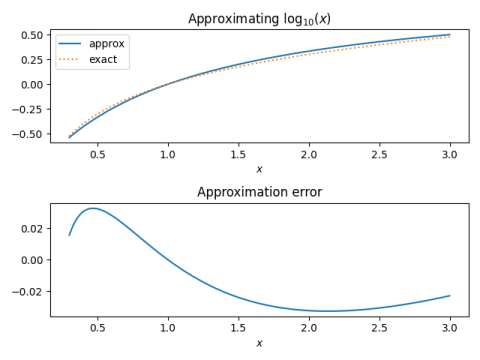
log10(x) ≈ (x − 1)/(x + 1)

is a remarkably good approximation. The absolute error is less than 0.0327 on the interval [0.3, 3].

Examples

log10 0.6 ≈ (0.6 − 1)/(0.6 + 1) = −1/4 = −0.25. Exact: −0.2218

log10 1776 = 3 + log10 1.776 ≈ 3 + 0.776/2.776 = 3.2795. Exact: 3.2494

log10 9000 = 4 + log10 0.9 ≈ 4 − 0.1/1.9 = 3.9473. Exact: 3.9542

Other bases

Logs to all bases are proportional, so you can convert between log base 10 and log to any other base by multiplying by a proportionality constant.

logb(x) = log10(x) / log10(b).

So suppose, for example, you want to compute log2 48. Since 48 = 32 × 1.5 we have

log2 48 = log2 32 + log2 1.5 = 5 + log10 1.5 / log10 2

We can approximate log10 1.5 as 1/5 and log10 2 as 1/3 to get

log2 48 = 5 + 3/5 = 5.6.

The exact value is 5.585.

If you want to use this for natural logs, you might want to memorize

1/log10 e = loge 10 = 2.3.

Update: There’s a better way to work with other bases. See this post. The same post explains why the approximation is particularly simple for logs base 10.

More accuracy

Abramowitz and Stegun refines the approximation t = (x − 1)/(x + 1). They use the interval [1/√10, √10] rather than [0.3, 3]. This slightly different interval is symmetric about 0 when you convert to t. Equation 4.1.41 runs t through a cubic polynomial and lowers the absolute error to less than 6 × 10⁻⁴. Equation 4.1.42 uses a 9th degree polynomial in t to lower the absolute error below 10−9.

Next

My next post will show how to compute 10x analogously.

Related posts

Simple trig function approximations

Anthony Robin gives three simple approximations for trig functions in degrees in [1].

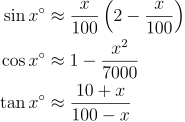
\begin{align*} \sin x\degree &\approx \frac{x}{100}\left(2 - \frac{x}{100} \right ) \\ \cos x\degree &\approx 1 - \frac{x^2}{7000} \\ \tan x\degree &\approx \frac{10 + x}{100-x} \end{align*}

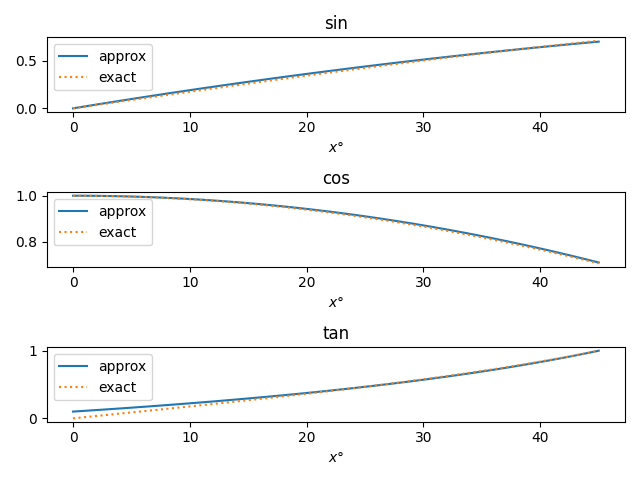
The following plots show that these approximations are pretty good. It’s hard to distinguish the approximate and exact curves.

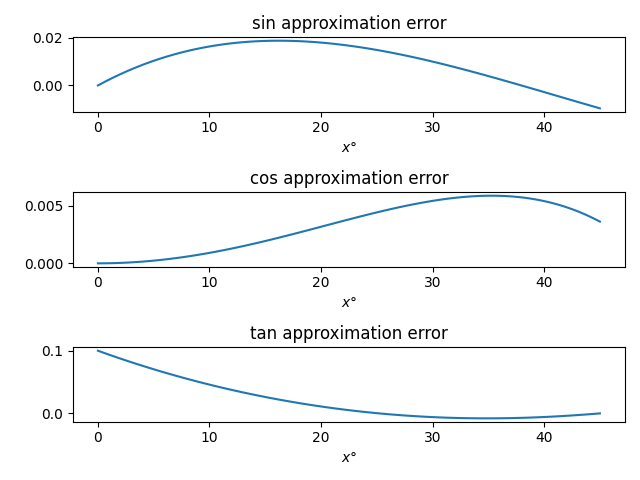
The accuracy of the approximations is easier to see when we subtract off the exact values.

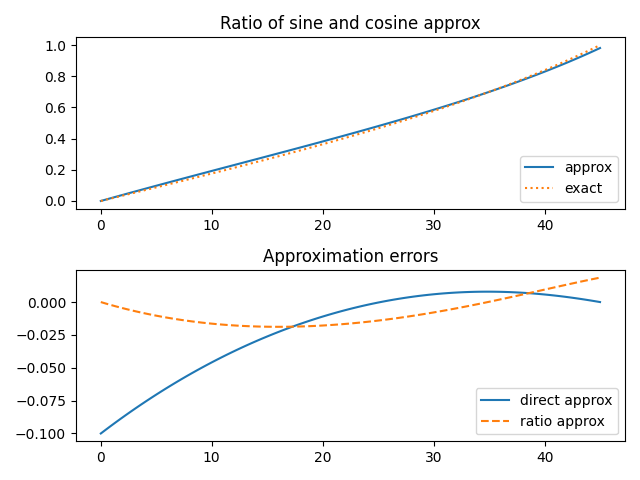
The only problem is that the tangent approximation is poor for small angles [2]. The ratio of the sine and cosine approximations makes a much better approximation, but it this requires more work to evaluate. You could use the ratio for small angles, say less than 20°, and switch over to the tangent approximation for larger angles.

Update: The approximations from this post and several similar posts are all consolidated here.

Here’s the Python code that was used to create the plots in this post. It uses one trick you may find interesting, using the eval function to bridge between the names of functions and the functions themselves.

from numpy import sin, cos, tan, linspace, deg2rad
import matplotlib.pyplot as plt

sin_approx = lambda x: 0.01*x*(2-0.01*x)
cos_approx = lambda x: 1 - x*x/7000.0
tan_approx = lambda x: (10.0 + x)/(100.0 - x)

trig_functions = ["sin", "cos", "tan"];
x = linspace(0, 45, 100)

fig, ax = plt.subplots(3,1)
for n, trig in enumerate(trig_functions):
    ax[n].plot(x, eval(trig + "_approx(x)"))
    ax[n].plot(x, eval(trig + "(deg2rad(x))"), ":")
    ax[n].legend(["approx", "exact"])
    ax[n].set_title(trig)
    ax[n].set_xlabel(r"$x\degree$")

plt.tight_layout()
plt.savefig("trig_approx_plot.png")

fig, ax = plt.subplots(3,1)
for n, trig in enumerate(trig_functions):
    y = eval(trig + "_approx(x)")
    z = eval(trig + "(deg2rad(x))")
    ax[n].plot(x, y-z)
    ax[n].set_title(trig + " approximation error")
    ax[n].set_xlabel(r"$x\degree$")

plt.tight_layout()
plt.savefig("trig_approx_error.png")

tan_approx2 = lambda x: sin_approx(x)/cos_approx(x)

fig, ax = plt.subplots(2, 1)
y = tan(deg2rad(x))
ax[0].plot(x, tan_approx2(x))
ax[0].plot(x, y, ":")
ax[0].legend(["approx", "exact"], loc="lower right")
ax[0].set_title("Ratio of sine and cosine approx")
ax[1].plot(x, y - tan_approx(x), "-")
ax[1].plot(x, y - tan_approx2(x), "--")
ax[1].legend(["direct approx", "ratio approx"])
ax[1].set_title("Approximation errors")

plt.tight_layout()
plt.savefig("tan_approx.png")

Related posts

[1] Anthony C. Robin. Simple Trigonometric Approximations. The Mathematical Gazette, Vol. 79, No. 485 (Jul., 1995), pp. 385-387

[2] When I first saw this I thought “No big deal. You can just use tan θ ≈ θ for small angles, or tan θ ≈ θ + θ³/3 if you need more accuracy.” But these statements don’t apply here because we’re working in degrees, not radians.

tan θ° is not approximately θ for small angles but rather approximately π θ / 180. If you’re working without a calculator you don’t want to multiply by π if you don’t have to, and a calculator that doesn’t have keys for trig functions may not have a key for π.

Divisibility by any prime

Here is a general approach to determining whether a number is divisible by a prime. I’ll start with a couple examples before I state the general rule. This method is documented in [1].

First example: Is 2759 divisible by 31?

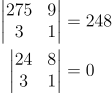
Yes, because

\begin{align*} \begin{vmatrix} 275 & 9 \\ 3 & 1 \end{vmatrix} &= 248 \\ \begin{vmatrix} 24 & 8 \\ 3 & 1 \end{vmatrix} &= 0 \end{align*}

and 0 is divisible by 31.

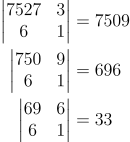
Is 75273 divisible by 61? No, because

\begin{align*} \begin{vmatrix} 7527 & 3 \\ 6 & 1 \end{vmatrix} &= 7509 \\ \begin{vmatrix} 750 & 9\\ 6 & 1 \end{vmatrix} &= 696\\ \begin{vmatrix} 69 & 6\\ 6 & 1 \end{vmatrix} &= 33 \end{align*}

and 33 is not divisible by 61.

What in the world is going on?

Let p be an odd prime and n a number we want to test for divisibility by p. Write n as 10a + b where b is a single digit. Then there is a number k, depending on p, such that n is divisible by p if and only if

\begin{align*} \begin{vmatrix} a & b \\ k & 1 \end{vmatrix} \end{align*}

is divisible by p.

So how do we find k?

  • If p ends in 1, we can take k = ⌊p / 10⌋.
  • If p ends in 3, we can take k = ⌊7p / 10⌋.
  • If p ends in 7, we can take k = ⌊3p / 10⌋.
  • If p ends in 9, we can take k = ⌊9p / 10⌋.

Here ⌊x⌋ means the floor of x, the largest integer no greater than x. Divisibility by even primes and primes ending in 5 is left as an exercise for the reader. The rule takes more effort to carry out when k is larger, but this rule generally takes less time than long division by p.

One final example. Suppose we want to test divisibility by 37. Since 37*3 = 111, k = 11.

Let’s test whether 3293 is divisible by 37.

329 − 11×3 = 296

29 − 11×6 = 37

and so yes, 3293 is divisible by 37.

[1] R. A. Watson. Tests for Divisibility. The Mathematical Gazette, Vol. 87, No. 510 (Nov., 2003), pp. 493-494

Mentally computing 3rd and 5th roots

A couple years ago I wrote about a trick for mentally computing the fifth root of an integer if you know that the number you’re starting with is the fifth power of a two-digit number.

This morning I wrote up a similar (and simpler) trick for cube roots as a thread on @AlgebraFact. You can find the Twitter thread starting here, or you could go to this page that unrolls the whole thread in one page.

Test for divisibility by 13

There are simple rules for telling whether a number is divisible by 2, 3, 4, 5, and 6.

  • A number is divisible by 2 if its last digit is divisible by 2.
  • A number is divisible by 3 if the sum of its digits is divisible by 3.
  • A number is divisible by 4 if the number formed by its last two digits is divisible by 4.
  • A number is divisible by 5 if its last digit is divisible by 5.
  • A number is divisible by 6 if it is divisible by 2 and by 3.

There is a rule for divisibility by 7, but it’s a little wonky. Let’s keep going.

  • A number is divisible by 8 if the number formed by its last three digits is divisible by 8.
  • A number is divisible by 9 if the sum of its digits is divisible by 9.
  • A number is divisible by 10 if its last digit is 0.

There’s a rule for divisibility by 11. It’s a little complicated, though not as complicated as the rule for 7. I describe the rule for 11 in the penultimate paragraph here.

A number is divisible by 12 if it’s divisible by 3 and 4. (It matters here that 3 and 4 are relatively prime. It’s not true, for example, that a number is divisible by 12 if it’s divisible by 2 and 6.)

But what do you do when you get to 13?

Testing divisibility by 7, 11, and 13

We’re going to kill three birds with one stone by presenting a rule for testing divisibility by 13 that also gives new rules for testing divisibility by 7 and 11. So if you’re trying to factor a number by hand, this will give a way to test three primes at once.

To test divisibility by 7, 11, and 13, write your number with digits grouped into threes as usual. For example,

11,037,989

Then think of each group as a separate number — e.g. 11, 37, and 989 — and take the alternating sum, starting with a + sign on the last term.

989 – 37 + 11

The original number is divisible by 7 (or 11 or 13) if this alternating sum is divisible by 7 (or 11 or 13 respectively).

The alternating sum in our example is 963, which is clearly 9*107, and not divisible by 7, 11, or 13. Therefore 11,037,989 is not divisible by 7, 11, or 13.

Here’s another example. Let’s start with

4,894,498,518

The alternating sum is

518 − 498 + 894 – 4 = 910

The sum takes a bit of work, but less work than dividing a 10-digit number by 7, 11, and 13.

The sum 910 factors into 7*13*10, and so it is divisible by 7 and by 13, but not by 11. That tells us 4,894,498,518 is divisible by 7 and 13 but not by 11.

Why this works

The heart of the method is that 7*11*13 = 1001. If I subtract a multiple of 1001 from a number, I don’t change its divisibility by 7, 11, or 13. More than that, I don’t change its remainder by 7, 11, or 13.

The steps in the method amount to adding or subtracting multiples of 1001 and dividing by 1000. The former doesn’t change the remainder by 7, 11, or 13, but the latter multiplies the remainder by −1, hence the alternating sum. (1000 is congruent to -1 mod 7, mod 11, and mod 13.) See more formal argument in footnote [1].

So not only can we test for divisibility by 7, 11, and 13 with this method, we can also find the remainders by 7, 11, and 13. The original number and the alternating sum are congruent mod 1001, so they are congruent mod 7, mod 11, and mod 13.

In our first example, n = 11,037,989 and the alternating sum was m = 963. The remainder when m is divided by 7 is 4, so the remainder when n is divided by 7 is also 4. That is, m is congruent to 4 mod 7, and so n is congruent to 4 mod 7. Similarly, m is congruent to 6 mod 11, and so n is congruent to 6 mod 11. And finally m is congruent to 1 mod 13, so n is congruent to 1 mod 13.

Related posts

[1] The key calculation is
10^3 \equiv -1 \bmod 1001 \implies \sum_{i=0}^n a_i10^{3i} \equiv \sum_{i=0}^n (-1)^ia_i \bmod 1001

Casting out z’s

“Casting out nines” is a trick for determining the remainder when a number is divided by nine. Just add the digits of the number together. For example, what’s the remainder when 3679 is divided by 9? The same as when 3 + 6 + 7 + 9 = 25 is divided by 9. We can apply the same trick again: 2 + 5 = 7, so the remainder is 8.

The “casting out” part of the name refers to the fact that you can ignore 9’s along the way because they don’t effect the final sum. In the example above, we could see that the result would be 7 by “casting out” 36 and 9.

Casting out nines works because 9 is one less than 10, i.e. one less than the base we use to represent numbers. The analogous trick would work casting out (b − 1)’s in base b. So you could cast out 7’s in base 8, or F‘s in base 16, or Z’s in base 36.

Why can you cast out (b − 1)’s in base b? First, a number written is base b is a polynomial in b. If the representation of a number x is anan-1 … a1a0 then

x = anbn + an−1bn−1 + … + a1b + a0.

Since

bm − 1 = (b − 1)(bm−1 + bm−2 + … + 1)

it follows that bm leaves a remainder of 1 when divided by b − 1. So ambm leaves the same remainder as am when divided by b − 1. If follows that

anbn + an−1bn−1 + … + a1b + a0

has the same remainder when divided by b − 1 as

an + an−1 + … + a1 + a0

does when it is divided by b − 1.

Related posts