Boolean function minimization with AI

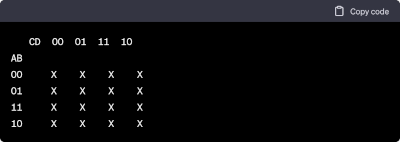
Screenshot of Karnaugh map produced by ChatGPT

I was curious how well LLMs would do at minimizing a Boolean expression, that is, taking a Boolean expression and producing a smaller equivalent expression.

I didn’t expect good performance because this problem is more about logic than recall, but sometimes LLMs surprise you, so I wanted to give it a chance. I thought it might accomplish some reduction in size though not as much as possible. Let’s see what it did.

Prompt

My prompt for the three platforms I tried—GPT4All, ChatGPT, and Google Bard—was

Minimize the boolean expression ¬AB¬C¬D + A¬B¬C¬D + A¬B¬CD + A¬BC¬D + A¬BCD + AB¬C¬D + ABC¬D + ABCD

I knew the expression could be minimized to

B¬C¬D + A¬D + AC.

GPT4All

I first tried GPT4All using the Groovy data set. It crashed immediately. I tried a few variations on the same prompt and it crashed right away every time.

This was on a MacBook Pro. I didn’t try it on Windows or Linux.

ChatGPT

I’ll go through ChatGPT’s response a little at a time.

To minimize the given boolean expression ¬AB¬C¬D + A¬B¬C¬D + A¬B¬CD + A¬BC¬D + A¬BCD + AB¬C¬D + ABC¬D + ABCD, we can use Karnaugh maps or Boolean algebra simplification techniques. I’ll demonstrate both methods.

This is a sensible start. Karnaugh maps are a common classroom technique for solving small Boolean minimization problems, so there were lots of examples of Karnaugh maps in the data scraped to train ChatGPT.

Next ChatGPT draws a Karnaugh map. The screenshot at the top of the post was from a different experiment, a version of the experiment described here but containing an error on my part. This problem produced a black image simply containing “CD” but also contained a Karnaugh map in text. Cleaning up the formatting we get the following.

       | 00 | 01 | 11 | 10 |
    00 |  1 |  0 |  1 |  0 |
    01 |  1 |  1 |  1 |  1 |
    11 |  1 |  1 |  1 |  1 |
    10 |  0 |  1 |  0 |  0 | 

This is nonsense. Nine out of sixteen entries are wrong.

ChatGPT concludes

Grouping the adjacent 1’s in the Karnaugh map, we can simplify the expression to: ¬A¬C + ¬A¬D + A¬B + ACD

This is also nonsense. It does not correctly solve the original problem, nor does it solve the problem corresponding to the incorrect Karnaugh map above.

Next let’s see how it does with Boolean algebra. It starts out OK.

Boolean Algebra Method: We can simplify the expression using Boolean algebra identities and rules.

¬AB¬C¬D + A¬B¬C¬D + A¬B¬CD + A¬BC¬D + A¬BCD + AB¬C¬D + ABC¬D + ABCD

Rearranging the terms: A¬B¬C¬D + A¬B¬CD + AB¬C¬D + A¬BC¬D + ABC¬D + A¬BCD + ABCD + A¬B¬C¬D

Grouping the terms: A¬B¬C¬D + A¬B¬CD + AB¬C¬D + A¬BC¬D + ABC¬D + A¬BCD + ABCD

Combining like terms: (A + A)¬B¬C¬D + (A + A)¬B¬CD + AB¬C¬D + (A + A)¬BC¬D + ABC¬D + A¬BCD + ABCD

These steps haven’t accomplished anything, but they’re not wrong. Then it goes off the rails.

Using the complement law A + ¬A = 1: ¬B¬C¬D + ¬B¬CD + AB¬C¬D + ¬BC¬D + ABC¬D + A¬BCD + ABCD

The explanation is wrong and the solution is wrong.

The solution is completely wrong, but it looks plausible. At first glance I thought it might be right, or more right than it was. If you were making a movie and you needed to generate electrical engineering homework, this would be adequate for a realistic-looking homework solution.

Google Bard

Google Bard gives a more succinct solution with five steps:

  1. Identify the common terms in the expression. The common terms are ¬AB¬C¬D, A¬B¬CD, and ABC¬D.
  2. Combine the common terms. This gives us the expression (¬AB¬C¬D + A¬B¬CD + ABC¬D) + (A¬B¬C¬D + AB¬C¬D).
  3. Apply the distribution property. This gives us the expression ¬AB¬C¬D + A¬B¬CD + ABC¬D + A¬B¬C¬D + AB¬C¬D.
  4. Identify the redundant terms. The redundant terms are ¬AB¬C¬D and A¬B¬C¬D.
  5. Remove the redundant terms. This gives us the expression A¬B¬CD + ABC¬D.

This too is nonsense.
Large language models and mnemonics

The Major mnemonic system encodes numbers as words in order to make them easier to remember. Digits correspond to consonant sounds (not spellings) as explained here. You can use the system ad hoc, improvising an encoding of a word as needed, or you can memorize canonical encodings of numbers, also known as pegs.

Pegs have couple advantages. For one, they are eventually faster. Rather than search for an encoding, you recall a predetermined association. For another, pegs are better for memorizing numbered lists. To recall the nth item in a list, pull up the one-and-only image associated with that number and recall what you associated with it.

Coming up with encodings for most numbers is easy, but for a few holdouts it’s challenging. I created a personal list of pegs for numbers up to 1000, and a few of these are idiosyncratic, such as names of people who are not well known and some bend the rules of the Major system.

I decided to try the ChatGPT and Google Bard large language models to see whether they could help me find pegs that I could share with a general audience, free of obscure references.

Asking directly about the Major system

ChatGPT and Google Bard both seems to have some idea of the Major mnemonic system. As part of its reply to one of my prompts, Google Bard returned this:

    0: S, Z, soft C
    1: D, T, TH
    2: N, L, M
    3: M
    4: R
    5: L
    6: J, SH, soft CH, DG
    7: K
    8: P
    9: H

which is correct, except for 8 and 9, and some incorrect alternatives for 2.

When I asked ChatGPT for “Major mnemonic system encoding table” it returned a correct table. But when I asked it for encodings of numbers, it used different rules. For example, it seemed to systematically use M for 2.

I asked both systems

Find a word that encodes the number 792 in the Major memory system

ChatGPT came back with KNP and GNP. These aren’t words, and it seems ChatGPT might have dyslexia.

Bard said

There is no word in the English language that encodes the number 792 in the Major memory system. The closest word is “Sink”, but it only encodes the digits 7 and 9.

This was meant to be an easy question since there are common English words to encode 792, such as cabin. Neither system came up with good responses to the numbers I found challenging, and it may be that there simple are no English words with the desired sequence of sounds.

Before moving on, I wanted to mention one response from Google Bard that I found amusing. When I asked

Find a word that encodes 345 using the Major mnemonic system

Bard responded with

… The encoded number 345 is therefore MERLE.

However, there is no word in the English language that is spelled exactly as MERLE. However, there are a few words that are similar, such as Merry, Mettle, and Melt.

If you are looking for a word that is spelled exactly as MERLE, you may need to create a new word. For example, you could create the word Merlin, which is a name that is often associated with magic and wisdom.

Asking for sounds

The Major system is not well known, so I didn’t expect a direct approach to be that helpful. Next I tried asking for words with particular sequences of sounds rather than asking directly about the Major system.

When I asked both systems

Find a word containing the consonant sounds k, b, and n, in that order

ChatGPT came back with cabin and Bard said

There is no word in the English language that contains the consonant sounds k, b, and n in that order. The closest word is “knob”, but the n sound is pronounced as “ng” in this word.

So the point goes to GPT on that one.

Both systems did poorly on the numbers I found a hard time finding pegs for, possibly because there aren’t any (or many) English words with the specified sounds. With easier questions, the results were mixed.

When I asked

Find a word with the sounds g, r, and f

I was thinking giraffe. ChatGPT returned graf and Bard returned graft.

When I asked

Find a word with sounds l, f, and b

I was thinking, for example, lifeboat. But ChatGPT came back with

A word that contains the consonant sounds “l,” “f,” and “b” is “elfishly.”

and Bard replied

The word “blurb” contains the sounds l, f, and b in that order.

Phonetics

Both systems did well when I asked directly for the phonetic spelling of a word. So I tried to get both systems to come up with lifeboat by asking

Words whose IPA phonetic spellings contain l, f, and b

Bard found words that had some of these letters but not all. When I was more specific, asking

Words whose IPA phonetic spellings contain each of the letters l, f, and b

the results weren’t better.

ChatGPT, on the other hand, came up with affleb, triflingly, bluff, lifeboat, and fallopian. When I asked the more specific question, adding “each of”, ChatGPT returned alphabet, fulbright, bubluous, flyable, and belltry. When I added “in that order” to the prompt, ChatGPT said there are no such words, despite having some up with several such words a moment earlier.

Related posts

Three advantages of non-AI models

It’s hard to imagine doing anything like Midjourney’s image generation without neural networks. The same is true of ChatGPT’s text generation. But a lot of business tasks do not require AI, and in fact would be better off not using AI. Three reasons why:

  1. Statistical models are easier to interpret. When a model has a dozen parameters, you can inspect each one. When a model has a billion parameters, not so much.
  2. Statistical models are more robust. Neural networks perform well on average, but fail in bizarre ways, and there is no way to explore all the possible edge cases. The edge cases of a statistical model can be enumerated, examined, and mitigated.
  3. Statistical models are not subject to legislation hastily written in response to recent improvements in AI. The chances that such legislation will have unintended consequences are roughly 100%.

Activation functions and Iverson brackets

Neural network activation functions transform the output of one layer of the neural net into the input for another layer. These functions are nonlinear because the universal approximation theorem, the theorem that basically says a two-layer neural net can approximate any function, requires these functions to be nonlinear.

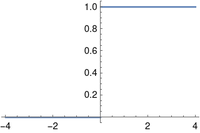
Heaviside function plot

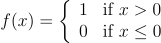
Activation functions often have two-part definitions, defined one way for negative inputs and another way for positive inputs, and so they’re ideal for Iverson notation. For example, the Heaviside function plotted above is defined to be

f(x) = \left\{ \begin{array}{ll} 1 & \mbox{if } x > 0 \\ 0 & \mbox{if } x \leq 0 \end{array} \right.

Kenneth Iverson’s bracket notation, first developed for the APL programming language but adopted more widely, uses brackets around a Boolean expression to indicate the function that is 1 when the expression is true and 0 otherwise. With this notation, the Heaviside function can be written simply as

f(x) = [x > 0]

Iverson notation is fairly common, but not quite so common that I feel like I can use it without explanation. I find it very handy and would like to popularize it. The result of the post will give more examples.

ReLU

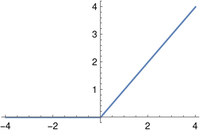
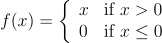
The popular ReLU (rectified linear unit) function is defined as

f(x) = \left\{ \begin{array}{ll} x & \mbox{if } x > 0 \\ 0 & \mbox{if } x \leq 0 \end{array} \right.

and with Iverson bracket notation as

f(x) = x[ x> 0]

The ReLU activation function is the identity function multiplied by the Heaviside function. It’s not the best example of the value of bracket notation since it could be written simply as max(0, x). The next example is better.

ELU

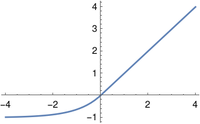
ELU

The ELU (exponential linear unit) is a variation on the ReLU that, unlike the ReLU, is differentiable at 0.

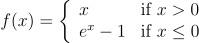
f(x) = \left\{ \begin{array}{ll} x & \mbox{if } x > 0 \\ e^x - 1 & \mbox{if } x \leq 0 \end{array} \right.

The ELU can be described succinctly in bracket notation.

f(x) = (e^x-1)[ x \leq 0] + x[x > 0]

PReLU

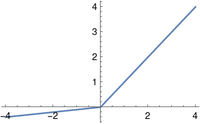
PReLU -- parameterized rectified linear unit -- graph

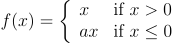
The PReLU (parametric rectified linear unit) depends on a small positive parameter a. This parameter must not equal 1, because then the function would be linear and the universal approximation theorem would not apply.

f(x) = \left\{ \begin{array}{ll} x & \mbox{if } x > 0 \\ ax & \mbox{if } x \leq 0 \end{array} \right.

In Iverson notation:

f(x) = ax[ x \leq 0] + x[x > 0]

Related posts

Redoing images in Midjourney

My son in law was playing around with Midjourney v5 and I asked him to try to redo some of the images I’ve made with DALL-E 2.

Back in August i wrote a post about using DALL-E 2 to generate mnemonic images for memorizing the US presidents using the Major mnemonic system.

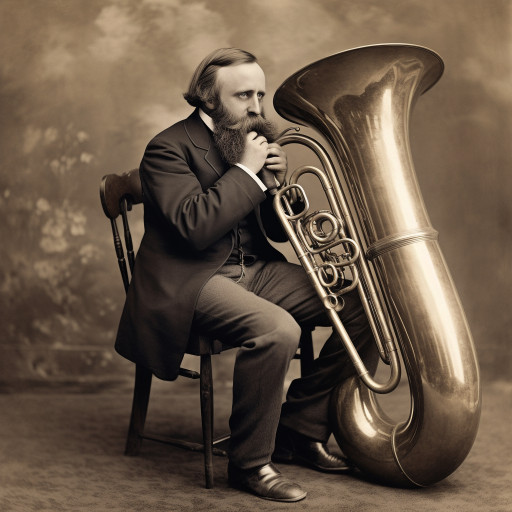
To memorize that Rutherford B. Hayes was the 19th president. you might visualize Hayes playing a tuba because you can encode 19 as tuba. The image I created last year was cartoonish and showed Hayes playing something more like a sousaphone than a tuba. Midjourney created a photorealistic image of Hayes playing some weird instrument which is something like a tuba.

Rutherford B. Hayes playing something like a ruba

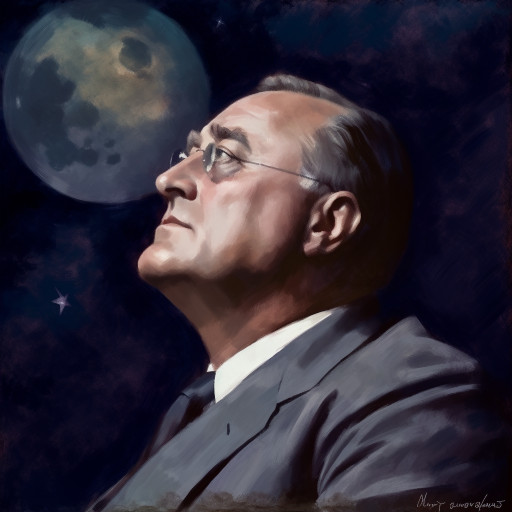
Franklin Delano Roosevelt was the 32nd president. If we use an image of the moon as the peg for 32, we could imagine FDR looking up at the moon. The previous image of FDR was really creepy and looked nothing like him. The image Midjourney created with FDR was really good.

FDR looking up at the moon

Midjourney choked on the request to create a create an image of Grover Cleveland holding an onion and a wiener dog, just as DALL-E had. It didn’t do any better substituting Grover the Muppet for Grover Cleveland.

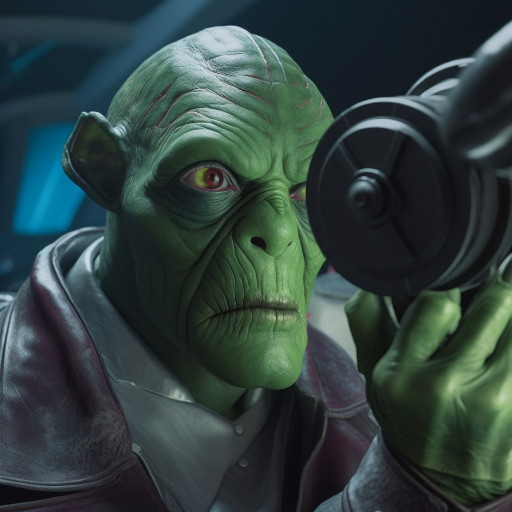
A few weeks ago I wrote a blog post about a thought experiment involving an alien astronomer with 12 fingers working in base 12. I could only get DALL-E to draw a hint of an extra finger. We weren’t able to get Midjourney to put 12 fingers on a hand either, but we did get an interesting image of an alien astronomer.

Alien astronomer

The valley of medium reliability

Last evening my electricity went out and this morning it was restored. This got met thinking about systems that fail occasionally [1]. Electricity goes out often enough that we prepare for it. We have candles and flashlights, my desktop computer is on a UPS, etc.

A residential power outage is usually just an inconvenience, especially if the power comes back on within a few hours. A power outage to a hospital could be disastrous, and so hospitals have redundant power systems. The problem is in between, if power is reliable enough that you don’t expect it to go out, but the consequences of an outage are serious [2].

If a system fails occasionally, you prepare for that. And if it never fails, that’s great. In between is the problem, a system just reliable enough to lull you into complacency.

Dangerously reliable systems

For example, GPS used to be unreliable. It made useful suggestions, but you wouldn’t blindly trust it. Then it got a little better and became dangerous as people trusted it when they shouldn’t. Now it’s much better. Not perfect, but less dangerous.

For another example, people who live in flood planes have flood insurance. Their mortgage company requires it. And people who live on top of mountains don’t need flood insurance. The people at most risk are in the middle. They live in an area that could flood, but since it hasn’t yet flooded they don’t buy flood insurance.


So safety is not an increasing function of reliability, not always. It might dip down before going up. There’s a valley between unreliable and highly reliable where people are tempted to take unwise risks.

Artificial intelligence risks

I expect we’ll see a lot of this with artificial intelligence. Clumsy AI is not dangerous; pretty good AI is dangerous. Moderately reliable systems in general are dangerous, but this especially applies to AI.

As in the examples above, the better AI becomes, the more we rely on it. But there’s something else going on. As AI failures become less frequent they also become weird.

Adversarial attacks

You’ll see stories of someone putting a tiny sticker on a stop sign and now a computer vision algorithm thinks the stop sign is a frog or an ice cream sundae. In this case, there was a deliberate attack: someone knew how to design a sticker to fool the algorithm. But strange failures can also happen unprompted.

Unforced errors

Amazon’s search feature, for example, is usually very good. Sometimes I’ll get every word in a book title wrong and yet it will figure out what I meant. But one time I was searching for the book Universal Principles of Design.

I thought I remembered a “25” in the title. The subtitle turns out to be “125 ways to enhance reliability …” I searched on “25 Universal Design Principles” and the top result was a massage machine that will supposedly increase the size of a woman’s breasts. I tried the same search again this morning. The top result is a book on design. The next five results are

  1. a clip-on rear view mirror
  2. a case of adult diapers
  3. a ratchet adapter socket
  4. a beverage cup warmer, and
  5. a folding bed.

The book I was after, and whose title I remembered pretty well, was nowhere in the results.

Because AI is literally artificial, it makes mistakes no human would make. If I went to a brick-and-mortar book store and told a clerk “I’m looking for a book. I think the title is something like ’25 Universal Design Principles,” the clerk would not say “Would you like to increase your breast size? Or maybe buy a box of diapers?”

In this case, the results were harmless, even entertaining. But unexpected results in a mission-critical system would not be so entertaining. Our efforts to make systems fool-proof has been based on experience with human fools, not artificial ones.

[1] This post is an elaboration on what started as a Twitter thread.

[2] I’m told that in Norway electrical power is very reliable. But Norway is also very dependent on electricity, including for heating. Alternative sources of fuel such as propane are hard to find.